
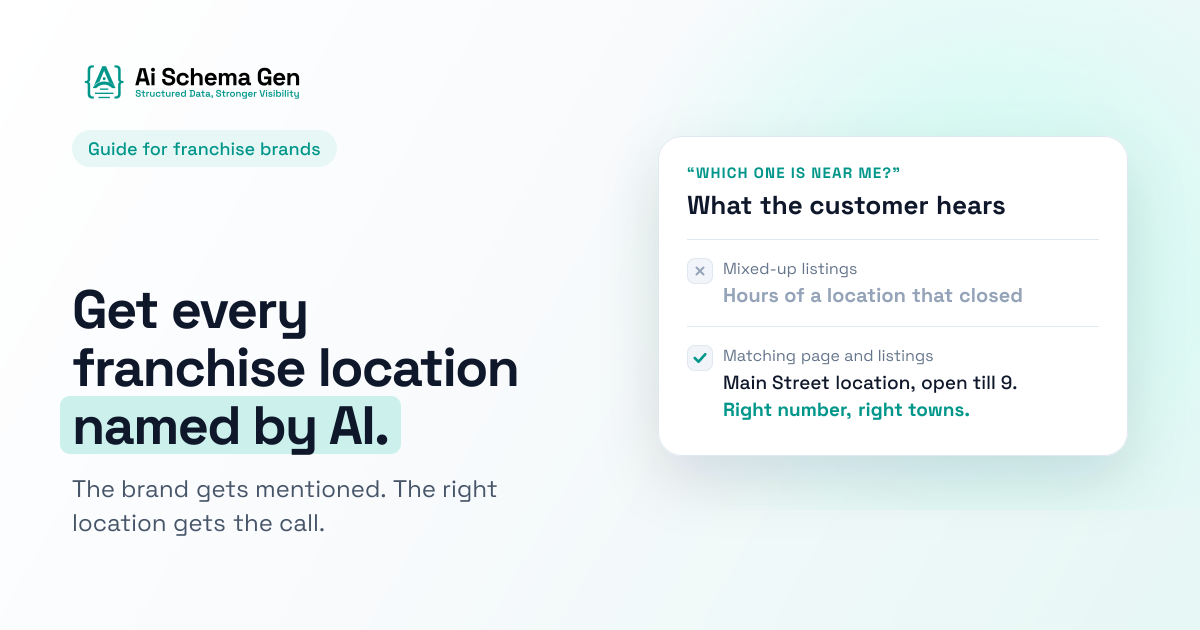
A customer in a hurry asks an AI assistant for help with a blocked drain, and the answer names your brand. That sounds like a win. Then the customer asks the follow-up that actually leads to a booking, "which one is near me and are they open tonight?", and the answer gives the hours of a location that closed last spring, or the phone number of your national call centre, or a franchisee two towns away whose territory doesn't cover the customer's street.
That gap between "the brand got named" and "the right location got the call" is what GEO for franchises is really about. A franchise system shows up in AI answers on two levels at once: the brand, which the franchisor shapes, and each location, which the franchisee mostly runs day to day. They answer different questions, they rely on different evidence, and in most systems they are controlled by different people under a contract that was written before anyone asked ChatGPT for a plumber.
The numbers say this gap is wide. SOCi's 2026 study of about 350,000 locations belonging to 2,751 multi-location brands in the US found that ChatGPT recommended 1.2% of locations, Perplexity 7.4% and Gemini 11.0%, while the same brands appeared in Google's local map results 35.9% of the time. A strong brand, in other words, does not carry its locations into AI answers on its own.
This guide is organized around that split. It sorts the questions customers ask into the ones the brand answers and the ones each location answers, shows what each side needs to publish, and then spends most of its time on the place franchise systems actually go wrong: where the two sides overlap and nobody owns the fix.
What GEO for Franchises Means
GEO stands for generative engine optimization; you'll also see it called AEO or AI search optimization. In plain terms, it means giving AI assistants enough clear, consistent evidence that they mention your business, get its details right and suggest it to people who ask. For a single shop, that is one business with one set of facts. For a franchise, it is one brand plus dozens or hundreds of separate businesses that share the brand's name but have their own owners, hours, phone numbers, staff, service areas and reviews.
An assistant answering a question about a franchise has to work out two things. First, what is this brand, and is it any good? Second, which location is the one this customer should contact, and what are that location's real details? Get the first right and the second wrong, and the customer still ends up calling a closed shop.
The technical setup that lets a website express both levels, one brand record plus one record per location, is covered in our guide to multi-location schema, including the short section on franchises. This post doesn't repeat that. It is about the people side: who in a franchise system holds each piece of evidence, and what each of them should do with it.
Three Kinds of Question a Franchise Gets Asked
It helps to sort the questions customers put to assistants into three groups, because each group is answered from different evidence and owned by a different person.
| Kind of question | Examples | What the answer leans on | Who mostly controls it |
|---|---|---|---|
| Brand questions | "Is [brand] any good?", "[brand] vs [competitor]", "How much does [brand] charge for a drain clean?", "How much does a [brand] franchise cost?" | The brand's own website, news and reviews across all locations, comparison articles | Franchisor |
| Location questions | "[brand] near me open now", "Phone number for [brand] in Plano", "Does the [brand] on Main Street do weekend appointments?" | That location's listings (Google, Yelp, Apple), its location page, its local reviews | Franchisee, often with franchisor rules |
| Category questions with no brand | "Emergency plumber in Plano", "Best place for a kids' birthday party near me" | Everything above, plus every local competitor's evidence | Both, and neither alone |
The third row is where most new customers come from, and it is the hardest. The assistant isn't looking for your brand. It is looking for a business that clearly fits the question in that place. Your brand name helps, but the location's own evidence decides whether that location gets named over an independent business down the road.
Brand strength helps more on some questions than others
Plumbing is one trade where someone has measured how much a big brand name carries. In a panel run by Cheers, which tracks AI answers about home services, covering plumbing questions across 100 US and Canadian metro areas (August and September 2026, four AI engines), national franchise brands appeared in about half of the answers to urgent questions: 52.7% for drain cleaning or sewer line repair, 51.8% for emergency plumbing and 49.2% for a burst or frozen pipe. On a question about the strongest reviews and fair pricing, the share fell to 13.1%.
Two caveats from Cheers itself are worth repeating. Franchise names are easier to pick out of an answer than small companies' names, so these shares "lean high." And the count includes answers "that tell readers to avoid national chains." A brand being mentioned is not the same as a brand being recommended.
For a franchise system, the lesson cuts both ways. On urgent, convenience-driven questions, the brand's size, round-the-clock availability and review volume carry real weight. On questions about value and trust, the brand is just one name among many, and each location has to earn its place on local evidence. Our plumbers guide looks at the same data from the independent's side.
What the Research Says About Franchise Locations
There is still very little independent research on how AI assistants treat franchise systems, and most of what exists comes from companies that sell listing or visibility services. Read the figures below as patterns, not laws. They are still the best evidence available, and they point the same way.
AI assistants are far choosier than map results. SOCi describes AI platforms as "3 to 30 times more selective than traditional local search." Fewer than half of the brands that lead ordinary local search were also among the most visible brands in AI recommendations. In retail, the overlap between the top 20 brands in each was 45%.
Wrong details are common, and they come from the listings. SOCi checked the business details in each assistant's answers: ChatGPT and Perplexity were right about 68% of the time, Gemini every time, since it works from Google's own maps data. SOCi blames the misses on directories that disagree with each other, not on the assistants. A franchise is unusually exposed here. It has hundreds of listings, and over the years many different people (franchisees, managers, agencies, the head office) have edited them.
Complete profiles aren't enough. ChatGPT's locations had complete profiles 99.9% of the time and were still recommended only 1.2% of the time. SOCi's report says that among brands with similar completeness, "consumer sentiment is the decisive factor," and recommended locations averaged 4.2 to 4.3 stars.
The brand's own pages matter, and so do the location pages on them. In SOCi's data, brand websites supplied 23.1% of AI local citations, behind Google Maps (32.5%) and niche directories (26.3%) and ahead of Yelp (10.5%) and Facebook (7.6%). Yext's study of 6.8 million AI citations from July and August 2025 found that local pages on brand websites made up between 8% and nearly 20% of citations, depending on the assistant and the kind of question, and its authors recommend "maintaining distinct, content-rich pages for each business location."
Some brands do far better than their category. SOCi names a few: Culver's was recommended by ChatGPT 30.0% of the time against a restaurant average of 5.3%, and Liberty Tax by Perplexity 26.9% of the time against a financial services average of 9.9%. The report doesn't explain exactly why, but its general findings (accurate data everywhere, strong ratings, detailed location pages) are what any system can copy.
The Franchisor's Side: Making the Brand Easy to Describe
The franchisor controls the brand's main website, the brand's identity across the web, and usually the location finder. Those are the pieces an assistant uses to answer brand questions and to find its way to each location.
One brand, described the same way everywhere
An assistant builds its idea of your brand from many sources: your website, your profiles on social sites and business directories, news coverage, franchise directories and review sites. When the brand's name, description and main facts match across all of them, the assistant has an easy job. When the brand has gone through a rebrand and half the web still uses the old name, or the "About" page says one thing about the company's founding and the franchise development page says another, it has to guess.
Pick one official version of the brand's name, a short description of what the brand does, the year it started, where its head office is and how many locations it has. Use those same facts on the website, in the brand's main structured data and on every profile you control. Our guide to Organization vs LocalBusiness explains why the brand and each location should be described as different kinds of thing.
Brand facts customers actually ask about
Brand questions are often about what is the same at every location: pricing approach, guarantees, hours policy, what's included in a service, how bookings work. If the brand's website doesn't answer these plainly, assistants piece the answer together from reviews and third-party articles, which may be out of date or about a single location's bad day.
Write a plain page for each of the common brand questions. Be honest about what varies. "Every location offers free estimates" is only useful if it is true; if prices and fees are set locally, say so, and say where to find a location's own prices. An assistant that quotes your brand page will repeat whatever it says, so a promise that only some locations keep turns into a promise made to every customer.
Franchise buyers ask assistants too
There is a group of questions only franchise systems get: people thinking about buying a franchise. "How much does a [brand] franchise cost?", "What are [brand]'s royalty fees?", "How many [brand] locations are there?" These people are researching a large investment, and they increasingly start with an assistant.
In the US, the answers to most of these questions already exist in your Franchise Disclosure Document. The FTC's Franchise Rule requires it to disclose the initial fees (Item 5), all other fees the franchisee must pay (Item 6), "the franchisee's estimated initial investment" (Item 7) and the number of franchised and company-owned outlets (Item 20). If your franchise development pages give vaguer or different figures than your current disclosure document, assistants can end up quoting old numbers from franchise directories and news articles instead of yours. Publish the current figures, or a clear summary of them, with the year of the document they come from, and update the page each time a new one is issued. Your franchise lawyer should approve the wording, since anything about earnings falls under the rule's separate requirements for financial performance claims (Item 19).
A location finder that can be read without clicking
Many brand websites list locations through a map widget: the visitor types a postcode and the results load from a separate system. A person sees a tidy list. An AI crawler that doesn't run the map's script may see an empty page, and even one that does may never type a postcode.
The fix is simple to describe. Every location should have its own page at its own stable web address, linked from an ordinary list of locations (by state and city, for example) that works with no searching at all. You can check your current finder in a couple of minutes: turn JavaScript off in your browser and reload the page. If the locations disappear, many crawlers can't see them either.
The Location's Side: Making One Location Easy to Pick
The franchisee, or whoever manages each location, holds the facts that decide location questions and most category questions: the real hours, the real phone number, the towns served, the team, the services this location actually offers, and the reviews from local customers.
The listings are the location's
Assistants lean heavily on business listings for local answers, and they don't all read the same ones. Google's AI features rely on Google Business Profiles, while ChatGPT leans on Yelp. Our guide to local AI search maps which assistant reads which listing.
For a franchise, the important part is who manages each listing. Google's rules for chains say that "all locations must have the same name unless the business's real world representation consistently varies," and that locations offering the same service should share the same category. A franchisee may use the brand name if it is "an authorized and fully dedicated seller" of the brand's product or service. That means no adding the city or a keyword to the name, which is a common local shortcut and a common reason profiles get suspended.
Brands with 10 or more locations can verify their Google profiles in bulk, but only if the profiles aren't owned by someone else. In many systems, some locations' profiles were set up years ago by a franchisee, a former manager or a local agency. Before anyone can fix those profiles, someone has to find out who owns each one.
A location page that only this location could have written
Open three location pages on most franchise websites and you'll find the same page three times. The address, phone and hours differ; every other sentence is the brand's national copy. An assistant comparing your location with an independent competitor has very little to go on.
Yext's "distinct, content-rich pages for each business location" is the right goal. The parts only a location can supply are the ones that make a page worth citing:
- Who runs it. The owner's or manager's name, how long they've run this location, and anything true and local about the team.
- Where it serves. For service businesses, the towns and neighbourhoods covered, in words, matching the territory the location really works.
- What this location offers. Not every location offers every service the brand lists. Say what this one does and doesn't do.
- Local credentials. Many trades need a state or city licence held by the local business, not the brand. Put the licence number on the location's page.
- Local proof. A few recent jobs, events or customer stories from this location, with real details.
- Its own hours and contact details, exactly as they appear on its listings.
None of this has to be long. Three or four short paragraphs of genuine local detail on top of the brand template turn a page an assistant can't tell apart from 300 others into one that answers the question "is this the right place for me?"
Territories and service areas should match
Many service franchises sell protected territories. Item 12 of the disclosure document covers territory, and a franchisee's agreement usually spells out which postcodes or towns are theirs. That territory should match what the location says publicly: its service-area towns on the location page and its service area on its Google profile.
Google's rules add two limits. A service-area business "should hide your business address from customers" if customers don't visit it, and its service area shouldn't reach "farther than about 2 hours of driving time" from where it's based. When a location's page claims towns that its territory doesn't include, or its Google profile still lists the area it covered before a territory was split, an assistant can send customers to a location that will then turn them away or pass them on.
Where the Two Sides Collide
Most of what goes wrong in franchise AI visibility isn't a franchisor problem or a franchisee problem. It sits in the gap between them. These are the six collisions we'd look for first in any system.
1. Two websites for one location
Some franchisees run their own website alongside the location page on the brand's site. Now there are two pages describing the same location, often with different hours, different phone numbers and different lists of services. An assistant that finds both has to choose, and it may choose the stale one.
Google's guidelines ask for "a website that represents your individual business location," which supports having one clear page per location. Whether a franchisee may run a separate site at all is a contract question. Item 12 of the disclosure document asks whether "the franchisee has the right to use other channels of distribution, such as the Internet," and most agreements set out website rules in more detail. Whatever the rules say, the practical goal is one main page per location that every listing points to, and anything else either removed or clearly pointing to it.
2. Three phone numbers for one location
Many systems route calls through a central booking centre or use tracking numbers to measure advertising. That is a reasonable business choice, but it creates a data problem when the number on the website, the number on the Google profile and the number on Yelp are three different numbers. When SOCi found assistants getting location details wrong about a third of the time, mismatches like this are the kind of thing it meant.
Agree on one main phone number per location, use it on the location page and every listing, and keep tracking numbers to the places where they don't become part of the location's public identity. If calls must go through a central line, that line should be the same everywhere for that location.
3. Brand promises that some locations don't keep
The brand site says "open 24/7" or "free estimates" or "same-day service." Some locations don't offer it. An assistant reading the brand page tells customers in those towns that they can expect it, and the location gets the angry call or the one-star review.
Brand pages should state what is truly the same everywhere and send customers to the location page for the rest. Location pages should say plainly when they differ from the brand's usual offer.
4. Hundreds of pages that say the same thing
Template location pages are efficient to run and almost impossible for an assistant to tell apart. If the only differences between your Austin and Dallas pages are the address and phone number, you have given the assistant no reason to prefer either over a local competitor with a detailed page.
The fix is the local section described above, and it needs both sides. The franchisor has to build a page template with space for local content and allow franchisees to edit it, or collect the details and add them centrally. The franchisee has to actually supply the details.
5. Locations that closed, moved or changed hands
When a location closes or moves, the location page, the Google profile, the Yelp page and the brand's own finder all need to change at the same time. In practice they rarely do. Assistants can keep recommending a closed location for months if one of those sources still says it is open.
Resales cause a quieter version of the same problem. Google requires the previous owner of a profile to "add you as an owner" before ownership can move to someone else. If a franchisee sells their unit and leaves without handing over the Google profile, the new owner may not be able to update the very listing assistants read most. Make profile handover part of every transfer and closing checklist, alongside the keys and the phone line.
6. Reviews that belong to everyone
Reviews of one location shape how assistants see the whole brand, and the brand's reputation colours how they see each location. SOCi found that only 46.9% of Google reviews across the brands it studied got a reply, after an average of 4.3 days. Most systems haven't decided who replies to reviews, so often nobody does.
Agree who replies to reviews at each level, how quickly, and in what tone. Local replies from someone who knows the customer usually read better than a national template, but a brand-level backstop catches the ones that would otherwise go unanswered.
A Simple Split of Who Does What
Every franchise agreement is different, and some systems run all listings centrally while others leave everything to franchisees. As a starting point, this is the split that tends to work:
| Task | Franchisor | Franchisee | Agreed together |
|---|---|---|---|
| Brand name, description and main facts | Owns | Uses as given | |
| Brand pages on pricing approach, guarantees, booking | Owns | Flags anything that differs locally | |
| Franchise development page with current disclosure figures | Owns (with legal approval) | ||
| Location finder and one page per location | Builds and hosts | Template with room for local content | |
| Local section of the location page | Reviews | Writes and keeps current | |
| Google, Yelp and Apple listings | Sets naming and category rules | Keeps hours, phone, photos, services current | Who holds ownership of each profile |
| Main phone number per location | Agreed once, used everywhere | ||
| Service area | Keeps current | Matches the territory in the agreement | |
| Review replies | Backstop and escalation | First reply | Response time and tone |
| Closures, moves and resales | Updates finder and page | Updates or hands over listings | One checklist for both |
The "agreed together" column is the one that usually doesn't exist yet. Writing it down, even in a one-page addition to the brand standards manual, fixes more AI visibility problems than any single technical change.
Structured Data for Franchise Systems
Structured data is code on a page that labels facts so machines can read them reliably: this is the brand, this is a location, this is its address and phone number. For a franchise, the brand's homepage describes the brand as an organization, and each location page describes that location as a local business with its own address, hours and phone number, linked back to the brand with the parentOrganization property.
The details, including how service-area locations differ from storefronts, are in the multi-location schema guide linked earlier. Two points matter most for franchises. Each location's details in its structured data must match its listings exactly, the same name, address and phone number. And a franchisee's location page should describe the franchisee's business, not copy the franchisor's head office address and number, which is a surprisingly common mistake when a template is copied across sites.
Common Mistakes
Treating brand mentions as the goal. Being named as a brand doesn't help if the location details that follow are wrong. Track whether assistants name the right location with the right details, not just the brand.
Assuming map rankings carry over. SOCi found fewer than half of the brands leading ordinary local search were also among the most visible in AI recommendations. Strong map results are a good base, not proof that assistants recommend you.
Leaving profile ownership unknown. If nobody knows who owns a location's Google profile, nobody can fix it. Find out before you need to.
Writing brand promises for the best location. A brand page that describes the system's best location becomes a promise to every customer in every town.
Putting the city in the business name. Google's chain rules require the same name across locations. Adding the city or a keyword to the profile name risks the listing itself.
Hiding locations behind a search box. A location finder that only works after typing a postcode may show a crawler nothing at all.
Forgetting the franchise development page. Prospective franchisees ask assistants about costs and fees. If your page is vague or out of date, the answer will come from somewhere else.
Fixing listings once and walking away. Hours, phone numbers and owners change. Accurate data is a routine, not a project.
How to Check and Fix It
You can get a clear picture of where your system stands in an afternoon.
- Ask the brand questions. In ChatGPT, Gemini and Perplexity, ask what your brand is, how it compares with your main competitor, what it charges and what a franchise costs. Note anything wrong or out of date, and where the answer seems to come from.
- Ask the location questions for a sample of locations. Pick five to ten locations, including a recently opened one, a recently sold one and a busy one. Ask for each by brand and town, and check the hours, phone number and address in the answer against reality.
- Ask the category questions. For the same towns, ask for your kind of business without naming your brand. Note whether your location is named, and which competitors are.
- Check ownership of every Google profile. List who owns and manages each one. Anything owned by a former franchisee, manager or agency goes to the top of the list.
- Compare every location's details across sources. Location page, Google, Yelp and Apple should show the same name, address, phone number and hours.
- Read three location pages side by side. If you can't tell which town each page is for without looking at the address, the template needs a local section.
- Check each location page technically. Our free AI readiness checker shows whether a page can be reached by AI crawlers, whether its structured data describes the right business, and what to fix first.
Repeat the same questions every few weeks and keep a record of the answers. Our guide to tracking brand mentions shows a simple way to do that and to tell a real change from normal variation.
FAQ
Is GEO for franchises different from GEO for a single business?
The basics are the same: accurate listings, clear pages, honest facts and good reviews. What's different is that a franchise has two levels, the brand and each location, controlled by different people. Most franchise problems come from the gap between them, such as two websites for one location, mismatched phone numbers or listings nobody owns.
Should franchisees have their own websites?
That depends on your franchise agreement, and many systems don't allow it. If they do, there should still be one main page per location that every listing points to. Two pages with different details for the same location make it harder for an assistant to give the right answer.
Why do AI assistants name our brand but give the wrong location details?
The brand and the location are separate records to an assistant. It can know your brand well and still pick up a location's hours or phone number from an old directory entry, a former owner's website or a profile nobody has touched since a move. Find every place a location's details appear and make them say the same thing.
Who should manage Google Business Profiles in a franchise system?
There is no single right answer, but someone must clearly own each one. Many systems have the franchisor hold ownership and set naming and category rules, with each franchisee managing day-to-day details like hours and photos. What matters most is that ownership is known and handed over when a location is sold or closed.
Our brand is small and regional. Does brand size matter much to assistants?
Less than you might think, outside urgent questions. Assistants recommend a tiny share of locations even for very large brands, and SOCi found several brands doing far better than much bigger names in their category. What separates them is accurate details everywhere, good ratings and location pages with real local detail, all of which a small system can do as well as a large one.
Should we publish franchise costs on our website?
If you are in the US, the figures are already in your Franchise Disclosure Document, and prospective buyers are asking assistants for them. Publishing a current summary, with the document's year and your lawyer's approval, means assistants are more likely to quote your current figures than old numbers from elsewhere.
Is your website ready for AI?
Check now. Free readiness score in under a minute, no signup, no card.