
Ask Google's Gemini and ChatGPT the same question, "can you recommend a good dentist in my town?", and you will often get two different lists. That is not random. Each assistant leans on a different source of business information, so a business that looks strong in one can be missing from the other.
The gap is large. In SOCi's 2026 study of about 350,000 locations belonging to 2,751 US brands, Gemini recommended 11.0% of locations, Perplexity 7.4% and ChatGPT just 1.2%. The same brands showed up in Google's map pack 35.9% of the time. Doing well in ordinary local search, in other words, does not carry over to AI answers on its own.
So the useful version of AI search optimization for a local business is not one long checklist. It is a map: which assistant reads which listing, where your own website fits in, and what to fix first when you only have a few hours a week. This guide is built on the largest studies published this year, and on a deal that changed where ChatGPT gets its local answers in July 2026.
What AI Search Optimization Means for a Local Business
AI search optimization (you will also see it called GEO, AEO or "AI SEO") is the work of making your business easy for AI assistants to find, describe correctly and recommend when someone asks about your kind of business in your area.
For a local business, two things have to go right. First, the assistant has to put you on its shortlist at all, which is decided mostly by business listings: your Google Business Profile, your Yelp page, your Apple Maps place card and so on. Second, once you are on the shortlist, it has to describe you correctly: the right hours, the right services, the right area. Your own website plays a bigger part in that second step. Our guide to near me answers explains that split in detail, so this post doesn't repeat it.
What this post adds is the part that changed in 2026: the assistants do not share one source. Fixing your Google profile helps you in Google's AI tools and does very little for ChatGPT. Fixing Yelp does the opposite. Once you know who reads what, the order of work becomes obvious.
Each AI Assistant Has a Main Source
Here is what the evidence says about where each of the big assistants gets its local business information. Where a company has said so officially, that is stated. Where the evidence comes from outside studies, that is stated too.
Google's AI Overviews, AI Mode and Gemini: your Google Business Profile
BrightLocal's August 2026 study looked at almost two million citations from local AI answers, across 1,355 business locations in the US, UK and Australia. In Google's two AI search features, the Google Business Profile was the top source by a wide margin: 108,018 citations in AI Overviews and 455,123 in AI Mode, with Yelp a distant second in both. Across all three engines in the study, Google Business Profiles made up 28.5% of every citation. The report's own summary is blunt: the Google Business Profile "is the source of choice for Google's own AIs."
Gemini works the same way. SOCi describes Gemini as "grounded in Google Maps data", and in its testing Gemini got business details right 100% of the time. That makes sense: it is reading the same profile you edit.
What this means for you: if a customer uses Google in any form, your Google Business Profile is the record the AI reads. Its categories, hours, services, photos and reviews are what gets turned into an answer.
ChatGPT: Yelp, by a long way
ChatGPT is the odd one out. In the same BrightLocal study, Yelp was cited 99,281 times in ChatGPT's local answers and appeared in 80% of them. Tripadvisor (10,227) and OpenTable (9,147) came next. Apple's listings were cited just 600 times. In BrightLocal's words, "Yelp is the most common source for ChatGPT in local search by some distance."
There is a clear reason. On 23 July 2026, Axios reported that Yelp is licensing its reviews, photos and business information to OpenAI for use in ChatGPT, with Yelp's branding and links shown alongside. The deal is not exclusive, and Yelp's "Request a Quote" feature is due to follow, so people will be able to contact a business for a quote from inside ChatGPT. Yelp's chief executive, Jeremy Stoppelman, put it simply: "If you want to answer local queries, you really need Yelp."
One honest exception: the source mix depends on the trade. For contractors, a September 2026 study found ChatGPT leaning on the Better Business Bureau and state licensing boards rather than Yelp, which we cover in our contractors guide. For restaurants, cafés, shops, salons, clinics and most other walk-in businesses, Yelp is the page ChatGPT is most likely to read.
What this means for you: if you have never claimed your Yelp page, ChatGPT may be describing your business from whatever Yelp collected on its own, including old hours, an old phone number or a review from years ago.
Siri and Apple Maps: Apple Business Connect
Apple's free tool for businesses, Apple Business Connect, lets you claim your place card on Apple Maps and control what it says. When Apple launched it, the company said this information appears to more than a billion Apple users across Apple Maps, Messages, Wallet, Siri and other apps.
Two details matter here. First, if you have not claimed your place card, Apple still shows one, filled in from outside data suppliers. The same Axios report notes that Yelp already supplies data to Apple Maps. Second, Apple has not published how Siri picks one business over another, so the honest advice is the simple one: claim the place card so the facts Siri reads are the ones you set.
What this means for you: anyone who asks Siri for "a pharmacy open now" or "a plumber nearby" on an iPhone is reading Apple's record of your business, not Google's.
Microsoft Copilot: Bing Places
Copilot's answers are built on Microsoft's Bing search engine, and Bing's record of a local business comes from Bing Places for Business, Microsoft's free listing tool. Microsoft has not published a document explaining how Copilot chooses local businesses, so treat this as the likely route rather than a confirmed rule. Either way, a claimed and correct Bing Places listing is the one record Microsoft controls directly, and it costs nothing to set up.
What this means for you: Copilot is built into Windows, Edge and Microsoft's office apps, so office workers searching from their work computer often meet Bing's version of your business.
Perplexity: a wider spread
Perplexity draws on a wider mix of sources than the others. Yext's October 2025 study of 6.8 million AI citations found that Perplexity "diversifies across MapQuest and TripAdvisor" rather than leaning on one listing. The same study, run before the Yelp deal, already found ChatGPT leaning on listings (48.7% of its citations). Perplexity also signed a partnership with Tripadvisor in January 2025 for hotel information, with restaurants due to follow.
What this means for you: there is no single Perplexity page to fix. Being consistent across many listings, and having a clear website, is what helps here.
The map in one table
| Assistant | Main source for local businesses | Where you fix it |
|---|---|---|
| Google AI Overviews, AI Mode, Gemini | Google Business Profile | business.google.com |
| ChatGPT | Yelp (BBB and licensing boards for contractors) | biz.yelp.com |
| Siri, Apple Maps | Apple Maps place card | Apple Business Connect |
| Microsoft Copilot | Bing's local data | Bing Places for Business |
| Perplexity | A mix of review sites, directories and websites | All of the above, plus your website |
Your Website Is Still the Most-Cited Place
After all that, you might think your website hardly matters. The studies say the opposite.
In BrightLocal's data, around 93% of all the different websites cited in local AI answers were individual business websites. Listings win the most citations per site because one Google or Yelp page is cited again and again, but the long tail of the answers is made of businesses' own pages. Yext's study points the same way: 44% of the citations it analysed came from businesses' own websites, against 42% from listings, and its 86% headline figure is the share of citations from sources a business can manage or strongly influence. Only 2% came from forums like Reddit, far less than in AI answers generally, because local questions lean on listings instead. Gemini cited websites more than any other assistant in that study (52.1% of its citations): it takes your basic details from Google's profile, but it still reads your site for everything else. SOCi's numbers are lower for websites (23.1% of citations) but still put them ahead of Yelp's 10.5%.
The reason is that listings only hold so much. A Google profile has a field for opening hours. It has no good place for:
- Which services you actually do, and which you don't. "We fit heat pumps but don't service oil boilers" is the kind of detail an AI needs and a listing can't hold.
- Who you serve and where. A full list of the towns or postcodes you cover, if you visit customers rather than the other way round.
- Prices, or at least price ranges. Questions like "how much does a dog groomer cost in Leeds" are answered from pages that state prices.
- Insurance, payment and booking details. Which insurance a clinic accepts, whether a restaurant takes bookings, whether you offer finance.
- Proof. Named staff with their qualifications, photos of real work, awards with the name of who gave them.
Yext found that for factual questions that don't name a business ("which vets near me do emergency visits?"), businesses' own websites and local pages made up nearly 60% of citations. Listings decide who makes the shortlist. Your website often decides who fits the question.
Make your website easy to match to your listings
There is one more job your website does. An AI assistant that finds your Yelp page, your Google profile and your website has to work out that all three describe the same business. You make that easy in two ways.
State the same core facts in the same form everywhere. Business name, address (if customers visit you), phone number and hours, written the same way on your site as on every listing.
Add structured data that points at your listings. Structured data (also called schema markup) is a short block of code that states your business facts in a format machines read reliably. Its sameAs field lists the web addresses of your profiles elsewhere: your Google profile, Yelp page, Apple Maps place card and so on. That gives an AI assistant a direct, stated link between your site and each listing, instead of leaving it to guess. Our guide to sameAs links covers which profiles to include, and our guide to Organization vs LocalBusiness covers which business type to declare.
Why the Same Business Gets Different Answers
If you ask several assistants about your own business, expect them to disagree. SOCi checked the business details each assistant gave against the real ones and found Gemini right 100% of the time, but ChatGPT only 68.3% of the time and Perplexity 68.0%. Roughly one in three ChatGPT descriptions had something wrong.
The pattern follows the sources. Gemini reads Google's profile directly, so it repeats whatever you have set there. ChatGPT and Perplexity piece their answers together from listings, review sites and websites, and if those sources disagree, the assistant has to pick one. If your Yelp page still shows your old address, there is a fair chance that is the one ChatGPT gives.
That gives you a useful way to read a wrong answer:
- Wrong in Gemini or AI Mode? Look at your Google Business Profile first. Someone may have suggested an edit that Google accepted.
- Wrong in ChatGPT? Check your Yelp page, then your website, then any directory that lists you with old details.
- Wrong in Siri? Check your Apple Maps place card.
- Missing everywhere? That points to a bigger problem: too few listings, too few reviews, or a website AI crawlers can't read.
Ratings Matter More in AI Answers
A business that ranks in Google's map pack with a 3.6-star rating can still get calls. In AI answers, the bar is higher. SOCi found that businesses recommended by AI "consistently maintain ratings above 4.0 stars", with recommended businesses averaging 4.2 to 4.3. Locations rated around 3.4 stars, and those that replied to fewer than 5% of their reviews, were close to invisible.
This is correlation, not proof that a 4.1 rating unlocks AI recommendations. But it fits how assistants talk: they tend to describe the businesses they name as well reviewed, and a low rating gives them a reason to name someone else.
What helps, in practice:
- Ask every happy customer for a review, on the platform that matters most for your trade. For most walk-in businesses that means Google first and Yelp second. Note that Yelp's rules forbid asking customers for reviews directly, so on Yelp the honest route is to make your page easy to find (a "find us on Yelp" link on your site, for example) and let customers decide for themselves.
- Reply to reviews, including the bad ones. A short, calm reply to a complaint shows anyone reading, human or machine, that the business is active and cares.
- Never buy reviews or offer something in return for a good one. Platforms remove them, and a sudden run of five-star reviews is easy to spot.
How the Sources Change by Business Type
The overall numbers hide big differences between trades. The same BrightLocal and Yext data shows:
- Restaurants, bars and cafés. Four sources made up about 80% of citations: Google Business Profile (45.2%), Yelp (21.8%), Tripadvisor (7%) and OpenTable (6.6%). Yext found food businesses had the highest share of citations from reviews and social media of any industry (13.3%). If you run a restaurant, your Tripadvisor and booking-site pages count nearly as much as your own site.
- Dentists. Google Business Profile alone made up 57% of citations.
- Vets and pet businesses. Google Business Profile made up 59.2%, with pet-specific sites such as Healthy Paws and Scratchpay also appearing.
- Healthcare in general. In Yext's data, listings made up 52.6% of healthcare citations, with WebMD, Vitals and medical directories prominent. Health is a field where AI tools are careful, so they lean harder on directories that check credentials.
- Shops and financial services. The reverse pattern: Yext found businesses' own websites behind 47.6% of retail citations and 48.2% of finance citations. People ask these businesses detailed questions about products, rates and branches, and only the website has those answers.
- Contractors and home services. The Better Business Bureau, Angi and state licensing boards carry more weight than Yelp, as covered in the contractors guide linked above.
So before spending time on any directory, ask which group your business is in. A dentist gets more from an hour on their Google profile than from an hour on Tripadvisor. A restaurant is the other way round.
What to Fix First: A Priority Order for a Small Team
Most local businesses don't have a marketing department. If you have a few hours a week, this is the order that covers the most assistants for the least work.
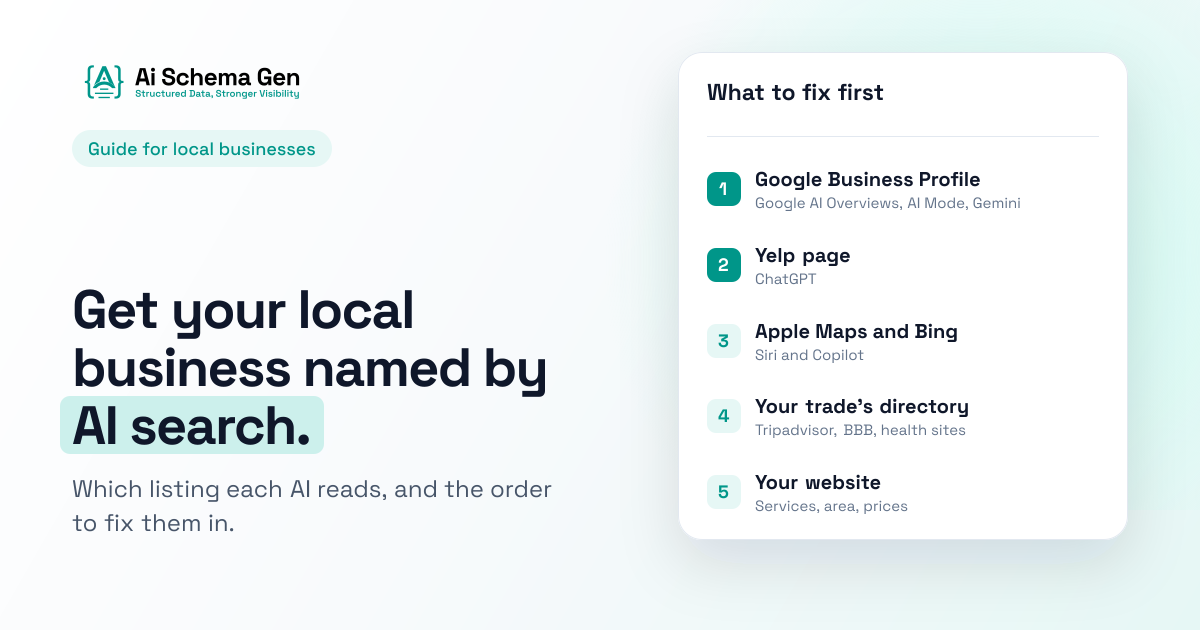
1. Complete your Google Business Profile. One profile feeds AI Overviews, AI Mode and Gemini, plus Google Maps and ordinary search. Fill in every field: your main category and the extra categories that fit, hours (including holiday hours), services, a description written in plain words, photos of the actual place and the actual work. Then check for edits suggested by the public, which Google sometimes accepts without asking you.
2. Claim your Yelp page and make it match. Claiming is free; you don't need to buy Yelp ads to have a correct page. Fix the hours, phone, address, website link and categories, add photos, and reply to recent reviews. With Yelp now feeding ChatGPT directly, this is likely the most useful hour you can spend on ChatGPT.
3. Claim Apple Business Connect and Bing Places. Each covers a whole family of devices: iPhones and Siri for Apple, Windows, Edge and Copilot for Microsoft. Both are free, and once your Google profile is right, most of the details can simply be copied across.
4. Claim the one or two directories that matter for your trade. Use the list above as a guide: Tripadvisor and OpenTable for restaurants, health directories for clinics, the Better Business Bureau and Angi for home services. Skip the hundreds of general directories that nobody, human or machine, actually reads.
5. Put the details listings can't hold on your website. One clear page per service you offer. The towns or areas you cover, written out as text. Prices or price ranges where you can give them. Staff names and qualifications. Then add structured data that states your business type, contact details, hours and area, with sameAs links to every listing from steps 1 to 4.
6. Check what each assistant says, then check again. Ask each assistant a question a real customer would ask ("who's a good [your trade] in [your town]?") and a question about you by name. Write down who gets named, what gets said about you and which sources are cited. Repeat every month or two. Answers change from one ask to the next, so one bad result is not a trend; a pattern over several checks is. Our guide on how to track ChatGPT answers explains how to read changes over time without overreacting.
If you do only the first two steps, you have covered Google's AI tools and ChatGPT, which between them handle most AI questions people ask today.
Common Mistakes
Fixing Google and assuming ChatGPT will follow. It won't. ChatGPT reads Yelp far more than Google's profile, so a perfect Google profile next to an unclaimed Yelp page leaves you exposed in the assistant many people use most.
Treating every directory as equal. Listing a dentist on fifty general business directories does less than one complete Google profile. Spend the time where your trade's customers, and the assistants, actually look.
Leaving old details on any listing. One out-of-date address on Yelp or an old supplier's directory is enough for ChatGPT or Perplexity to repeat it. When you move, change your number or change your hours, update every listing the same day.
Letting your website say less than your listings. A homepage with a slogan and a contact form gives an AI nothing to answer detailed questions with. If your Google profile lists eight services and your website names two, you are leaving most questions to your competitors.
Judging the whole effort by one answer. AI answers vary from one ask to the next. A single check where you don't appear tells you very little. Look for patterns across several checks, several assistants and several weeks.
Paying someone who promises a guaranteed spot in ChatGPT. Nobody controls which businesses an AI assistant names. What you can control is whether every source it reads describes you clearly and correctly.
How to Check and Fix It
You can work through the listings above by hand: each one has its own free login. The website side is where AI Schema Gen helps.
Run the free check. Our AI readiness checker reads your website the way an AI crawler does and reports whether AI tools can reach your pages, read them, work out who runs the business and answer common customer questions from what's there. It also flags when your site doesn't link to your profiles elsewhere.
Fill in your Business Identity once. In the dashboard, you enter your business details one time: name, contact details, hours, and either your address or, if customers don't visit you, the areas you cover. You also add the links to your Google, Yelp, Apple and other profiles. We clean up those links (removing tracking codes and fixing common address mistakes) and turn everything into structured data on every page.
Apply the fixes and keep watching. Most problems the check finds come with a fix you can apply in one click. Monitoring then rechecks your site on a schedule, so you hear about it if something breaks later, for example after a website redesign. On paid plans, AI Visibility tracking asks ChatGPT your chosen questions every week and records which websites ChatGPT cites in its answers, including whether it cites your own site, your Yelp page or a competitor. That last detail is exactly what this guide is about: it shows you which source ChatGPT is reading when it talks about your trade in your area.
What AI Schema Gen can't do is log in to your Google, Yelp, Apple or Bing accounts for you. Those listings are yours to claim, and they are the first two or three steps of the priority list for a reason.
Frequently Asked Questions
AI Schema Gen makes your website easy for AI assistants to read and match to your listings: business details, coverage area and profile links turned into structured data on every page, then checked on a schedule. Run the free check to see what AI finds on your site today.
Is your website ready for AI?
Check now. Free readiness score in under a minute, no signup, no card.