
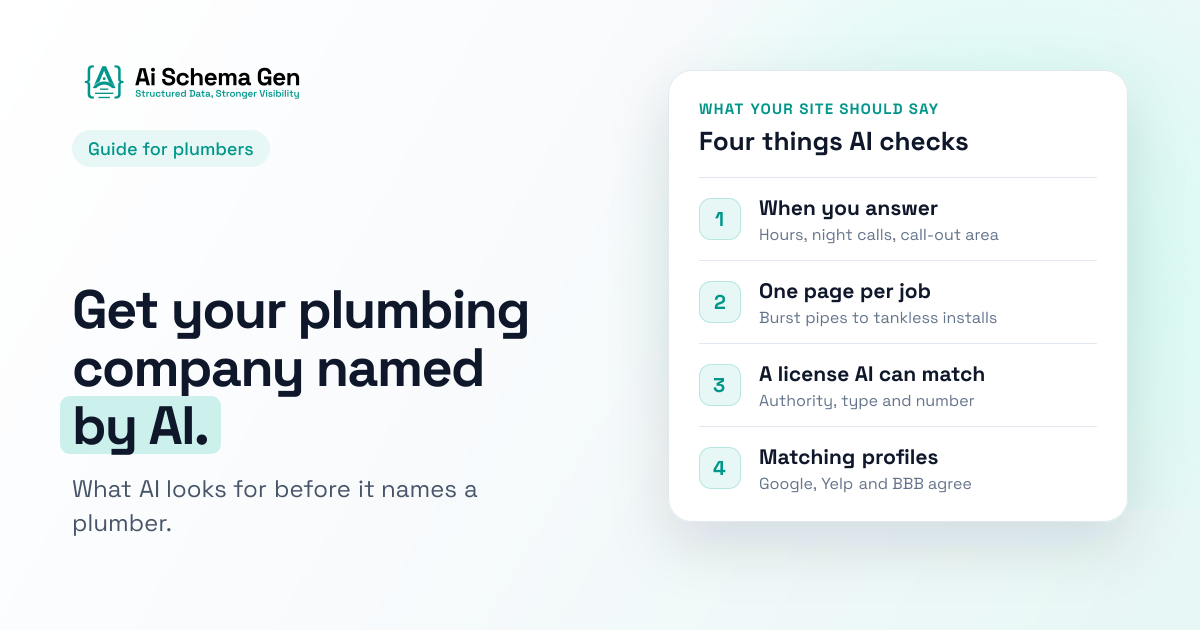
At two in the morning, a homeowner stands in an inch of water and types "emergency plumber near me, pipe burst" into an AI assistant. Three months later, the same homeowner asks the same assistant who installs tankless water heaters in their town. Both are plumbing questions. To an AI engine they are very different questions, and they tend to get very different answers.
That difference is the most useful thing a plumber can understand about AI search. Cheers, a company that tracks AI answers about home services, asked four AI engines nine plumbing questions across 100 US and Canadian metro areas in September 2026. Plumbing answers talked about availability far more than answers about heating and air conditioning did. Questions about emergencies, drains and same-day repairs named a national franchise brand about half the time. Questions about tankless installs and repiping named one less than a fifth of the time.
So this guide to GEO for plumbers is organised around those two kinds of question: the emergency call and the planned job. It covers how AI engines answer plumbing questions today, what each kind of question needs from your website and listings, where an independent plumber has the best chance against the big brands, and how to check where you stand.
What GEO for Plumbers Means
GEO stands for generative engine optimization: making your business easy for AI assistants like ChatGPT, Google's AI Mode, Gemini and Perplexity to understand, trust and recommend. For a plumber, it means that when someone asks an assistant who to call, the assistant can find clear answers about your business: what jobs you do, where you work, when you answer the phone, which license you hold, and what past customers say.
If you want the wider picture first, including what is worth paying an agency for and what isn't, our guide to GEO for small business covers it. Here the focus is narrower: what a plumbing company in particular should change, based on how AI engines have actually answered plumbing questions this year.
How AI Engines Answer Plumbing Questions Today
Three recent studies give a fair picture. They measure different things, so their numbers are not directly comparable, but they point the same way.
Most plumbers are not named yet. 8ight.AI checked 230 plumbing businesses from Google Maps against ChatGPT's answers to "who is the best plumber" in 19 places in September 2026. Fewer than one in ten of them, 8.3% of plumbers, turned up by name. With only 19 places, treat that as a rough sense of scale rather than a precise figure.
Answers change from one week to the next. Spearleaf asked ChatGPT the same "who is the best" question in 216 local markets (12 kinds of business, plumbers among them, in 18 US cities), then asked again 4 to 9 days later. Only 48.2% of businesses shown the first time were shown again, and the top name stayed the same in 34.1% of markets. One answer from ChatGPT tells you very little.
Your own website is the main evidence. In Cheers' data on plumbing questions, plumbing company websites (including franchise sites) supplied 75.2% of citations, across about 100,000 classified citations over 28 days. Directories and review platforms supplied 19.5%, google.com 3.1%, and social sites and forums 2.2%. Google AI Mode, Gemini and Perplexity each cited a plumbing company's own site in more than 96% of answers. ChatGPT was the odd one out at 53.7%, leaning more on directories, lists and Angi or HomeAdvisor.
One more finding matters for plumbers. In Spearleaf's panel, 92.0% of the businesses ChatGPT showed had an address in the city that was asked about, against 73.9% of the businesses it could have shown but didn't. Being clearly based in the place in the question is a big part of being shown. That comes up again below, in the section on competing with the big brands.
Two Kinds of Plumbing Question
Cheers' plumbing panel asked nine questions. The table groups the ones that line up most clearly into emergency and planned work, with the share of answers (among those naming any business) that included a national franchise brand. Cheers notes these shares lean high, so read them as a pattern.
| Question | Kind | Answers naming a franchise brand |
|---|---|---|
| Drain cleaning or sewer line repair | Emergency or urgent | 52.7% |
| Emergency plumbing service | Emergency | 51.8% |
| Same-day repair | Emergency or urgent | 50.8% |
| Burst or frozen pipe | Emergency | 49.2% |
| Water heater repair or replacement | Mixed | 33.4% |
| Repiping and fixture installation | Planned | 18.8% |
| Tankless water heater installation | Planned | 14.6% |
The pattern is clear. On the urgent questions, about half the answers include a big brand with hundreds of locations, round-the-clock call centres and large review counts. On the planned jobs, the answers are much more open.
The two kinds of question also want different things from you:
- The emergency caller wants someone who will answer now, can reach them tonight, and won't take advantage of a desperate moment. The facts that matter are hours, response area, what counts as an emergency, and what an after-hours visit costs.
- The planned-job customer has time to compare. They want to know you do this specific job well: which equipment you install, whether you pull permits, how long it takes, how you price it and what the warranty covers.
Most plumbing websites try to answer both with one homepage and a list of services. The rest of this guide splits them apart.
The Emergency Side
Say exactly when you answer
In Cheers' data, plumbing answers mentioned 24/7 or after-hours service in 63.9% of answers from ChatGPT, 75.0% of Google AI Mode answers, 78.4% of Perplexity answers and 87.3% of Gemini answers. For heating and air conditioning, the same mentions ranged from 48.6% to 66.2%. When a question was about a burst or frozen pipe, essentially every answer from every engine talked about it.
So an AI engine is looking for an availability answer about your business, and "Call us anytime!" is not one. Write it out on your site in plain words:
- Your normal hours, and separately, your emergency hours if they are different.
- What happens when someone calls at night: a person answers, an on-call plumber calls back within a stated time, or the call goes to voicemail until morning.
- Where you go at night. Many plumbers cover a smaller area after hours. "Emergency call-outs after 8pm within Travis and Williamson counties" is something an assistant can pass on. "Serving all of Central Texas" is not, if it isn't true at 2am.
- What you treat as an emergency: a burst pipe, a sewer backup, no water at all, a water heater leaking into the house. Some plumbers don't send someone at night for a dripping tap, and saying so saves everyone a frustrating call.
- How after-hours pricing works. If there is a higher rate or a call-out fee at night, say so. You don't need to publish every figure, but a customer who learns about a night rate only on the invoice is likely to say so in a review.
Only claim what is true. Google's own guidelines say a business serving customers at its address should be staffed and able to receive them during its stated hours. Cheers' advice to plumbers is the same idea: state emergency availability only when the local team can deliver it. If your Google profile says "Open 24 hours" and your phone sends night calls to voicemail, the AI engine will repeat the claim, and the customer will find out the hard way.
One more reason to be exact. When Spearleaf asked ChatGPT at night, only 31.5% of the businesses it displayed were open at the time of asking, against 93.8% during the day. That figure covers all 12 kinds of business, not plumbers alone, but it shows that open-or-closed status at the moment of asking can shape who gets shown. Hours that are wrong or missing on your profiles work against you exactly when emergency calls come in.
One page for each emergency
Cheers counted more than 25,000 citations to plumbing company websites. The homepage drew 35.7% of them. Service pages drew 19.6%, pages about a service in a named city drew 18.3%, and location pages drew 16.4%, so those three together drew 54.3%. Blog and resource pages drew 1.0%.
That says a lot about where to spend your writing time. An AI engine answering "who can fix a burst pipe tonight in Round Rock" is looking for a page about burst pipes, by a plumber in Round Rock. The more of your writing goes into pages shaped like that question, the more often your site has something to offer.
Write a page for each emergency you actually handle: burst and frozen pipes, sewer and drain backups, water heater failures, leaks, no water. On each, say:
- What you do on the visit, in order. For a burst pipe, that might be shutting off the water, finding the break, a temporary or permanent repair, and checking for other weak spots.
- How fast you aim to arrive, and in which areas.
- What the customer should do while waiting, such as where to find the main shut-off valve. This is useful to the homeowner, and it is the kind of specific, practical text an assistant can quote.
- Whether you work with water damage restoration companies or insurers, and what you don't do.
For a suspected gas leak, put safety first: tell readers to follow their gas utility's emergency instructions before calling anyone, then explain what you do once it is safe. An AI engine should never come away thinking a plumber's page is the first step in a gas emergency.
Competing with the big brands at night
Half the emergency answers include a national franchise. You won't out-advertise them, but an AI engine is looking for more than a big name. It is looking for a business that clearly serves the place in the question.
That is where a local plumber has an edge, if the website shows it. Spearleaf's in-city address finding is one sign of it. The other is that franchise location pages are often thin and look the same from one city to the next. Your pages can say things theirs can't: the owner's name, how long you have worked in the area, the neighbourhoods and towns you cover, the old cast-iron drains common in a particular part of town, the hard water you deal with every week.
Cheers' citation counts back this up: pages about a service in a named city, and location pages, together drew about a third of all citations to plumbing websites. The ones worth writing carry facts only a local plumber would know: jobs done in that town, how long it takes to get there at night, the age of the housing and what that means for its pipes, local water hardness, any city rule on water heater permits or backflow testing.
Watch the review sites you don't think about
Cheers found that ChatGPT showed a plumber rated under 4 stars in 37.6% of plumbing answers that included business cards. Google AI Mode did so in 2.6%. Almost all of ChatGPT's low-rated cards came from Yelp: 21% of the Yelp-sourced cards were under 4.0 stars, against 0.2% of the rest. For the same businesses, Yelp averaged 4.3 stars and Google AI Mode showed 4.9.
Many plumbers have a strong Google rating and have never looked at their Yelp page. ChatGPT may be showing that Yelp page to people asking about you. So:
- Claim your Yelp page and make sure the name, phone, hours and service area match your website.
- Reply to reviews there, especially the bad ones, calmly and specifically.
- Don't ask customers for Yelp reviews. Yelp's rules are blunt: "Don't ask anyone to review your business." Its software tries to spot requested reviews and not recommend them. Asking on Google is a different matter; just don't ask on Yelp.
Fewer reviews is not the end of the road. Cheers found that 50.9% of ChatGPT's plumbing answers with business cards named at least one plumber with fewer than 20 reviews. The median plumber shown had 157 reviews on ChatGPT, against 364 on Google AI Mode, so Google's AI leans much harder on big review counts than ChatGPT does.
The Planned Side
Where an independent plumber has the best chance
On repiping and tankless installs, franchise brands appeared in fewer than one in five answers. These are also the jobs a homeowner researches in advance, often by asking an assistant questions like "is a tankless water heater worth it for a family of four" before asking who does the work.
That is good news for a local plumber, because a planned-job question rewards detail. The homeowner, and the AI engine answering for them, wants evidence that you do this particular job often and well. A page that says "We install tankless water heaters" has nothing in it to quote. A page that says which brands you install, what size of unit suits which home, whether you upgrade gas lines or electrical panels when needed, how long an install takes and what the warranty covers gives the assistant real facts to pass on.
What a planned-job page should say
For each planned job you want more of (tankless and tank water heaters, repiping, water softeners and filtration, fixture and bathroom work, sewer line replacement, backflow testing), cover:
- What the job involves, step by step, in plain words.
- Equipment and materials: the brands you install, PEX or copper for repiping, trenchless or open-trench for sewer lines, and why you would choose one over the other.
- Permits and inspections: whether you pull them, and who arranges the inspection. Homeowners ask about this, and saying you handle it is a strong sign of a legitimate business.
- How long it takes, from the first visit to the finished job.
- How you price it: flat rate or hourly, whether estimates are free, and a realistic range if you are comfortable giving one.
- Financing, if you offer it, and what the warranty covers, from the manufacturer and from you.
- A few recent examples, with the town, the month and what was done.
Cheers found that Google AI Mode linked a booking page in 62.0% of answers about water heater repair or replacement, against 26.3% for burst pipes. If you take online bookings for estimates, link the booking page from each planned-job page.
Prices: explain how you charge
People ask AI assistants what a water heater swap or a repipe costs, and the assistant answers with general figures whether or not you publish any. What it can't get from those figures is how your company charges. A short pricing section on each planned-job page fills that gap: whether the estimate visit is free, whether the quote is fixed before work starts, and what typically moves the price up or down for that job in your area (access, the age of the existing pipes, a gas line or panel upgrade). That gives an assistant something specific to say about you, and it gives the customer a reason to call you rather than rely on a general figure.
License Details an AI Can Match
ChatGPT regularly cites state licensing boards and license look-ups when it recommends tradespeople. Our guide to AI SEO for contractors has the figures, along with the wider set of hiring checks homeowners make. For a plumber, the point is simple: the licensing board is a record the AI engine may read, so your website should make the match easy.
Plumbing licensing varies a lot by state, and sometimes by city, so "licensed and insured" on its own tells nobody anything. Two examples show how specific it gets:
- Texas licenses individual plumbers through the State Board of Plumbing Examiners, which issues Tradesman Plumber-Limited, Journeyman and Master licenses (plus a Plumbing Inspector license), each renewed yearly. Its public license search shows a license's status, expiry date, endorsements and any disciplinary actions.
- California licenses plumbing contractors through the Contractors State License Board under the C-36 classification, which covers water supply, waste disposal, water heating equipment and related work.
Plumbing has a wrinkle many trades don't: in Texas, for example, individual plumbers hold the licenses, and the Tradesman Plumber-Limited license only covers work under a responsible master plumber. So say whose license the company works under, by name, as well as the license type and number. If the master plumber is also the owner, say so on the about page; it connects the person, the license and the business in one place. If your plumbers carry their own licenses, a line like "all our plumbers hold Texas journeyman licenses or higher" is useful, and true or false in a way anyone can check.
Structured Data for Plumbers
Structured data is a short, machine-readable description of your business that sits in your page code. Schema.org, the shared vocabulary for it, has a Plumber type, so a plumbing company never needs to describe itself as a generic local business.
For the emergency side, the useful pieces are your hours and your area. Schema.org's own example for a business that is open all day, every day writes the hours as Mo-Su; only use it if a person really answers at night. The towns and counties you serve go in areaServed. For the planned side, each job page can describe the service it covers.
The order matters, though. Write the availability block and the job pages first. Structured data can only repeat facts that are already on the page, and an hours entry that says "all day, every day" on a site that never explains what happens at 2am helps nobody.
Common Mistakes
Leaving "Open 24 hours" on your Google profile by default. Some plumbers set it once to look available and forget it. If night calls go to voicemail, change it to your real hours and describe your emergency service in words.
Emergency pages with no place on them. A burst pipe page that never names a town answers half the question. Say where you go, by day and at night.
Hiding the night rate. An after-hours fee the customer only hears about on the invoice turns into a one-star review on exactly the sites ChatGPT reads.
Ignoring Yelp because your Google rating is strong. ChatGPT's business cards often come from Yelp, and that is where almost all of its low ratings came from in Cheers' data. Check yours, and don't ask customers for reviews there.
A gas leak page that reads like a sales page. Safety instructions first, your service second. An AI engine quoting your page in an emergency should quote the safe part.
No booking link on planned-job pages. Google AI Mode linked a booking page in most water heater answers. If you take online bookings for estimates, every planned-job page should link to it.
Pouring effort into the blog. Blog posts drew 1% of citations to plumbing websites in Cheers' data. Service and city pages drew more than half. Write those first.
Not saying whose license the company works under. A license number with no name, or a company name with no license holder, gives a licensing board nothing to match.
How to Check and Fix It
Step 1: Ask the two questions about your own site. Pick one emergency job and one planned job you want more of. For each, open your website and look for a single page that answers the question a homeowner would ask an assistant, such as "who can fix a burst pipe tonight in my town" or "who installs tankless water heaters near me". If no such page exists, that is your first piece of work.
Step 2: Write your availability block. Normal hours, emergency hours, what happens to a night call, the after-hours area, what counts as an emergency, and how night pricing works. Put it on your homepage and every emergency page, then change your Google, Yelp and Bing hours to match it exactly.
Step 3: See what an AI can work out from your text alone. Our free AI readiness checker hands an AI nothing but the words on your website and asks it questions about the business, including where you are and which areas you serve. A plumber whose site leaves those blank is hard to place in a "near me" emergency answer.
Step 4: Set up your business details once. In the AI Schema Gen dashboard, pick Plumber as your business type and add your service area, owner and profile links (Google, Yelp, BBB, Angi). The fix guide on adding your service area and founders walks through it. Those details feed the structured data on every page.
Step 5: Check the sites ChatGPT reads. Yelp, Angi, HomeAdvisor and other directories come up far more in ChatGPT's plumbing answers than in Google's. Claim each listing and make sure the hours and service area match your website. For why ChatGPT in particular leans on Yelp, see our guide to local business AI search.
Step 6: Track a fixed set of questions. Ask the same emergency and planned-job questions every couple of weeks and write down who gets named. Because answers change so much from week to week, one result means little; our guide on how to check what ChatGPT says about your business explains how to read the results.
Frequently Asked Questions
Is your website ready for AI?
Check now. Free readiness score in under a minute, no signup, no card.