
A homeowner buys an electric car, then asks ChatGPT: "Can I put a Level 2 charger on a 100-amp panel?" The answer they get back is careful and correct, and it ends the same way almost every time: it depends on the house, so have a licensed electrician check. The same thing happens when they ask about a heat pump, an induction range, a hot tub or a home battery.
That ending is the most valuable moment in AI search for an electrician. The assistant has just told someone they need a professional, and the next question is which one. This guide is about being the electrician it names at that point, and the main way to get there is unusual: explain, on your own website, how you answer the panel question.
What AI SEO for Electricians Means
AI SEO for electricians is the work of making an electrical contracting business easy for AI assistants (ChatGPT, Google's AI Mode and AI Overviews, Perplexity, Gemini, Copilot) to find, understand and recommend. It overlaps with ordinary local SEO, but the goal is different. A search results page lists ten businesses and lets the person choose. An AI answer usually names three or four and explains why. To be one of them, your website has to give the assistant something specific to say about you.
For most trades, that "something" is a mix of services, reviews, service area and credentials. Electricians have all of those, plus one thing most trades don't: a single technical question that sits in front of a large share of the work homeowners are planning right now. Is the electrical service big enough for what they want to add? Answer that well on your site, and you give AI engines exactly the kind of material they quote.
Broad Questions and Job Questions Get Different Answers
There isn't much published testing of how AI picks electricians specifically, so treat what follows as a snapshot rather than a law. On October 13, 2026, SuperDupr, a marketing company that sells AI visibility work to electricians, ran a small AI test using Perplexity with live web search. It asked for the "best electrician" in five cities (Austin, Dallas, Houston, Denver and Atlanta) and then asked two job-specific questions: an EV charger installation in Austin and a panel upgrade in Dallas.
The broad questions and the job questions came out very differently:
- Broad questions leaned on directories and franchises. Across the five cities the answers named 18 electricians. Directory sites such as ConsumerAffairs and Best Pros in Town were read in all five cities, and a national franchise was named in four of them. Company websites were read only 10 times across the five answers.
- The EV charger question leaned on company websites. Of 10 sources, 9 were electrical companies' own sites. The article reports that "every company named for the EV charger question was one whose site the AI had just read."
- The panel upgrade question was similar. It named four electricians and had read the sites of three of them.
It was one run per question, by a company with something to sell, so the exact counts will move. The pattern is the useful part, and it matches what we see elsewhere in AI search: a broad "best electrician near me" question is decided mostly by directories, reviews and brand size, which an independent shop can't change quickly. A specific job question is decided much more by whether a company has a page that actually explains that job. That second kind of question is where a well-written website can win, and it is also the kind of question homeowners ask when they are close to hiring.
The Question Behind Most Electrical Jobs Now
Look at the jobs homeowners bring to AI assistants and a pattern appears. Almost every new electrical load they want to add raises the same question first:
| What they want to add | What they ask an AI | What the answer depends on |
|---|---|---|
| Level 2 EV charger | "Do I need a panel upgrade for an EV charger?" | Panel and service size, existing loads, charger setting, room in the panel |
| Heat pump (replacing gas) | "Can my panel handle a heat pump?" | Size of the unit, backup heat, what else runs at the same time |
| Induction range | "Do I need a new circuit for an induction stove?" | Existing range circuit, wire size, panel space |
| Heat pump water heater | "Does a heat pump water heater need a special circuit?" | Model, existing water heater circuit |
| Home battery or standby generator | "Can I add a battery without upgrading my panel?" | How the system connects, what it powers, local utility rules |
| Hot tub, workshop, ADU | "How big a subpanel do I need?" | Distance, loads, existing service |
An AI assistant can explain the general idea behind every row of that table. What it can't do is look at the customer's panel. So the honest answer is always "it depends, ask an electrician," followed by a recommendation. If the only pages the assistant has read are directory listings, it recommends from those. If it has read an electrician's page that explains how they check a panel for an EV charger, what the possible outcomes are, and roughly what each one involves, that electrician is a natural name to give.
There is a second reason this matters. Homeowners now take quotes back to AI to check them. In Acorn Finance's survey of 1,000 US homeowners, published in 2026, 52% said they had used AI to double-check a contractor's estimate. A panel upgrade quote is exactly the sort of thing someone will paste into ChatGPT and ask "is this reasonable, or is there a cheaper way?" If your website already explains the options and when each one applies, the assistant's answer is far more likely to agree with your quote than to undercut it.
Explain How You Answer It
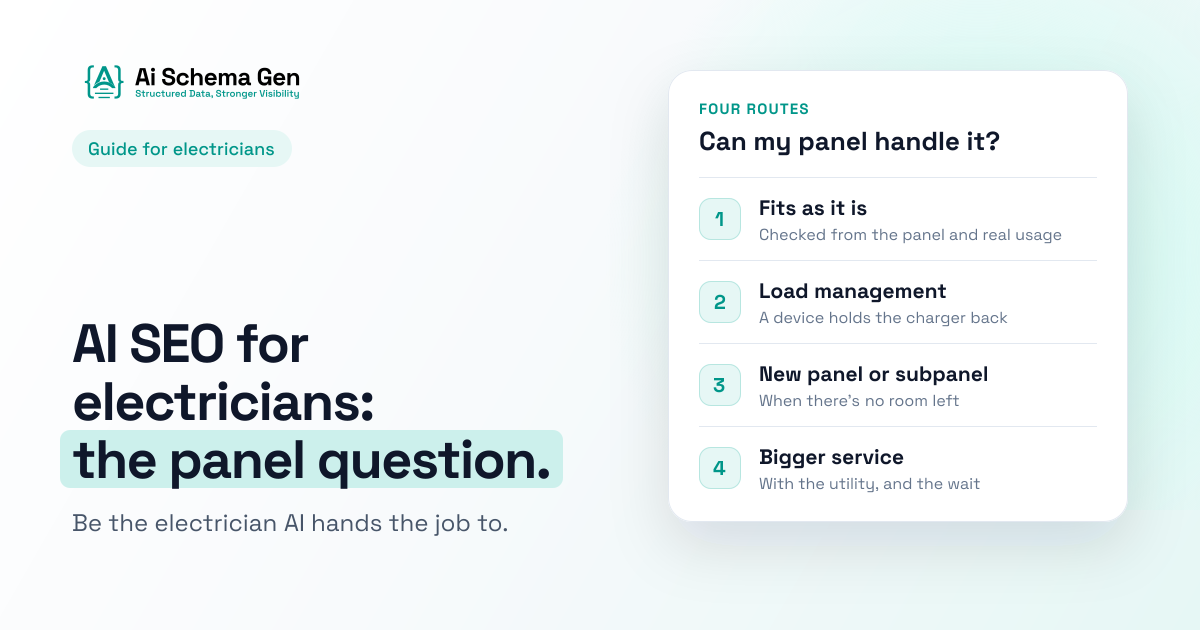
You don't need to publish engineering. You need to explain, in plain words, the routes you consider and how you choose between them. Most electricians weigh some version of these four.
Route 1: The paper calculation
The electrical code sets out a way to add up a home's loads on paper (floor area, appliances, heating and cooling, the new load) and compare the total with the size of the service. What a homeowner wants to know is what it asks of them. Say exactly what you need to start: a clear photo of the panel with its door open and its label readable, the size of the main breaker, a list of the big appliances, and whether anything runs on gas today. Many electricians can give a first answer from that alone and only send someone out when the photo raises a question. If that is how you work, saying so turns a vague "free estimate" into a five-minute task the homeowner can do tonight.
Route 2: Measuring what the house really uses
For an existing home, the code also allows the existing load to be worked out from real meter readings over a year rather than from the worksheet. The worksheet is deliberately cautious. Researchers at Lawrence Berkeley National Laboratory have found it can overestimate what a home really needs, so a home that looks "full" on paper sometimes has room once its real use is measured. Whether this route is available depends on what your utility can provide and what your local inspector accepts, so say that plainly: "Where the utility can give us a year of usage data, we can use it to see how much room your service really has."
Route 3: Load management instead of a bigger service
This is the route that has changed the most, and the one homeowners are least likely to know about. A load management device (sometimes called an energy management system, or a power control system) watches how much power the house is drawing and holds back a big load, like an EV charger, when the house is busy. The 2026 edition of the National Electrical Code took this further. Minnesota's code adoption committee summarised the change this way in its 2026 review minutes: listed power control systems "can control loads (e.g., EVSE) and can now be used to determine the size of a service or feeder." The same edition moved the load calculation rules from Article 220 to a new Article 120.
What that means for your website: if you install load management, say so, and explain when it is a sensible alternative to an upgrade (an EV charger that can slow down during dinner time, for example) and when it isn't. Don't quote code sections unless you are sure which edition your area enforces. States and cities adopt new editions at different times, which is a good thing to mention on its own: "Your area currently enforces the [year] National Electrical Code" is a dated, specific fact that an AI engine can repeat.
Route 4: A service upgrade, and who does what
Sometimes the answer really is a bigger service. Homeowners are often surprised that this involves the utility as well as the electrician. Explain the split as it works in your area: what you do (the panel, the meter base, the permit, the inspection), what the utility does (the line to the house, the meter, the reconnect), and roughly how long the utility side usually takes locally. That last detail matters to a homeowner planning around a car delivery or a heating season, and it is not something an AI can know unless a local electrician writes it down.
A short page or section that walks through these four routes, in this order, does two jobs at once. It answers the question AI engines can't answer alone, and it shows a homeowner that you will look for the least expensive route that is safe, which is precisely the worry behind "is this quote reasonable?"
One Page per Job, Written Around the Panel
A single "Services" page with a list of twenty bullet points gives an AI engine almost nothing to quote. Each main job deserves its own page, named the way homeowners say it: "EV charger installation," "electrical panel upgrade," "heat pump electrical work," "generator installation," "induction range circuit." Our contractors guide covers job pages for the trades in general. For electricians, build each one around the panel question.
An EV charger installation page should say:
- That you check the panel and service before quoting, and how (photo of the panel label first, site visit if needed).
- The outcomes you see most: fits as is, fits with load management, needs a subpanel or panel replacement, needs a service upgrade.
- What the homeowner should know about charger settings (a charger set to draw less power needs a smaller circuit, which can be the difference between fitting and not fitting).
- Whether you pull the permit and book the inspection.
- Which charger brands you install, and whether you install chargers the customer bought themselves.
- The areas you cover for this job specifically.
A panel upgrade page should say:
- The common reasons people upgrade (new loads, an old or recalled panel, insurance requirements, a full panel with no spaces), and that you check whether an upgrade is actually needed first.
- The difference between replacing the panel and increasing the service size.
- The utility's part and the typical local timing.
- What a homeowner should expect on the day: power off for how long, inspection, reconnect.
A heat pump electrical work page should say:
- That you work with the HVAC contractor or the homeowner's chosen installer, and who pulls which permit.
- What usually decides whether the existing service is enough (the unit's size, electric backup heat, whether other big loads run at the same time).
- Whether you can install load management so backup heat and an EV charger don't run together.
If you also serve heat pump customers directly, our HVAC guide explains the other half of that conversation, which changed a lot in 2025 and 2026.
What a Quote Is Made Of
Most electricians don't want to publish fixed prices, and for panel work they usually can't. You can still give an AI engine, and a homeowner, something useful. Explain what moves the price:
- Fits as is: the cost is mostly the circuit and the charger installation.
- Needs load management: add the device and its setup.
- Needs a subpanel or a new panel: add the panel, the work and usually a longer inspection.
- Needs a bigger service: add the meter base, the utility's work and the wait.
Then, if you are comfortable with it, give rough local ranges for the most common cases and date them: "Typical EV charger installations in [city] that fit the existing panel, as of November 2026." A dated range is much more useful to an assistant than "call for a free quote," and it protects you when a homeowner pastes your quote into ChatGPT, because the assistant has your own explanation of what each part costs and why.
Money Questions Come With Conditions
Homeowners also ask AI who pays for part of the job. For electrical work the honest answer usually comes with a condition attached, and conditions are exactly what a short AI answer tends to drop. Two current examples:
- The federal EV charger credit had a location rule, and it has now ended. The IRS page for the home charger credit covers property placed in service at a main home from January 1, 2023 to June 30, 2026, and only in eligible low-income or non-urban census tracts. A homeowner in most city neighbourhoods never qualified, even before it ended. Articles written before the change still describe it, and an AI answer built from them can repeat that.
- Panel rebates under state home electrification programs depend on what the panel is for. These programs, funded by the Inflation Reduction Act and run by each state, can pay toward a panel upgrade. Minnesota, for example, lists up to $4,000 for a panel for lower-income households, but its program page states that panel work only qualifies when it supports another qualifying appliance, and that "a project consisting solely of an electrical panel install would not be eligible." The same page says Minnesota's program has not launched yet. Each state sets its own amounts, income limits and start dates.
The electrician's part in this is narrow but valuable: say which programs you are an approved contractor for, if any, and which conditions apply to the jobs you do. "We can apply the state panel rebate at the time of sale when the panel is needed for a heat pump, for households under the income limit" is a sentence no national article can write for your area. Don't promise a rebate you can't apply for on the customer's behalf.
Licence and Permits, Briefly
Licensing is covered in depth in our contractors guide, so only the electrical-specific points here. Electrical licences come in classes (apprentice, journeyman, master, contractor), and homeowners often don't know which one their job needs. State the business's contractor licence exactly as it appears in your state's register, with the number, and name the master electrician responsible if your state requires one.
Some states also say where the number must appear. In Texas, for example, the state's electrician rules require the contractor's name and licence number on all proposals, invoices and written contracts, on advertising meant to win electrical work, and on both sides of each work vehicle, where the number has to start with the letters "TECL". A website that shows the same number in the same format as your paperwork and your trucks is easy for an AI engine to match against the state record.
Permits deserve a sentence on every job page. "We pull the permit and book the inspection" answers a question homeowners ask AI constantly, and it quietly separates you from anyone who doesn't.
Structured Data for Electricians
Two details are worth getting right for an electrical business. The first is the type: schema.org, the shared vocabulary that structured data uses, has an Electrician type of its own, so there is no need to describe the business as a generic local business or contractor. Put it on the homepage or contact page with the name, phone number, service area and hours exactly as the page shows them.
The second is the licence, and this is where electricians differ from most trades. A state often licenses both the company and an individual (a contractor licence for the business, a master licence for the person responsible for the work). The schema.org property hasCredential can be used on an organization and on a person, so each licence can sit where it belongs: the contractor licence on the business, the master licence on the named electrician, linked to the business as an employee or founder. An AI engine then sees the same structure the state's register uses.
Each job page can describe its job as a Service provided by the business, with the areas you cover for that job. Our guide to Service schema covers how. None of this replaces the writing on the page. It removes any doubt about which business and which licence the writing belongs to.
Common Mistakes
"Panel upgrade" as the default answer. If every page implies that an EV charger means a new panel, you lose the homeowner who asked AI for a cheaper route, and the AI has nothing from you to suggest one. Explain the routes, then the upgrade.
One page for every job. A long services list with no detail is invisible to job-specific questions, which are the questions where company websites actually get read.
Charger brands shown only as logos. A row of manufacturer logos tells a person which chargers you fit. An AI engine reading the page usually sees nothing. Name the brands in text, and say whether you install a charger the customer has already bought.
Leaving the utility out. Pages that describe a service upgrade as if the electrician controls the whole timeline set the wrong expectation. When the homeowner later asks AI why it's taking so long, the answer won't come from you.
Only one of your licences on the site. Many electrical businesses hold a company licence and rely on a named master electrician's licence as well. A site that shows only one of them, or shows the master's number as if it were the company's, gives an AI engine a record that doesn't line up with the state register. Show each one, labelled for what it is.
No word on permits. Homeowners ask AI whether a job needs a permit. A page that says "we pull it" answers them. A page that says nothing leaves the assistant to find someone else who does.
A business name that changes between the site and the paperwork. Electrical contractors often trade under a shorter name than the one on the licence and the permits. If the website, the Google Business Profile and the permit records use different names with no link between them, an AI has to guess that they are the same company. State the registered name somewhere on the site next to the trading name. Our fix guide on keeping business details consistent walks through checking the rest.
How to Check and Fix It
- Test the job questions, not just the broad one. The broad "best electrician in [city]" question is mostly decided by directories. Ask the questions that come before a hire instead: "do I need a panel upgrade for a [car model] charger in [city]," "can my 100-amp panel handle a heat pump," "who installs home batteries in [city]." Note whether any answer cites an electrician's own page, and whose. Our guide to checking ChatGPT's answers explains how to run this fairly, since answers vary between runs.
- Pick the three jobs where the panel question comes up most in your phone calls, and check whether each has a page that covers the routes, the outcomes, permits and area.
- Write the four-routes explanation once and link to it from every job page that adds a big load.
- Write down the utility side for your area: what the utility does, and how long it usually takes.
- Match your licence details on the site to your state's register, letter for letter, for both the business and the master electrician.
- See what an AI can and can't read on your site. Our free AI readiness checker looks at your site the way an AI crawler does: whether your job pages can be reached and read, whether the business and its details are clearly identified, and what an assistant reading only your site could answer about you. It ends with a list of fixes.
Frequently Asked Questions
Is your website ready for AI?
Check now. Free readiness score in under a minute, no signup, no card.