
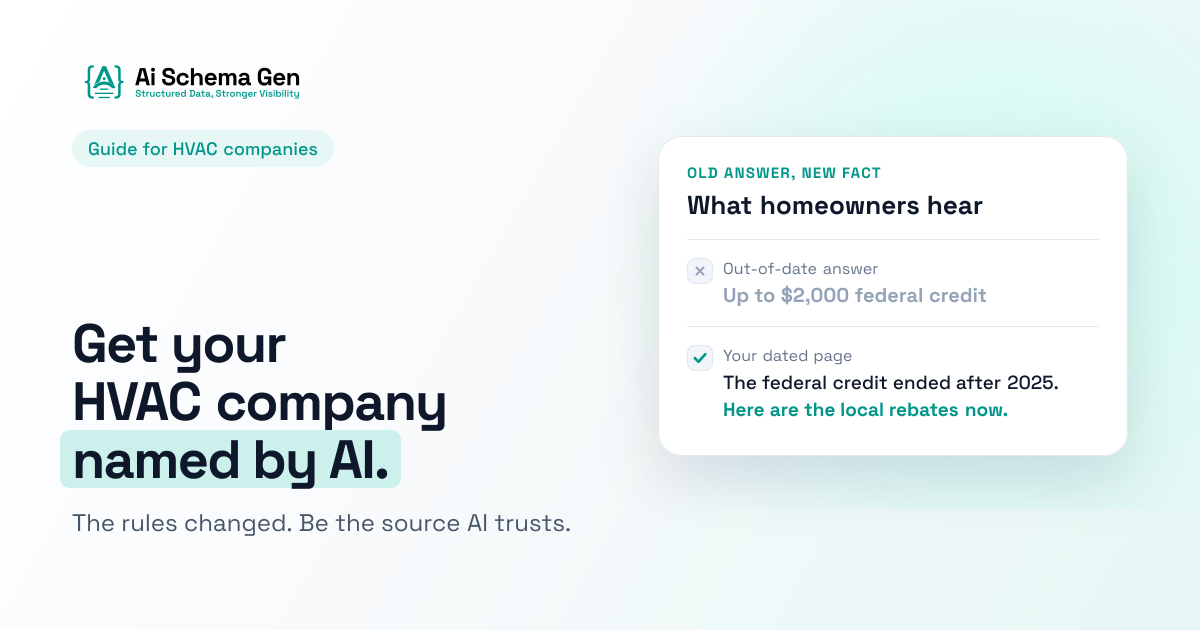
It's the second week of a July heat wave and a homeowner's 14-year-old air conditioner has stopped cooling. While they wait for a call back, they ask an AI assistant whether to repair it or replace it. The answer is confident and reasonable-sounding. It says older systems use a refrigerant that is "being phased out," that a new heat pump could qualify for a federal tax credit of up to $2,000, and that any new system should meet "SEER 14 or higher."
Each of those points was true at some moment. As of late 2026, none of them is a safe thing to tell that homeowner without a qualifier. The federal credit ended for work done after 2025. The rules on installing older refrigerant equipment changed again in 2026. The efficiency rating everyone quotes was replaced in 2023 by a new scale with different numbers.
HVAC is the home-service trade where the facts behind a customer's decision changed the most in the last three years. That creates a specific opening for AI SEO for HVAC companies. An assistant that wants to get these answers right needs current, plain explanations from someone who works with the rules every day. If your website is that source, you become far easier for an assistant to trust, quote and recommend. This guide covers the three changes your site should explain, the other facts homeowners check, and how to turn all of it into pages an assistant can use.
What AI SEO for HVAC Companies Involves
AI SEO (also called GEO or AEO) is about getting assistants such as ChatGPT, Gemini, Perplexity, Copilot and Google's AI Mode to name your company when a homeowner nearby needs heating or cooling work. In HVAC it has an extra layer. Before a homeowner asks for a company, they usually ask about the decision itself: repair or replace, which system, what it costs, what help is available. The fresher and clearer your answers to those questions, the more useful your site is to an assistant trying to answer them.
Listings, reviews and the records homeowners use to check a trade still come first. Our guide for any local business maps the listings, and our contractors guide explains why, in a large September 2026 test that included HVAC, ChatGPT leaned on the Better Business Bureau and state licensing records when naming trades. Everything below sits on top of that.
Who Gets Named Today
Ranking well on Google doesn't guarantee an assistant will mention you. In October 2026, Riptide Growth, an agency that sells AI visibility work, took 13 HVAC companies that each held the first organic Google result for "hvac company [city]" in a different metro and asked four AI models five buyer-style questions about each market. The tested companies were named in only 80 of 260 answers, about 31%, with individual results ranging from never named to named in 15 of 20.
Two details from that test matter for this guide. First, other local contractors filled most of the gap, but manufacturers came up too: Carrier, Trane and Lennox were the most common alternative names. When a question didn't name a city, answers drifted toward brand dealer networks. Second, the sites cited most often were directories and consumer review sites, followed by a long tail of other HVAC companies' own websites. Company websites as a group were cited far more than any directory. The study is small (one run, smaller versions of each model, one company per city) and comes from a vendor, so treat it as a picture rather than a measurement. The picture is useful all the same: an assistant answering HVAC questions reads a lot of contractor websites, and it rewards the ones that explain things.
Why HVAC Answers Go Out of Date
An assistant's answer comes from two places: what the model learned during training, and what it finds when it searches the web while answering. The first part is always months or years behind. The second part is only as good as the pages it finds.
For most trades that lag doesn't matter much. The way a drain gets unblocked hasn't changed. HVAC is different. Between 2023 and 2026, three things a homeowner weighs when replacing a system changed: how efficiency is rated, which refrigerant new equipment uses, and whether federal tax credits apply. An assistant that leans on older training, or on the many guides written in 2023 and 2024 that were never updated, can give an answer that sounds authoritative and is wrong.
That is a problem for homeowners and an opportunity for you. A clear, dated page on your site that says what the rule is now, what it means for a homeowner in your area, and when you last checked it, is exactly the kind of source an assistant searching the web can use to correct itself.
The Three Changes Your Website Should Explain
Refrigerant: what new systems use, and what happened to the deadline
Federal rules under the AIM Act have been moving new air conditioners and heat pumps away from high global-warming refrigerants such as R-410A. Manufacturers switched new residential systems to lower-impact refrigerants (mostly R-454B and R-32, which belong to a mildly flammable class called A2L) from January 1, 2025.
The part that changed again is installation. EPA's original rule allowed systems made before 2025 to be installed only until January 1, 2026. In May 2026, EPA finalized a rule that lifts that deadline for residential and light commercial equipment made or imported before 2025, according to ACCA, the contractors' trade association. New York kept the January 2026 deadline under its own state rule.
What a homeowner wants to know is simpler than the regulation:
- What refrigerant does a new system from you use, and why? Name the refrigerant in the equipment you install.
- Can my existing system still be repaired? The transition rules are about new equipment. Say how you handle repairs and refrigerant top-ups on older systems, and what refrigerant costs look like.
- Does an A2L system need anything different? Say that your technicians are trained to install and service it, and mention any local code requirements you follow.
- Is there a sell-by date I should worry about? In most states, no longer. In New York, yes. Say which applies to your customers.
Tax credits: the federal credit ended, local rebates didn't
The federal Energy Efficient Home Improvement Credit (often called 25C) paid up to $2,000 a year toward a qualifying heat pump and up to $600 toward a central air conditioner or furnace. The IRS now says the credit applies to improvements made through "December 31, 2025." A system installed in 2026 doesn't qualify.
Plenty of HVAC websites still carry "save up to $2,000 with the federal tax credit" banners. An assistant that finds those pages may repeat them. Replace that banner with something true and local: which state programs, utility rebates or manufacturer promotions your customers can use right now, how much they are worth, and whether you handle the paperwork. If you're not sure a program is still running, say when you last checked.
Efficiency: SEER2, and why the numbers look lower
Since January 1, 2023, new central air conditioners and heat pumps have been rated on SEER2, a newer test that runs closer to real-world conditions. The numbers come out lower than the old SEER figures for the same equipment, which confuses homeowners comparing an old quote with a new one. Under the federal rules, the national minimum for a new split-system air conditioner is 13.4 SEER2, and 14.3 SEER2 for a split-system heat pump, with higher minimums for air conditioners installed in the Southeast and Southwest.
On your site, explain what SEER2 is in two sentences, give the minimum that applies in your region, and show the ratings of the systems you actually offer. "Our standard heat pump is rated 15.2 SEER2; our high-efficiency option is 17.5 SEER2" is information an assistant can repeat. "High-efficiency systems available" isn't.
The Repair-or-Replace Question
The three changes above all feed into the question homeowners ask most often when a system fails: fix it or replace it? It's also the question where they most fear being pushed into a sale.
You can't answer that for every home on a web page, but you can explain how you decide. A good repair-or-replace page says:
- What you look at. The age of the system, the refrigerant it uses, what's failed and what it costs to fix, how often it has needed repairs, and whether it ever cooled or heated the house properly.
- When you recommend repair. Give real examples: a failed capacitor or contactor on a system with years left in it.
- When you suggest replacement. A failed compressor on an old system, repeated refrigerant leaks, a system that was never sized right.
- What a service call costs, and how it's handled if the homeowner goes ahead with the repair or the replacement.
- That the homeowner decides. Say you'll give both options in writing, with prices, when both are reasonable.
Be specific about the trade-offs that are particular to HVAC right now. A homeowner with a 12-year-old R-410A system and a failed compressor is weighing an expensive repair, refrigerant prices that may climb as supply tightens, and a new system on a different refrigerant. Explaining how you think about that case, in a few honest sentences, answers a question homeowners take to an assistant every summer and winter, and shows you're not just trying to sell a new system.
Sizing: Say Whether You Do a Load Calculation
A system that's too big or too small costs more to run and wears out faster. The industry method for getting it right is a load calculation using ACCA's Manual J, followed by equipment selection using Manual S. These aren't just good practice. Many local building departments require them, because the model residential building code calls for it. Pima County in Arizona, for example, states that "IRC M1401.3 requires heating and cooling equipment sizing per ACCA Manual S based on ACCA Manual J 8th edition."
Plenty of replacements are still sized by matching the old unit's tonnage. If you do a proper load calculation on every replacement, say so on your replacement page and explain what it involves: measuring the house, checking insulation and windows, and choosing equipment to match. It's a concrete difference between you and the lowest bid, and it's the kind of detail an assistant can pass on when someone asks "how do I know what size AC I need?"
Credentials Homeowners Can Check
Three kinds of credential matter in HVAC, and they mean different things.
EPA Section 608 certification is required. Federal rules say technicians who "maintain, service, repair, or dispose of" equipment that could release refrigerants into the air must be certified by EPA. Every technician working on your customers' systems should hold it. Saying so plainly costs nothing and answers a question careful homeowners ask.
State or local licensing varies. Some states license HVAC or mechanical contractors, some leave it to cities or counties, and some license only certain kinds of work. Whatever applies where you work, spell out the licence and the number as plain text on every page, and say which kinds of work it covers.
Manufacturer dealer status is a different kind of record. Brand programs such as factory-authorized or premier dealer tiers come with their own requirements, and the brands list their dealers in online locators. In the Riptide test, when questions didn't name a city, assistants leaned toward these brand networks. The locator listing is the part most contractors forget. Log in to each brand's dealer portal and check the name, address, phone number, service area and the services listed against your website. If you hold a dealer tier, write it out on your site too, with the brands you install and the brands you only service.
Optional technician certifications, such as NATE, are worth listing too. Say how many of your technicians hold them and in what.
Maintenance Plans and Seasonal Work
Most HVAC companies sell maintenance agreements, and homeowners ask assistants what a tune-up should include and whether a plan is worth it. A plan page that answers this in plain words is useful to both: how many visits a year, what each visit covers for cooling and heating, whether filters are included, what discount members get on repairs, whether members get priority when it's 100 degrees out, and how to cancel.
Emergency calls are the other side of HVAC. When the heat fails on a January night, the homeowner wants to know who answers, how fast and what it costs after hours, though in the Cheers data cited in our plumbers post, AI answers mentioned round-the-clock service less often for heating and cooling than for plumbing. Our post on GEO for plumbers walks through how to set up emergency pages and hours so an assistant can rely on them; the same approach works for no-heat and no-cooling calls.
Structured Data for HVAC Companies
schema.org has a specific type for this trade, HVACBusiness, which sits under HomeAndConstructionBusiness and LocalBusiness. Using it tells software what you do without leaving it to guess from your page text.
Pick "HVAC / Heating & Cooling" in AI Schema Gen's Business Identity and that type is applied for you. The bigger risk for an HVAC company is mismatched details: a dealer locator, a Google profile and a website that each show a slightly different name or phone number. Our fix guide on keeping your details consistent covers that. Refrigerant, rebates, SEER2 ratings and sizing stay in your page text.
Common Mistakes
A tax-credit banner from 2024. "Save up to $2,000 with federal tax credits" on a site in late 2026 is wrong, and an assistant may repeat it to your customers.
Refrigerant scare copy. Pages warning that R-410A systems "must be replaced by 2026" were written for a deadline that no longer applies in most states. Update them or take them down.
Old SEER numbers. Quoting "16 SEER" for current equipment, or comparing SEER and SEER2 figures as if they were the same scale.
Brand logos with no words. A row of manufacturer logos doesn't say whether you're an authorized dealer, which brands you install, or which you only service.
"Free estimates" with no word on sizing. Say whether a replacement quote includes a load calculation. It's one of the clearest ways to stand apart from the lowest bid.
Expired utility rebates. A rebate program that closed or ran out of money last year, still advertised with its old amount. Utility programs change often; date every rebate you list.
How to Check and Fix It
- Ask the changed-fact questions. Put these to ChatGPT, Gemini and Perplexity with your city in them: "Is there a federal tax credit for a heat pump?", "Can I still get an R-410A system installed?", "What SEER2 rating do I need in [state]?", "Should I repair or replace a 15-year-old AC?" Note what's wrong, what's out of date, and whose pages are quoted.
- Update or remove stale pages on your own site first: tax credits, refrigerant deadlines, old SEER figures, expired seasonal offers.
- Write the four explainer pages: refrigerant, rebates and credits in your area, SEER2 and the ratings you offer, and repair or replace. Put a "last reviewed" date on each.
- Add sizing and credentials to your replacement and about pages: load calculations, EPA 608, licence details, dealer status, NATE.
- Check your dealer locator listings with each brand you carry, and make the details match your site.
- Check the technical side. Our free AI readiness checker flags things like an old rebate page that assistants can still reach while your new one is hidden from them.
Ask the same questions again after a few weeks, and keep track of who gets named over time; our guide to tracking brand mentions shows a simple way to do it.
FAQ
Should I write about refrigerant rules and tax credits if they keep changing?
Yes, because they keep changing. Homeowners ask about them constantly, and assistants often answer from older information. A short, dated page that says what applies today in your area is more useful than any national guide, and it gives an assistant a current source to check. Put a review date on it and look at it every few months.
Why do AI answers name Carrier or Trane instead of local companies?
When a question doesn't make clear where the homeowner is, or what kind of help they want, assistants can fall back on well-known brands and their dealer networks. You can't stop that, but you can make sure that when the brand's dealer locator is used, your listing is accurate, and that your own site says plainly which brands you're authorized to install, in which towns.
What if an assistant tells my customers something wrong?
You can't edit an assistant's answer, but you can publish the correct information clearly on your site, where assistants that search the web can find it, and make sure your listings match. When a customer arrives with a wrong answer, a page you can show them on the spot helps too.
Do I need to list SEER2 ratings on my website?
There's no rule that says you must, but it helps. Homeowners compare efficiency, and the switch from SEER to SEER2 confuses them. Listing the SEER2 ratings of the systems you install, and the minimum in your region, gives them, and assistants, numbers they can use.
Is a manufacturer dealer listing worth keeping up to date?
Yes. In the Riptide test, dealer locators were rarely cited, but brand names came up a lot when a city wasn't specified. A dealer listing with your correct name, address, phone and service area is a small job that connects you to those brand-led answers.
How often should I review my HVAC pages?
At least at the start of each heating and cooling season, and whenever a federal, state or utility program changes. Update the "last reviewed" date when you do, so homeowners and assistants can see the page is current.
Is your website ready for AI?
Check now. Free readiness score in under a minute, no signup, no card.