
In August and September 2026, a researcher asked five AI assistants the questions a nonprofit or town finance officer would ask when hunting for an auditor in North Carolina's Research Triangle. The ten local firms in the study were picked from the federal record of who actually does that work. The four busiest, with 45 of the panel's 75 federal audits between them, were recommended 24 times across 250 answers. The six smallest, with 30 audits, were recommended 184 times. The busiest firm of all was never recommended once.
That result, from a study called "Three Doors and a Brick Wall" by AIWorthy, is the best evidence so far of how AI assistants choose an accounting firm. It says something uncomfortable for established firms: experience, client count and reputation inside the profession did not decide who got named. What the firm's own website said, and whether an AI could read it, mattered far more.
A second study, published the same week, found the same thing from the other end of the market. This guide to AI SEO for accountants walks through both studies, then turns their findings into a plan: how an AI assistant comes to know about a firm at all, what it needs to find when it does, and what to fix first.
What AI SEO for Accountants Means
Whether you call it AI SEO, GEO (generative engine optimization) or AEO (answer engine optimization), the job for an accounting firm is the same. When someone asks ChatGPT, Gemini, Perplexity or Google's AI Mode for an accountant, a CPA or a tax professional, the assistant should be able to tell that your firm exists, what kind of work it does, for whom and where, and say so accurately.
People already bring money questions to these tools. In Invoice Home's second annual US Tax Filing Report, 37% of taxpayers said they would consider trusting AI over hiring a tax professional, down from 43% a year earlier. Turned around, that means nearly two in three would still rather have a professional, and for many of them the natural next question to the same chatbot is "who should I hire?"
You influence the inputs: what your website and listings say, and whether an AI can read and check them. The output, which firms a given answer names, is chosen by the AI provider, and the studies below show it shifting between August and September. No consultant controls that output. What you can do is remove the reasons an assistant would skip you, and the two studies below are unusually clear about what those reasons are.
What Two 2026 Studies Found About AI and Accounting Firms
The Research Triangle study
AIWorthy built a panel of ten CPA firms in the Raleigh-Durham area that the Federal Audit Clearinghouse names as the auditor on three or more Single Audits between 2023 and 2025. A Single Audit is the audit required of an organization that spends a large amount of federal grant money in a year, so the clearinghouse is a public, official record of exactly who does this work and how much of it.
The researcher wrote ten buyer-style questions (a first Single Audit, a charter school, a housing authority, a small charity, a town government and so on), fixed the questions and scoring rules in advance, and asked ChatGPT, Claude, Gemini, Perplexity and Google AI Mode each question five times on 11 August and again on 28 September 2026. That gave 500 answers. The headline findings:
- The work did not predict the recommendation. The four busiest firms got 24 recommendations in August; the six smallest got 184. September looked the same: 17 against 163.
- The public record was almost never read. The two assistants that show their sources cited 2,725 pages between them. The Federal Audit Clearinghouse was cited 4 times. The North Carolina State Board of CPA Examiners was never cited. Firms' own websites made up 67% of citations in August and 53% in September.
- Google rankings did not predict AI citations. Of the 49 pages Google AI Mode cited on 28 September, 42 did not rank on Google's first page for the question or for any of 30 shorter searches tested.
- Old names lived on. In 79 of the August answers and 85 in September, a firm was recommended under a name it no longer uses.
- Popular advice did not show up. Reddit, Quora, forums, Wikipedia and YouTube accounted for none of the 2,725 citations.
The full report is on AIWorthy's site, with its limits stated plainly: it covers one region and one kind of engagement, it measures what a buyer is told rather than how buyers choose, and it does not show that a recommendation turns into a client. AIWorthy also sells records and technical reviews to firms it measures, which it discloses. Treat it as strong evidence about where AI assistants look, not as a law of nature.
The Top 100 firms study
The second study came from Expert Press, a marketing advisory firm, and was reported by Accounting Today on 7 October 2026. It ran 100 buyer questions about tax, audit, advisory and risk services through seven AI tools, five times each, for 3,480 responses. Just 25 firms accounted for 87.2% of results, and the top 10 took 61.3% of mentions. Seventy-nine of the Top 100 firms shared about 3% of mentions, and eight were never named.
That sounds like a story about size, and partly it is. But several smaller firms did far better than their revenue rank would suggest, and the authors suggested size "might be more of a correlation versus a causation," with a strong online presence in a specific area seeming to matter more.
Put the two studies side by side and the same pattern appears. AI assistants named the firms that had clearly written down who they serve, what they do and where. For a small or mid-sized firm, that is good news, because it is the one thing you can fix this month.
The Three Ways an AI Learns About a Firm
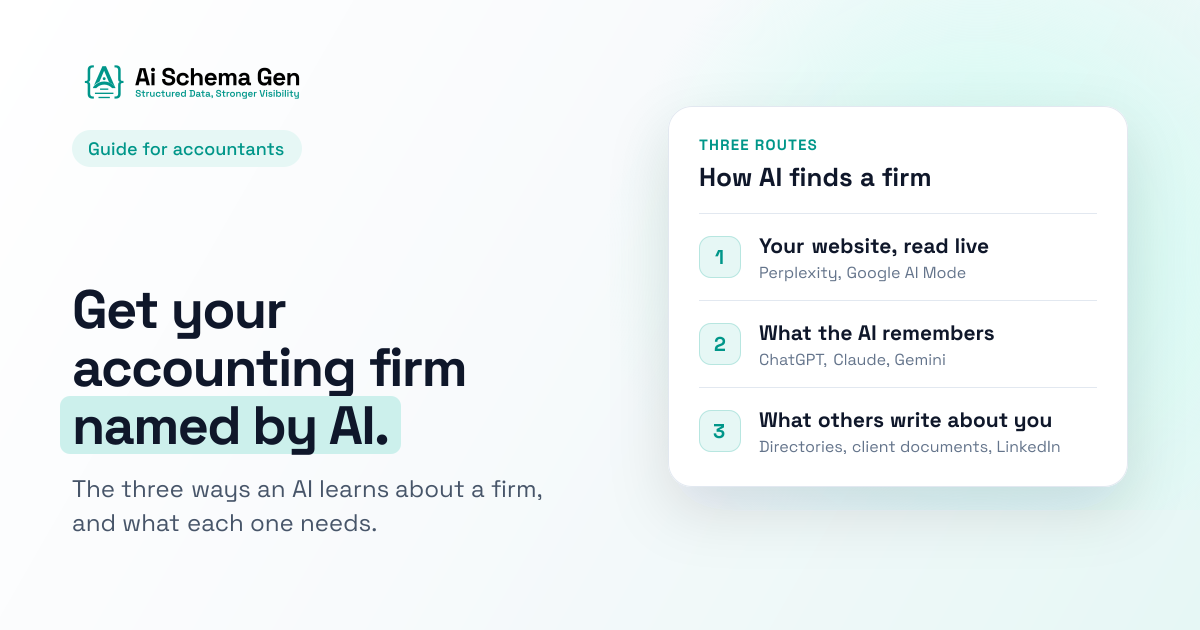
The most useful idea in the AIWorthy report is that a firm gets into an AI answer through one of three "doors." Each door works differently, and each needs a different fix.
| Route | Which assistants lean on it | What it means for you |
|---|---|---|
| Reading your website during the answer | Perplexity and Google AI Mode, which search the web as they answer | Your pages need to say who you serve, what you do and where, in plain text, right now |
| Remembering you from training | ChatGPT, Claude and Gemini, which in this study cited little | What has been written about your firm over the years, under which name, shapes what they recall |
| Reading what others wrote about you | All of them, to some degree | Directories, client documents, LinkedIn and published lists can name you even when your site does not |
The study also found that answers given from memory stayed fairly steady between August and September, while the assistants that search the web changed more. Google AI Mode's list of cited websites per question fell from 83 to 39 in that time. So a change to your website is likely to reach the search-as-you-go assistants sooner, and the ones answering from memory much later, if at all. There is no fixed timetable for either, so plan for both.
Door one: your website, read live
When an assistant reads the web as it answers, your site is competing on one thing: whether a page clearly answers the buyer's question. In the AIWorthy study, every page cited on both dates named the Triangle, between 11 and 32 times. The cited pages also described the buyer's own service in depth and ran to real length, not a short paragraph under a stock photo.
The busiest firm in the panel had 1,821 pages on its website, according to Accounting Today's summary, and none of them mentioned the Triangle. Its experience was real and on the public record, but its website never connected that experience to the place and the type of client a buyer was asking about. A smaller firm with one long, specific page did.
This is the single biggest lesson for accountants. Most firm websites are organized around the firm: About Us, Our Team, Services, with "Services" listing tax, audit, advisory and bookkeeping in a sentence each. AI assistants answer questions from the buyer's side: "Who does Single Audits for charter schools near Durham?" "Which CPA in Austin works with real estate investors?" "Is there an enrolled agent near me who can handle an IRS notice?" If no page on your site answers a question in that shape, door one stays shut.
Door two: what the AI already remembers
ChatGPT, Claude and Gemini, in the way the study accessed them (through developer access rather than the consumer apps), answered these audit questions mostly from what they learned during training and cited little. That is not true of every kind of question. In a separate study of contractor recommendations, ChatGPT cited licensing boards and the Better Business Bureau heavily, so how much an assistant searches depends on the question and the setup. For accounting firms, though, the lesson holds: you cannot count on an assistant looking you up fresh. You cannot edit that memory directly. What you can influence is what gets written about your firm from now on, and whether it is consistent.
This is where firm names cause real damage. The accounting profession has seen years of mergers and rebrands, and AI memory is slow to catch up. In the AIWorthy panel, one firm that changed its name in April 2024 was recommended under its old name 62 times in August and 61 times in September, and never once under its current name. A firm's Durham office was still recommended under its name from before a 2023 merger. A national firm that merged in 2022 was still recommended under both former names.
The worst detail is why. In September, Google's AI Mode also used the retired name, and the evidence it cited was the firm's own website, whose homepage title, service pages and LinkedIn page still carried the old name. The firm had confused the AI itself.
Door three: what others write about you
The third door is everything other people publish: directories, rankings lists, LinkedIn, job postings, and the documents your clients put online. That last one is particular to accounting. Public bodies publish their audit reports, council minutes and treasurer filings, and those documents name their auditor.
The AIWorthy report describes a firm that was recommended 78 times while its website showed only a maintenance notice. The assistants had learned about it from its clients' documents: a school's archive, a council's minutes, the state treasurer's files. Another firm, the second busiest in the panel, filed every engagement from a web address that had email but no website at all.
Door three can work in your favour without any effort on your part, but you have no control over what it says, how current it is, or which version of your name it uses. It is a reason to get your own pages right, not a replacement for them.
Say Exactly What Kind of Accountant You Are
Before an AI assistant names anyone for a money question, it often has to work out what kind of professional the person needs. In accounting, that is a real distinction with legal weight behind it, and your website should make it easy to place you.
The IRS explains the main types on its page about preparer credentials:
- Certified public accountants (CPAs) are licensed by state boards of accountancy. They have unlimited rights to represent clients before the IRS, including audits, payment and collection issues, and appeals.
- Enrolled agents (EAs) are licensed by the IRS itself, after passing a three-part exam or through experience as a former IRS employee, and keep their status with 72 hours of continuing education every three years. They have the same unlimited representation rights as CPAs and attorneys.
- Attorneys licensed by a state also have unlimited representation rights.
- Annual Filing Season Program participants hold a yearly IRS record of completion and can represent only clients whose returns they prepared and signed, and only before certain IRS staff.
- Other paid preparers hold a PTIN (preparer tax identification number) and can prepare returns, but have no right to represent clients before the IRS.
State law adds another line. State accountancy laws, most of them built on the Uniform Accountancy Act written by the AICPA and NASBA, restrict the title "certified public accountant" to licensees, and reserve audit and review reports on financial statements for licensed CPAs and CPA firms. Bookkeeping, tax preparation and advisory work are generally open to anyone. The exact wording varies by state.
That gives you a simple test for your own site. Can a reader, or a machine, tell from your pages:
- Which credential each professional holds, written out in full at least once ("Certified Public Accountant, licensed in Ohio") rather than as a bare "CPA" after a name?
- Which services need that credential? If you represent clients in IRS audits, say that your CPAs or EAs can. If you perform audits or reviews, say you are a licensed CPA firm.
- Which services you do not offer? A bookkeeping firm that is clear it does not do audits will be matched to bookkeeping questions, which is what it wants.
Most firms bury all of this on a team page. Put it on the service pages, where the matching happens.
The IRS directory: a public record worth checking
The IRS runs a public Directory of Federal Tax Return Preparers with Credentials and Select Qualifications. It lists people with an active PTIN who are also CPAs, enrolled agents, attorneys, enrolled retirement plan agents, enrolled actuaries or Annual Filing Season Program participants. According to the IRS's directory FAQ, it takes its information from each preparer's PTIN account, is updated weekly, and new or changed details can take up to four weeks to appear. Some preparers who would qualify have opted out.
Two caveats from the research keep this in proportion. The AIWorthy study found the state licensing board was never cited in 2,725 citations, so do not count on any AI checking an official register for you. And a register only lists people, not the services they offer. Still, keep your PTIN account current and your directory listing switched on: a careful client may look you up there after an AI names you, and it costs nothing.
Build the Page the Buyer Is Asking About
Here is what a page needs if it is going to answer an AI assistant's question about your firm. The examples assume a mid-sized firm, but the same pattern works for a solo EA.
| The buyer's situation | What your page needs to say | Who is allowed to do it |
|---|---|---|
| "We just crossed the federal funding threshold and need a Single Audit" | That you perform Single Audits, for which types of organization, in which area, and the current threshold | A licensed CPA firm |
| "I got a letter from the IRS" | That you handle IRS notices and audits, which kinds, and who on your team represents clients | CPA, EA or attorney |
| "I'm starting an S corp" | Entity choice, payroll setup, the first-year tax steps, and the kind of owner you usually work with | Anyone may advise |
| "I'm a year behind on my books" | Catch-up bookkeeping, what you need from the client, typical timelines | Anyone; say if you are not a CPA firm |
| "I need audited statements for a bank loan" | That you provide audits or reviews of financial statements, for which kinds of business | A licensed CPA firm |
| "I moved abroad and still owe US tax" | Expat returns, which countries you often deal with, remote working | CPA, EA or attorney for representation |
Each row is one page, or one clear section of a page, written around the client's situation rather than your service catalogue. Four elements matter most, based on the studies:
Name the place, more than once. Every page cited on both dates in the AIWorthy study named its region at least 11 times. That does not mean stuffing a city name into every sentence. It means writing naturally about where you work: the cities and counties you serve, whether you meet clients in person, and whether you also work remotely and with clients in which states.
Describe the client, not just the service. A page titled "Audit and Assurance" says little. A page that explains how you audit charter schools, what their boards usually ask, and what documents you need gives an AI something to match against a charter school's question. The Expert Press finding points the same way: the smaller firms that outperformed had an obvious focus.
Write enough to be useful. The study did not set a word count, and neither should you. But a two-sentence service blurb is not going to be the best answer to anyone's question.
Keep the numbers current. Tax and audit work is full of figures that change: contribution limits, filing deadlines, mileage rates, audit thresholds. The Single Audit threshold, for example, rose from $750,000 to $1,000,000 for fiscal years starting on or after 1 October 2024, and the AIWorthy report suggests searching your site for the old figure. A page quoting last year's numbers tells a reader, and an AI, that nobody has looked at it in a while. In the study, three in five of the dated pages the assistants read had changed within the previous six months; freshness was, in its words, "the one piece of the standard advice the record supports." Our guide to page dates explains how to show when a page was last updated in a way machines can read.
If you work with a few industries (dentists, construction, nonprofits, real estate investors), each one deserves its own page for the same reason. You can also list those subject areas in your site's structured data; our guide to subject areas shows how. But the page comes first. Structured data can only confirm what the page already says.
Old Names, Mergers and Retired Partners
Name problems deserve their own section, because they are so common in accounting and so easy to miss. If your firm has merged, rebranded, dropped a founding partner's name or joined a larger group in the last few years, check all of these:
Your homepage title. The title that appears in the browser tab and in search results is one of the first things an AI reads. In the AIWorthy panel, a firm two years past its rebrand still carried the old name there.
Service pages and blog posts. Old pages are often written in the old name and never updated. Search your own site for every former name.
LinkedIn, directories and your Google Business Profile. These are among the third-party pages an AI can read. Update each one to the current name.
One clear sentence that links old and new. On your About page, say it plainly: "Smith & Jones CPAs (formerly Smith, Jones & Brown LLP) became part of Example Partners in 2025." That gives an AI a single sentence connecting the names it remembers to the firm that exists today. If the merged firm still operates from the old office, say that too.
Most firms think of a rebrand as a design project. For AI search it is also a records project, and it is not finished until every page and profile agrees. Our guide to consistent business details covers how to find pages on your own site that still disagree.
The same applies to people. When a partner retires or a well-known accountant leaves, update the team page, their bio, and any service page that names them as the contact. An AI that recommends a firm "because Jane Smith leads its nonprofit practice" a year after she left sends the client in with the wrong expectation.
Your Google Profile and the Wider Local Picture
Many accounting clients still look locally, especially individuals and small businesses at tax time. The basics from our local business guide apply in full: a complete Google Business Profile with the right primary category, claimed listings on the platforms people use, and the same name, address and phone number everywhere.
One accounting-specific point: Google lets some public-facing professionals have their own Business Profile, separate from their firm's. Its examples of these "individual practitioners" do not name accountants (they include lawyers and financial planners), so read Google's practitioner rules before setting up profiles for individual CPAs or EAs. Whatever you decide, the people and names on Google should match your website's team page.
Where Structured Data Fits, Honestly
Structured data is a summary of key facts about your firm, written in a format machines can read: your name, legal name, business type, address, phone, the areas you serve, the subjects you work in, and links to your profiles elsewhere. Schema.org has a specific type for this, AccountingService, which sits under FinancialService and LocalBusiness.
It is tempting for a company like ours to oversell this, so here is what the AIWorthy data actually shows. Structured data was present on 69% of the pages the assistants cited. FAQ markup was on none of the 20 most-cited pages. So structured data was common on cited pages, but it plainly was not the deciding factor, and FAQ markup in particular showed no sign of mattering.
The fair way to see it: structured data confirms facts your pages already state, and it removes doubt about which business a page belongs to. That is useful, especially for the name problems above, but it cannot stand in for a page that names the place and describes the client. Write the pages first, then make sure the structured data agrees with them.
Common Mistakes
A services page that is one long list. "Tax, audit, bookkeeping, payroll, advisory" in a paragraph matches no buyer's question. Split it into pages built around client situations.
Never saying where you work. Many firm websites mention their address only in the footer. If the area you serve is not written in the body of your service pages, door one stays shut for local questions.
Leaving old names in place after a rebrand. Homepage titles, old blog posts and LinkedIn pages keep the retired name alive in AI answers for years.
A bare "CPA" after every name. Write out the credential and the licensing state at least once, and say which services need it.
Last year's numbers. Outdated thresholds, limits and deadlines tell readers and machines that a page has not been looked at. Review every page that quotes a figure each tax year.
Putting Reddit and Quora ahead of your own pages. For audit questions in one region, the AIWorthy study found no citations from Reddit, Quora, forums, Wikipedia or YouTube in 2,725 sources. Other questions and other industries can behave differently, and genuine community mentions do no harm. But for an accounting firm whose service pages are thin, those pages come first.
Assuming a strong Google ranking covers AI. Most of the pages Google's AI Mode cited in the study did not rank on Google's first page for the questions tested. Good rankings are welcome, but they are not the same test.
Asking ChatGPT about your firm by name and stopping there. The AIWorthy report recommends testing both ways: by name (does the AI know you?) and without your name (does it find you for a buyer's question?). Our guide to checking what ChatGPT says about your business explains how to run those tests properly, since one ask proves very little.
How to Check and Fix It
Step 1: Test door one. Run your site through our free AI readiness checker. It first checks that AI crawlers are allowed onto your pages, then gives an AI nothing but your own content and asks it basic questions about the firm. For an accounting firm, watch two of them closely: which areas you serve, and what services you offer. A vague or empty answer to either means an assistant reading your site live has little to match against a buyer's question. The downloadable report also lists the last-updated dates your pages give, which helps with the freshness point above.
Step 2: Search your site for old names and old numbers. List every former firm name and partner name, and search for each. Then search for last year's key figures. Fix every page you find, starting with the homepage title.
Step 3: Write the missing pages. Pick your three most valuable client types or situations and write one full page for each, using the table above: the place, the client, the work, the credential, and current figures.
Step 4: Fill in your Business Identity. In the AI Schema Gen dashboard, choose Accountant / CPA as the business type, enter your legal name, the areas you serve, your founders or managing partners, the subject areas you work in, and links to your profiles on LinkedIn, Google and any directories you use. The structured data on your pages is built from these details, so it stays in step with what you enter.
Step 5: Line up the outside records. Update LinkedIn, your Google Business Profile, directories and your IRS PTIN account so they all carry the current name and credentials.
Step 6: Test again in six weeks. The AIWorthy report suggests rechecking after about six weeks. Expect the assistants that search the web to change first and the ones answering from memory to change slowly.
If your firm works closely with attorneys, or you share clients with a law practice, our GEO guide for law firms shows how the state bar's advertising rules shape what a lawyer's website can claim.
Frequently Asked Questions
Is your website ready for AI?
Check now. Free readiness score in under a minute, no signup, no card.