
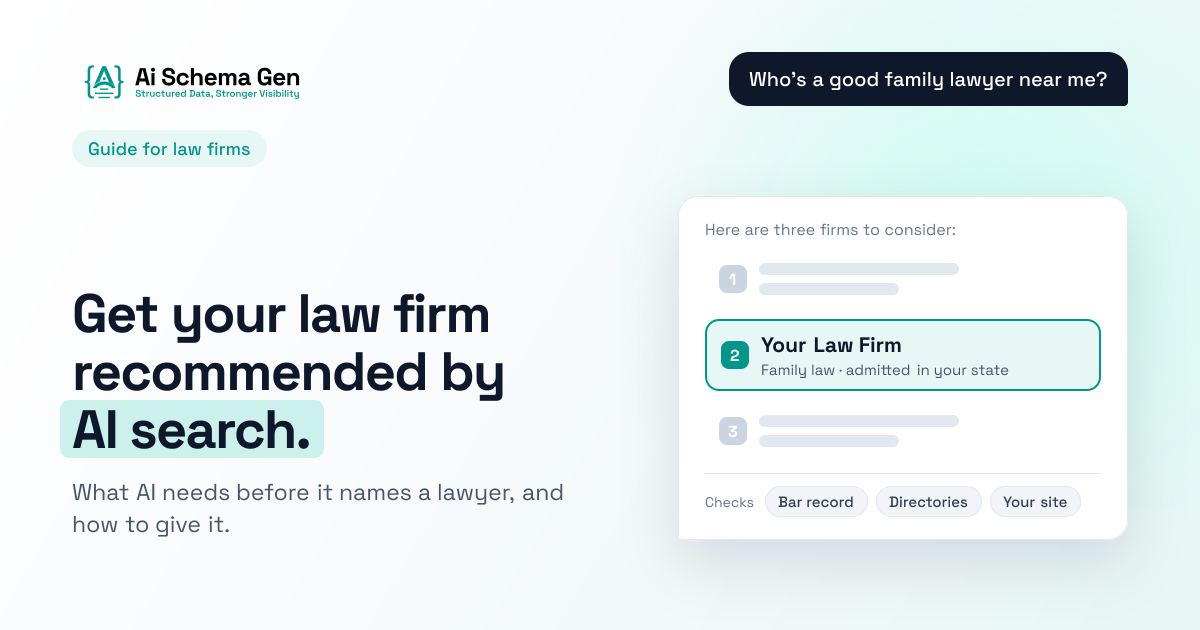
A law firm's website has always had one strict reader: the state bar, which expects every claim about the firm to be true and not misleading. It now has a second one. When a prospective client asks ChatGPT or Google's AI Mode for a good family lawyer in their city, the AI reads the firm's site too, and it has a surprisingly similar test. It can only repeat a claim it can stand behind.
That second reader matters more each year. In a July 2025 survey of 1,052 US adults by iLawyer Marketing, a legal marketing agency, the share who would use ChatGPT to research an attorney rose from 9% to 28.1% in two years, making it the second most used source after Google. The same survey found something just as useful: of the people who would use ChatGPT, 94% said they would also check on Google. People let AI suggest a lawyer, then they verify.
This guide to GEO for law firms is built on that idea. The claims bar rules discourage, such as "best," "specialist" and "we always win," are the same claims an AI engine cannot verify and a careful client will not trust. The claims that pass all three tests are specific, checkable facts. Here is how to turn a law firm website into a set of those facts.
This is about marketing your firm, not legal ethics advice. Advertising rules differ by state, so check your own state's rules, or ask your bar's ethics hotline, before changing how you describe your firm.
What GEO for Law Firms Actually Means
GEO stands for generative engine optimization. AEO (answer engine optimization) and AI SEO describe roughly the same thing. For a law firm, it means making it easy for AI assistants to find your firm, understand what you do and where, and describe you correctly when someone asks for a lawyer.
Some of that is up to you and some of it isn't. What your site and listings say, and whether those statements are clear, consistent and checkable, is fully in your hands and can be measured. Whether a given AI answer names your firm on a given day is decided by the AI provider, and no agency, tool or consultant can promise it. Treat any such promise the way you would treat a client asking you to guarantee a verdict.
This guide is about the part you control, with one legal twist: every change has to stay inside your state's advertising rules.
Two Readers, One Standard
The American Bar Association's Model Rules of Professional Conduct are the template most state rules are built on, with local changes. The core advertising rule is short: a lawyer shall not make a false or misleading communication about the lawyer or the lawyer's services. The ABA's comments then spell out what "misleading" covers, and three parts of them line up closely with how an AI engine treats a website.
Past results. According to the ABA, a truthful report of a lawyer's achievements "may be misleading if presented so as to lead a reasonable person to form an unjustified expectation" that other clients will get the same result. An AI engine has the same problem from the other side. A headline like "$4.2 million recovered" says nothing it can safely pass on to a new client about their own case.
Comparisons. The same comment says an unsubstantiated comparison with other lawyers' services may be misleading. "The best DUI lawyer in Phoenix" is exactly that. It is also a claim an AI cannot check, so at best it ignores it.
Specialist claims. The ABA's Rule 7.2 says a lawyer shall not state or imply that they are certified as a specialist in a field of law unless an approved or ABA-accredited body certified them, and that body is clearly named. A named certifying body is also something an AI can look up.
So the rules and the machines point the same way. Vague praise fails both. Specific, sourced facts pass both, and they are also what the 94% of clients who double-check on Google are looking for.
Claim by Claim: What to Say Instead
Most law firm websites lean on a handful of standard claims. Here is how each one fares, and what to write in its place.
| What firms often write | Problem under the ABA Model Rules | What to write instead |
|---|---|---|
| "The best personal injury lawyer in Dallas" | Unsubstantiated comparison | A named, dated third-party recognition, with its source |
| "Family law specialist" | Specialist claim without a named certifying body | The certification and the body that granted it, or "practice focused on family law" |
| "$12 million recovered for our clients" | Can create an unjustified expectation | The types of cases you handle, with context and a clear disclaimer |
| "Aggressive, experienced, results-driven" | Not false, but says nothing checkable | Years in practice, jurisdictions, courts you appear in |
| "Top-rated by our clients" | Vague, and easy to make misleading | Where your reviews are, so readers can check them |
| "Serving all of Texas" | Often not quite true for a small firm | The courts and counties you actually practice in |
"Best" becomes a named recognition
If you have been recognized by a known third party, say exactly that: who recognized you, for what, and when. "Selected to Super Lawyers, Family Law, 2026" can be checked against the directory itself, so an AI engine can tie your site to an outside source it may already read. Many states have extra rules about how awards and ratings are presented, including required disclaimers, so check yours before you add them. If you have no such recognition, leave the comparison out. A plain description of what you do beats a claim nobody can back up.
"Specialist" becomes a named certification
Under the Model Rules comment, a lawyer is generally allowed to say they "concentrate in" or "focus on" an area based on experience, as long as it is not misleading. Saying you are certified as a specialist is different: it needs an approved certifying body, named in the same place. If you are board certified, write it out in full on your attorney page, for example "Board Certified in Family Law by the Texas Board of Legal Specialization." Certifying bodies usually publish who they have certified, which gives an AI engine a second source that agrees with yours.
Results become context
You may still be allowed to describe past results in your state, often with a disclaimer. But for both the bar and the AI, context beats a headline number. A case page that says what kind of matter it was, which court, what the main issue was, and that results depend on each case's facts, gives an AI engine something accurate to say about your experience. A list of dollar amounts gives it something it cannot responsibly repeat.
Adjectives become facts
"Aggressive" and "results-driven" are not violations, but they are empty. Replace them with facts a client, a bar regulator and an AI can all check: the year each lawyer was admitted, the states they are admitted in, the courts they appear in, the languages spoken in the office, and how fees work.
The Lawyer Is the Entity, Not Just the Firm
When a client asks an AI for "a good immigration lawyer in Houston," the honest answer depends on people. Is there a licensed lawyer at this firm who practices immigration law, and can they take a case in that state? That makes each attorney's page more important than any page about the firm as a whole.
Every attorney page should state, in plain text:
- Full name, matching the bar record. The state bar's public attorney search is the official record of who is licensed, and it is exactly the kind of source a careful client, or an AI, can check. Use the same form of the name on your site, or say both forms if you use a shorter one.
- Where they are admitted, and since when. "Admitted in New York (2014) and New Jersey (2016)." This is the fact that decides whether they can take a case in the client's state, and AI questions are almost always local.
- What they actually practice. The two or three areas they spend their time on, not a list of twenty.
- Certifications, by name. As above, with the certifying body.
- Education and languages. Simple, checkable, and often asked.
Google's own rules treat lawyers this way too. Google lists lawyers among "individual practitioners," who can have their own Business Profile if they are public-facing and can be reached directly at the verified location. A solo lawyer operating under a firm brand should use a single profile named "[brand/company]: [practitioner name]", following Google's individual practitioner guidelines. Getting this right keeps your Google listing, your website and your bar record telling the same story.
Directories: Where Paying Is Fine and Where It Is Not
Legal directories matter in AI search. In the iLawyer survey, FindLaw and Justia were each used by about one in six people researching an attorney, and directory profiles are among the outside pages an AI engine can read about you. Claim your profiles on the directories that matter for your practice area, and keep the same name, address, phone number, practice areas and attorney list on every one.
The ABA rules draw a useful line here. Rule 7.2 says a lawyer may not give anything of value to someone for recommending the lawyer's services, with listed exceptions such as paying the reasonable cost of advertising. The comment explains that a communication is a recommendation if it vouches for a lawyer's abilities or character, and that directory listings that simply list lawyers by practice area "do not constitute impermissible recommendations." In plain terms: paying for a directory listing is usually fine. Paying, or giving gifts, for reviews or "recommended" badges is not. That also happens to be what keeps your review profile believable to clients and to AI engines.
Once your profiles are claimed and correct, link to them from your site. Our guide to profile links explains how to list them in your site's structured data so an AI can connect your website to the same firm on Avvo, Justia or your Google listing.
State Rules Change the Details
Everything above uses the ABA Model Rules because they are the common starting point, but your state's version is what applies to you. The ABA publishes a state variations chart for Rule 7.1 (last updated in 2022), and the differences are real. Alabama's rule, for example, writes the bans on creating unjustified expectations about results and on comparing the quality of your services with other lawyers' straight into the rule itself, rather than leaving them to the comments. Other states add their own rules on testimonials, past results or required disclaimers.
Two practical habits help. First, keep your site's claims boring in the best sense: dated, sourced, specific. Those survive almost any state's rules. Second, when you are unsure about a particular claim, many state bars run an ethics hotline for exactly that question. A five-minute call is cheaper than rewriting your site after a complaint.
What This Looks Like Behind the Scenes
Behind the visible page, a site can also carry structured data: a machine-readable summary of the firm's name and type, address, phone number, lawyers, service area and outside profiles. Schema.org's LegalService type covers a law firm, and each lawyer can be described as a Person linked to the firm. Our guide to law firm schema covers the types and properties in detail, including how to mark up attorneys and practice areas.
The point to keep in mind for GEO is the order of things. Structured data can only confirm facts. If your pages say "best lawyer in town" and nothing checkable, there is nothing useful for structured data to confirm. Fix the words first.
Common Mistakes
Calling yourself a specialist without naming a certification. It is the most common advertising-rule problem on law firm sites, and it gives an AI engine a claim it cannot check. Use "focuses on" or name the certifying body.
Leading with settlement totals. Big numbers on the homepage tell an AI nothing it can responsibly repeat, and in many states they need careful framing. Put results on case pages with context.
Attorney pages that are only a photo and a paragraph. If the page does not say where the lawyer is admitted and what they practice, an AI cannot match that lawyer to a client's question.
A different attorney list on every platform. Lawyers join and leave firms. When your site, Google profile and directory profiles list different people, an AI engine has to guess which is current.
Rewarding clients for reviews. Gift cards for five-star reviews can break both the bar's rules on paying for recommendations and the review platforms' own rules. Ask every client the same way, and accept what they write.
Claiming coverage you do not have. "Serving clients nationwide" from a firm admitted in one state is the kind of claim that misleads clients and confuses AI answers to "lawyer in [state]" questions.
Asking ChatGPT about your firm once and drawing conclusions. The same question can produce a different list of firms each time. Our guide on how to ask ChatGPT about your business explains how to test it properly.
How to Check and Fix It
Step 1: Find out whether an AI can name your lawyers. Our free AI readiness checker reads your site the way an AI crawler does and asks an AI six basic questions about the firm, using nothing but that content. One of them is who runs the business. If the answer comes back empty, an AI has no lawyer to recommend, however good your practice area pages are. The report also shows which answers are confirmed by your structured data and which the AI had to piece together from the text.
Step 2: Rewrite the claims. Go through your homepage, practice area pages and attorney pages with the table above. Replace comparisons, uncertified "specialist" wording and bare results with named recognitions, named certifications and context. Check the changes against your state's rules.
Step 3: Complete every attorney page. Full name as on the bar record, jurisdictions with admission years, practice focus, certifications, education, languages.
Step 4: Update the firm's Business Identity. In the AI Schema Gen dashboard, choose Legal Service as the business type, add the firm's founders or name partners, list the places you take clients from, and paste in the links to your Google, Avvo or Justia profiles. Our founders fix guide shows where each field is. The structured data on your pages is generated from these details. The rest of your lawyers, their bar admissions and their certifications belong on their attorney pages, which is where a client or an AI looks for them.
Step 5: Line up the outside records. Make sure your Google Business Profile follows the practitioner rules above, and that Avvo, Justia, FindLaw or any other directory you use lists the same lawyers, address and practice areas as your site.
The same approach works outside law. Our guide for contractors applies it to licensed trades, where the licensing board plays the role the state bar plays here.
Frequently Asked Questions
Is your website ready for AI?
Check now. Free readiness score in under a minute, no signup, no card.