
If you run a small business, someone has probably already offered to "get you into ChatGPT." The offer might come from your web designer, an agency cold email, or an ad promising AI visibility for a monthly fee. What these offers rarely tell you is which parts of the work you could do yourself in an afternoon, which parts are worth paying for, and which parts are no use at all.
That matters because most small businesses are only just starting. In Bluehost's May 2026 survey of 350 US small business owners, just 13% were actively optimizing their websites for AI search. Another 35% were exploring without acting, 31% had heard of it but didn't know how to start, and 22% were hearing about it for the first time in the survey itself. The same share, 13%, said they already get traffic from AI search.
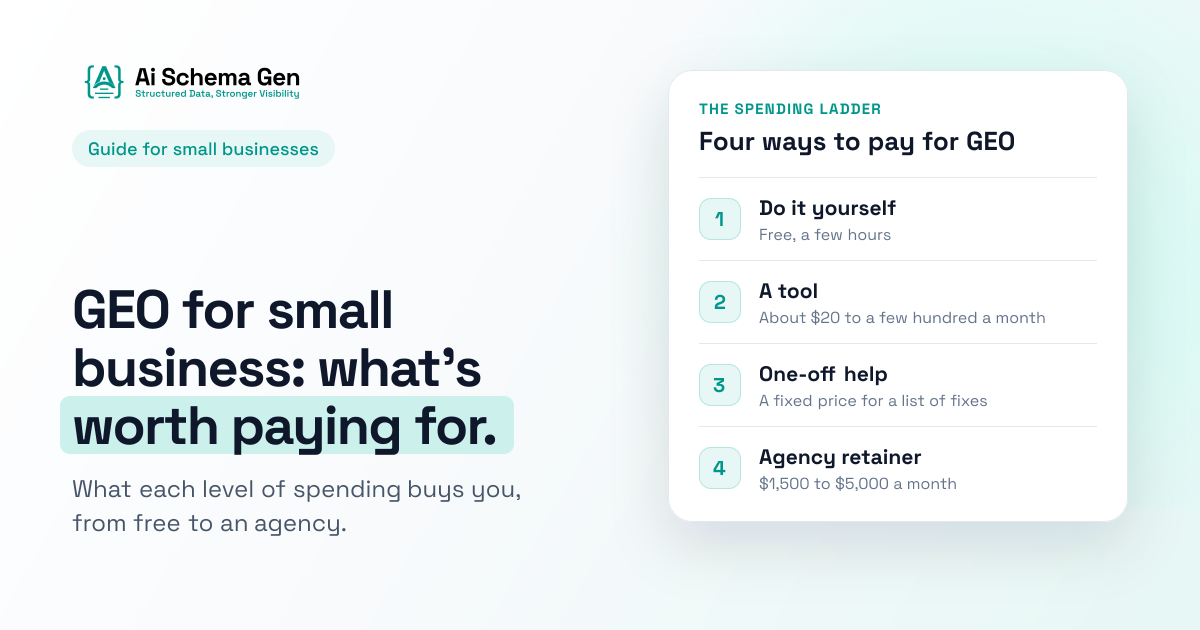
So this guide to GEO for small business is organised around money and time rather than tactics. It starts with what generative engine optimization means for a business your size, then goes up the spending ladder, from free to a few thousand dollars a month, and says what each step buys you. It ends with the offers to turn down and the questions to ask before you sign anything.
What GEO Means for a Small Business
GEO stands for generative engine optimization. You will also see AEO (answer engine optimization) and AI SEO, which mean roughly the same thing. For a small business, it comes down to one question: when someone asks ChatGPT, Gemini, Perplexity or Google's AI Mode for the kind of thing you sell, can the AI tell that your business exists, understand what you do and for whom, and describe you correctly?
That question splits into two parts, and the split decides where your money should go:
- Readiness is the part you control. Can AI crawlers reach your website? Do your pages say plainly what you do, where, and for whom? Do your details match the other records about you online? This can be checked, fixed and measured.
- Visibility is whether a particular AI answer actually names you. That is decided by the AI provider, it varies from one ask to the next, and no one outside those companies controls it.
We explain that difference in more depth in our post on readiness and visibility. For a small business on a budget, the practical rule is simple: spend first on readiness, because it is fixable and it lasts. Spend on visibility only once readiness is solid, and only on measuring it, never on promises of it.
One more point before the ladder. A small business is not automatically at a disadvantage. In our guide for accountants, two 2026 studies found that smaller firms with a clear, written-down focus were recommended far more often than their size would suggest, and in one study the busiest firms were recommended least. AI assistants seem to reward businesses that say clearly who they serve and where. Being small makes that easier, not harder.
First, Which Kind of Small Business Are You?
The free work in the next section depends on how customers reach you. Most small businesses fall into one of three groups, and two of them already have their own guides:
- Customers come to you, or you go to them, in a local area. A café, a dentist, a plumber, a salon. Your Google Business Profile and other map listings matter as much as your website, because that is where several AI assistants get local details. Our guide to local business AI search covers which listing each assistant reads and what to fix first.
- You sell products online. Product pages, prices, stock and shipping details are what AI shopping features look for. Our guide to getting an online store ready for AI shopping covers that.
- You sell a service that isn't tied to one place. A consultant, a bookkeeper who works remotely, a design studio, a coach, a small software company. You have no map pin to lean on, so your own website and what others write about you carry almost all the weight.
The rest of this guide applies to all three, with the third group in mind where it differs.
Rung One: Free, If You Have the Time
Everything on this rung costs nothing but a few hours. It is also where most of the readiness work lives, which is why it comes first.
Check whether AI crawlers can reach your site. Some website builders, security plugins and firewall services block AI crawlers without telling you. If the crawlers cannot get in, nothing else on this list matters. Our free AI readiness checker (more on it at the end of this guide) tests this, then gives an AI nothing but your own website's text and asks it basic questions about your business: what you do, where you are, which areas you serve, what you offer, who runs it, and how to get in touch. The answers it can't give are your to-do list.
Write down what you do, for whom, in plain words. Many small business homepages say something like "Helping you grow" or "Solutions that work." An AI cannot match that to anyone's question. Write one clear sentence near the top of your homepage: what you do, who it is for, and where (or "anywhere in the US," if that is true). Then make sure each main service has its own page that explains it properly.
Answer the questions customers actually ask. You already know them: what does it cost, how long does it take, do you work with businesses like mine, what happens first. If the answers are only in your head or your inbox, an AI has nothing to repeat. Put them on the relevant pages.
Make your details match everywhere. Your business name, phone number, address (if you have one), website and opening hours should be the same on your website, your Google profile, your social media pages and any directory you are listed in. Small differences make an AI less sure that two records are the same business.
Ask happy customers for reviews, the honest way. Reviews on the platforms your customers use (Google, Yelp, Trustpilot, Clutch or an industry directory) are among the outside sources AI assistants can read. Ask every customer the same way, and do not reward anyone for a positive review. More on why below.
Test the way a customer would. Ask ChatGPT or Gemini the question a new customer would ask, without your business name in it. Then ask it about your business by name. The first tells you whether you are found, the second whether what the AI knows about you is correct. Do each more than once: a single answer tells you very little, because the same question can produce different answers each time.
None of this needs a specialist. What it needs is a few uninterrupted hours, which is often the scarcest thing a small business owner has. That is the honest reason to consider the next rungs.
Rung Two: A Tool, From About $20 to a Few Hundred a Month
Software tools in this space do one or both of two jobs.
Monitoring tools ask AI assistants a set list of questions on a schedule and record whether your business is named. Otterly.AI, for example, lists a Lite plan at $29 a month for 15 tracked questions across ChatGPT, Google AI Overviews, Perplexity and Microsoft Copilot, rising to $489 a month for 400 questions. These tools measure visibility. They do not change it. They are useful once your readiness work is done and you want to know whether anything is moving, and much less useful before that.
Fixing tools find and fix readiness problems on your own website: missing business details, pages with no structured data (a machine-readable summary of facts like your name, services and contact details), blocked crawlers and so on. AI Schema Gen is one of these. You can run the report and fix up to 25 pages without paying anything. The Pro plan, at $19 a month, covers up to 500 pages and adds a weekly re-check with an alert if your score drops, two competitors to compare against, and five AI visibility questions tracked in ChatGPT.
Two things are worth knowing before you pay for any tool, ours included.
Check what the tool actually measures. A report that says your business "appears in 40% of AI answers" means nothing until you know which questions were asked, how many times, in which assistants, and whether any of those questions are ones your customers would actually ask. Our guide to tracking brand mentions explains why a single ask is not a measurement and how to read the numbers over time.
Start with the fixing, not the watching. For most small businesses, paying to watch AI answers every week before the website is in good shape is paying to watch a number that has no reason to change yet.
Rung Three: One-Off Help
Somewhere between doing it yourself and paying a monthly fee is hiring someone once: a freelancer, your web designer or a consultant, to do the readiness work in one go.
This can be good value for a small business, because most readiness work is done once and then only checked. A reasonable one-off job looks like this:
- Check that AI crawlers can reach the site, and fix it if they can't.
- Rewrite the homepage opening and the main service pages so they say what you do, for whom and where.
- Add the missing pages customers need: pricing or how pricing works, how the process works, an about page with the real people behind the business.
- Add or correct the structured data on the site so it matches the visible pages.
- Line up your details across your Google profile, social media and directories.
- Hand you a short list of what to check each quarter.
Ask for a fixed price and a list of deliverables. Prices vary widely by country and by person. WebFX, a large US agency, puts project work such as audits and overhauls at $5,000 to $50,000 per project, but that is agency pricing aimed at bigger companies. A freelancer doing the list above for a ten-page website will usually charge far less. Whoever you hire, the list matters more than the price: every item on it should be something you can see and check afterwards.
Rung Four: A Monthly Agency Retainer
At the top of the ladder is a monthly retainer. WebFX's 2026 guide to GEO costs puts small business plans at $1,500 to $5,000 a month, medium-sized businesses at $5,000 to $25,000 or more, and its own GEO plan starts at $3,000 a month. Many smaller agencies charge less, but those figures give you a sense of the market.
For many small businesses, a retainer at that level is hard to justify for GEO alone. Most of the readiness work is a one-off job, so a monthly fee mainly pays for ongoing content, monitoring and reporting. That can be worth it if:
- you sell something with a high value per customer, so one or two extra clients a year cover the cost;
- you need a steady flow of new, useful content and have no one in-house to write it;
- the agency also handles marketing work you would pay for anyway, and GEO is part of a wider plan rather than a separate charge.
It is probably not worth it if most of what the agency plans to do each month is "monitoring and reporting," or if you cannot get a clear answer to what they will actually change on your website.
What to Refuse, Whatever the Price
Some offers are not worth buying at any price, and a few could get you into trouble. Turn these down.
A guarantee of being named by ChatGPT or Google AI. No agency or tool controls which businesses an AI answer names. That decision belongs to OpenAI, Google and the other providers, and their answers change from one ask to the next. A guarantee is either a misunderstanding or a sales tactic. A reasonable promise sounds like "we will fix these specific problems on your site and show you the before and after."
"Special AI files" or "AI schema" sold as essential. Google's own page on AI features answers this directly. It says you don't need to create new machine-readable files, AI text files or markup to appear in AI Overviews or AI Mode, and that there is "no special schema.org structured data that you need to add." Structured data is still useful for describing your business clearly, and it is part of what we do. But anyone selling it as the key that unlocks AI answers is overselling it. The same goes for llms.txt files: our post on llms.txt covers measurements showing that AI crawlers almost never request them.
Review packages. Any offer to supply reviews, or to reward customers only for positive ones, is a legal risk in the US, not just a bad tactic. The Federal Trade Commission's rule on fake reviews, announced in August 2024, bans fake reviews including AI-generated ones that claim to be from people who don't exist. It also bans buying reviews by offering payment or other rewards on the condition that the review expresses a particular sentiment, positive or negative. Asking every customer for an honest review is fine. Paying for good ones is not.
Fake posts in forums and communities. Some services offer to post about your business on Reddit, Quora or other forums, written to look like real customers. Apart from breaking those sites' rules, a fake testimonial has the same problem under the FTC rule as a fake review. Genuine participation is a different thing and can help: answering questions in your field, openly as yourself, is the kind of mention that builds a real reputation over time.
Reports based on a handful of single asks. A monthly report that says "you now appear for 7 of 10 questions," based on asking each question once, is mostly measuring chance. Ask how many times each question was asked and how the questions were chosen.
Long contracts before any work is shown. A twelve-month commitment to a service whose results can't be guaranteed should come after you have seen what they did in the first month, not before.
Questions to Ask Before You Sign
If you do decide to pay someone, these questions will tell you a lot in a short call.
- What exactly will you change on my website in the first month? You want a list of specific pages and fixes, not "optimization."
- How will I be able to check it? Every change should be visible to you: a rewritten page, a new page, a fixed setting, a before-and-after report.
- Which parts of this could I do myself? A good provider will tell you honestly. If the answer is "none of it," be wary.
- What do you measure, and how? Which questions, which AI assistants, how many asks per question, how often. Ask to see a sample report.
- What happens if nothing changes in AI answers? The honest answer is that they cannot control that, and here is what they will show you instead.
- Can I leave after three months? A provider confident in its work rarely needs to lock you in.
- Who owns the work? Content written for your site and any accounts created in your name should stay yours if you leave.
A Plan That Fits in a Few Hours a Month
For most small businesses, a realistic plan looks like this.
Week one (about three hours). Run the free readiness check. Fix anything that stops AI crawlers reaching your site. Rewrite your homepage opening so it says what you do, for whom and where.
Week two (about two hours). Make sure each main service has its own page that answers the questions customers ask. Add how pricing works, even if you only give a typical range or a starting point.
Week three (about an hour). Line up your business details on your Google profile, social media and directories. Claim any listing you haven't claimed yet.
Week four (about an hour). Ask your last ten happy customers for an honest review. Ask an AI assistant the questions a new customer would ask, a few times each, and write down what you see as a starting point.
Every month after that (about an hour). Add or improve one page based on a real question a customer asked. Update anything that has changed: prices, hours, services, people. Ask your test questions again.
Every quarter. Re-run the readiness check and compare it with the last one.
If you find you can't keep up with that, that is the point at which a tool or a one-off job from a freelancer makes sense. It is rarely the point at which a $3,000 monthly retainer becomes necessary.
Common Mistakes
Measuring before there is anything to measure. A weekly AI visibility report on a website that still doesn't say what the business does will show the same result every week. Do the free rung first.
A homepage that never says what you do. Slogans and stock photos give an AI nothing to match. One plain sentence fixes more than most paid services.
Treating one ChatGPT answer as the verdict. The same question can produce different businesses each time. Ask several times before drawing conclusions, and never pay for a report that doesn't.
Signing a long contract for something nobody can guarantee. Start with work you can check, and commit for longer only once you've seen it.
Buying reviews or posts. It breaks the rules of the platforms involved and, in the US, the FTC's rule on fake reviews. Honest reviews from real customers are both safer and more convincing.
Thinking you are too small to bother. AI assistants have recommended small, focused businesses over bigger ones when the small business described itself more clearly. Your size is not the problem; a vague website is.
How to Check and Fix It
Step 1: Get your baseline for free. Run your site through our AI readiness checker. It shows whether AI crawlers can reach your pages, how well your pages can be read, whether your business details are clear and consistent, and which basic questions an AI can and can't answer about you from your own site. The report turns what it finds into a list of fixes.
Step 2: Fix what you can yourself. Work through the free rung above: crawler access, the homepage sentence, service pages, customer questions, matching details.
Step 3: Let the tool handle the technical parts. In the AI Schema Gen dashboard, fill in your Business Identity (business type, legal name, contact details, the areas you serve, who runs the business, and links to your profiles elsewhere). The free plan applies structured data built from those details to up to 25 pages with one click, and connects to WordPress through our plugin or to other sites with a short piece of code.
Step 4: Decide whether you need more. If the check is clean and you have the time to keep your pages current, you may not need to pay anyone. If you don't have the time, use the questions above to choose between a tool, a one-off job and a retainer.
Frequently Asked Questions
Is your website ready for AI?
Check now. Free readiness score in under a minute, no signup, no card.