
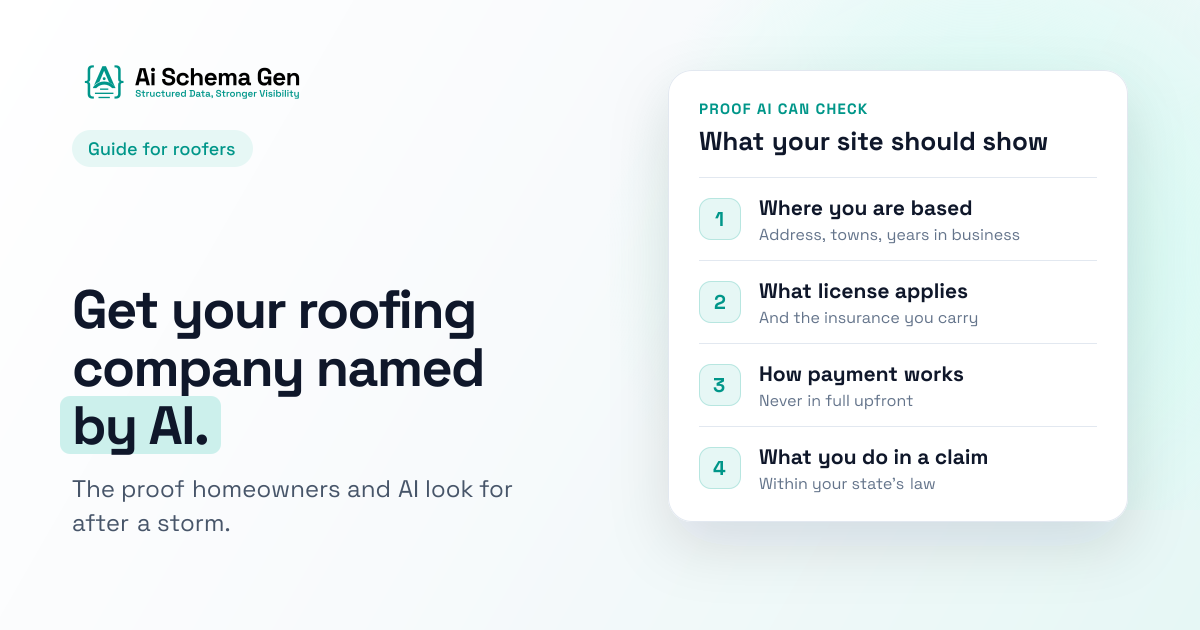
The day after a hailstorm, a homeowner looks up at their roof and has two worries. The first is the damage. The second is the stranger who will knock on the door that afternoon offering to fix it. Few trades come with as much official warning attached as roofing. The Federal Trade Commission, the Better Business Bureau and state insurance regulators all publish advice on spotting "storm chasers": crews that follow bad weather from town to town, take a deposit and are gone before the first leak.
More and more, that homeowner asks an AI assistant who to call. An answer built from public information has the same problem the homeowner does: telling a local roofer who will still be in business next year apart from a crew that arrived with the storm. The roofers who make that easy, with evidence an AI can read and check, are the ones it can safely name.
This guide to AI SEO for roofers is built around that test. It covers how often AI assistants name roofers today, the official warning signs homeowners are taught to look for, and what your website, listings and manufacturer profiles need to show so your business is clearly on the right side of every one of them.
What AI SEO for Roofers Means
AI SEO goes by several names: GEO (generative engine optimization), AEO (answer engine optimization), AI search optimization. For a roofing company the goal is the same under any of them. When a homeowner asks ChatGPT, Gemini, Perplexity or Google's AI Mode for a roofer, the assistant should be able to find your business, work out what you do and where you work, and describe you accurately.
You can't decide which roofers an AI names on a given day. That choice belongs to the AI provider, and the same question can produce a different list each time it is asked. What you can decide is what the AI finds when it looks: whether your website says plainly who you are, where you are based and how you work, and whether the outside records about you agree. That is the part this guide covers.
The general groundwork for any home-service business still applies, and our contractor guide covers it: the seven checks a homeowner runs before hiring, license and insurance details, service-area pages and reviews. This post is about what is particular to roofing.
How Often AI Names a Roofer Today
The best current data comes from 8ight.AI's October 2026 study of AI recommendations across 39 local trades, which our contractor guide describes in full. In short: the researchers asked AI assistants to name the best business of a given trade in a given city, in September 2026, and compared the names against businesses listed on Google Maps.
For roofing, the study covered 20 places and 149 roofing businesses from Google Maps. ChatGPT named at least one of those businesses in 50% of the places, and only 9.4% of the roofing businesses checked were named. Roofing sat around the middle of the 39 trades.
Two things follow. First, most roofers are not being named most of the time, so there is plenty of room to stand out. Second, the answers are not random: across all trades in the same study, ChatGPT leaned heavily on the Better Business Bureau and government licensing records, the kind of sources a careful homeowner checks. That matters for roofing in particular, because the checks homeowners are taught to run are unusually specific.
Hold these numbers loosely. Twenty places is a small sample for one trade, the researchers sell AI visibility services themselves, and a snapshot of September answers says nothing about why one roofer was picked over another.
The Storm-Chaser Test
Here is what official sources tell homeowners to watch for, and what each warning sign means for your website.
The FTC's consumer advice after the 2024 Midwest tornadoes put it bluntly: "Never pay in full upfront." The same alert said not to hire anyone who refuses to give you copies of their license and insurance, and a contract in writing. Consumer stories passing on FTC and BBB advice add more: be wary of contractors who are vague about where they are from or what their business is officially called, of the unsolicited "I was driving by and noticed your roof" pitch, and of pressure to sign on the spot.
| What homeowners are warned about | What a storm chaser looks like | What your site and listings should show |
|---|---|---|
| Arrived after the storm, from somewhere else | Out-of-town plates, no local address, a phone number from another state | A permanent local address, how long you have worked in the area, and past jobs in named local towns |
| Vague about the business name | A crew name that matches no record | The same business name everywhere, plus your legal name if you trade under a different one |
| Won't show a license or insurance | "We're fully covered," with nothing in writing | Exactly which license or registration applies where you work, and which insurance you carry |
| Wants payment upfront | Large cash deposit before materials arrive | Your payment schedule in writing: what is due when |
| Pushes you to sign today | "This price is only good if you sign now" | How long a quote stays valid, and an invitation to get other quotes |
| Promises to make the insurance claim go away | "We'll cover your deductible" | What you do and don't do in an insurance claim, within your state's law |
| Gone when the leak appears | No way to reach them a year later | Your workmanship warranty, in plain words, and how to make a warranty claim |
None of this is unusual for an established roofer. The problem is that most of it lives in the owner's head, on a paper contract or in a sales conversation, not on the website. An AI assistant, like a homeowner checking you out at 10 pm, can only go by what is published.
Prove You Are Local and Permanent
The single strongest signal against the storm-chaser label is a long, visible history in one place.
A real address, consistently. If you have an office or yard, show the full street address on your contact page and in your site's footer, and use exactly the same address on your Google Business Profile, BBB profile and manufacturer profiles. If you work from home and keep your address private on Google, still say which town you are based in.
How long you have been here. "Serving Tulsa since 2009" is a fact a homeowner and an AI can both use. Put your founding year on your About page and in your Business Profile.
Jobs in named places. A project page titled "Hail damage repair and new ridge vents in Owasso, after the April storm" ties your business to a specific town and event. A gallery of unlabeled roof photos ties it to nothing. You don't need to publish customers' street addresses; the town or neighborhood and the month are enough.
Local people. Name the owner and, if you are happy to, the crew leads or project managers. A roofing company with named local people behind it is much harder to mistake for a crew passing through.
Licensing: Say Exactly What Applies Where You Work
Roofing licensing varies more than most trades. Some states issue a specific state roofing license. Others have no statewide roofing license at all and leave it to cities or counties, or require only a business registration. Some cities require their own permit or registration on top.
That variation is exactly why a vague "Licensed and insured" line does so little. A homeowner, or an AI, can't check it against anything. Instead, write down exactly what applies:
- If your state licenses roofers: the license type, number and issuing body, in your footer and on your About page. Make sure the number and the name match the licensing body's record.
- If your state doesn't, but your city or county does: name the local license or registration and the authority that issued it.
- If no license is required where you work: say so honestly, and list what you do have instead, such as your business registration, insurance and manufacturer certifications.
The contractor guide linked above has more on matching your license record to your website, including the common problem of trading under a different name from the one on your license.
Payment, Contracts and Quotes in Writing
Three of the FTC's warning signs are about money and paperwork, so they are easy to answer on a website.
Publish your payment schedule. For example: "A deposit when you sign, the balance when the job is finished and you have walked the roof with us." If you finance jobs, say how. If you never ask for full payment upfront, say that too. It directly answers the FTC's advice.
Say how long quotes last. A line such as "Our written quotes are valid for 30 days" answers the high-pressure warning without you having to mention it.
Show what a contract covers. You don't need to publish your contract, but a short list of what every written agreement includes (materials, scope, start date, clean-up, warranty) shows a homeowner what to expect and gives an AI something concrete to describe.
Insurance Claims: What You Do, and What You Don't
Storm work and insurance claims go together, and this is where a roofer's website can either reassure or alarm. Several states have specific rules here, and following them openly is a strong trust signal.
Colorado's roofing law is a clear example. Under section 6-22-105 of the Colorado Revised Statutes, a roofing contractor paid from a homeowner's insurance claim "shall not advertise or promise to pay, waive, or rebate" any part of the insurance deductible. The same section says a roofer soliciting work in the state shall not claim to be or act as a public insurance adjuster, though a roofer with a signed contract may discuss the scope of repairs with the insurer on the owner's behalf. Texas's insurance regulator likewise says it is illegal there for a contractor to offer to waive, rebate or absorb a policyholder's deductible.
Rules differ by state, so check yours. But the honest version of an insurance page tends to look the same anywhere:
- What you do: inspect the roof, document storm damage with photos and a written report, give the homeowner a detailed estimate, and, where your state allows it, meet the insurance adjuster on site to explain the damage.
- What you don't do: pay or waive the deductible, promise a particular claim result, or negotiate the claim on the homeowner's behalf where your state's law reserves that for licensed public adjusters.
- What the homeowner should do: contact their insurer, read their policy, and keep copies of everything.
A roofer who writes this down looks like the opposite of a storm chaser, because "we'll take care of your deductible" is exactly the line the warnings are about. It also gives an AI answering "do roofers help with insurance claims?" an accurate, local example to describe.
Manufacturer Certification: The Outside Record
Roofing has something most trades don't: the big shingle manufacturers run certification programs and list certified contractors on their own websites. These listings are third-party records of your business, published by a large company, and they are worth getting right.
GAF, which describes itself as North America's largest roofing manufacturer, is a useful example. Its homeowner page invites people to enter a zip code, see a listing of local contractors certified by GAF, look at their profiles and read reviews. It says contractors certified by GAF must be insured and licensed in the state where their main place of business is located (if a license is required), and that GAF may also consider years of experience and customer reviews. It also says only about 2% of roofers in North America are invited to become GAF Master Elite Contractors, and that these contractors can offer some of its strongest warranties, including the Golden Pledge and Silver Pledge Limited Warranties, which add workmanship coverage. Owens Corning and CertainTeed run similar tiered programs, with their top warranties tied to their top tiers.
If you hold any of these certifications, three things help:
Name the certification exactly, with the year. "GAF Master Elite Contractor since 2018" or "CertainTeed SELECT ShingleMaster" is checkable. A row of manufacturer logos with no words is not.
Make your manufacturer profile match your website. The business name, phone number, website address and service area on your manufacturer profile should be identical to your own site and your Google profile. A profile with an old phone number or a previous business name is a third-party record that contradicts you.
Link to the profile from your site. A link from your About page to your manufacturer profile, and a link back from the profile to your site, connects the two records. You can also list the profile among your profiles elsewhere in your site's structured data; our guide to linking your profiles shows how.
If you don't hold a manufacturer certification, don't imply one. A homeowner can look it up in seconds, and so can anything that reads the directory.
Explain Your Warranties in Plain Words
Homeowners hear about two kinds of roofing warranty and often confuse them. Your site should separate them clearly.
The manufacturer's warranty covers defects in the materials. Its length and terms depend on the product and, for enhanced warranties, on the contractor's certification level and the products used.
Your workmanship warranty covers mistakes in the installation. This one comes from you, so state how long it lasts, what it covers, what it doesn't, and how a homeowner makes a claim.
A single warranty page with both, written plainly, answers one of the most common follow-up questions homeowners ask. It is also the most direct answer to the "gone when the leak appears" warning: a written promise from a business with a local address.
Your Storm Response Page
After a big storm, many homeowners are searching at once, and the questions are urgent. A dedicated storm page, kept up to date, is worth more to a roofer than almost any other page on the site.
What it should cover:
- Emergency help: whether you do emergency tarping or temporary repairs, and how fast you can usually come out.
- What happens first: a free inspection, or not; what the homeowner gets afterwards (photos, a written report).
- Insurance: a short version of the section above, linked to a fuller page.
- The areas you cover: the towns and counties you serve, so a homeowner in a neighboring town knows whether to call.
- How to spot a real local roofer: a short, fair list based on the official advice above. It helps homeowners, and it sets you apart without naming anyone.
Update the page after each major storm in your area, with the date: "Updated 12 May 2026, after the hailstorm in north Dallas County." A dated, current storm page shows a business that is present and responding, not one that arrived with the weather.
Structured Data for Roofers
Behind your visible pages, structured data can give AI systems a tidy summary of your business: name, legal name, business type, address, phone, opening hours, the areas you serve, who runs it, and links to your profiles elsewhere, including your manufacturer and BBB profiles. Schema.org has a specific type for roofers, RoofingContractor, which sits under HomeAndConstructionBusiness and LocalBusiness.
Structured data confirms what your pages say; it can't make up for what they don't. If your site never mentions where you are based or how long you have been there, there is nothing for it to confirm. Write the pages first.
Common Mistakes
"Licensed and insured" with nothing behind it. It is the most common line on roofing websites and the least useful. Name the license or registration, the authority and the insurance you carry.
A gallery with no places or dates. Unlabeled photos could be from anywhere. Add the town, the job type and the month.
Manufacturer logos instead of facts. A logo strip doesn't say what level of certification you hold or since when. Write it out, and make sure it matches the manufacturer's directory.
Promising to "handle" the deductible. In states like Colorado and Texas, offering to pay or waive a deductible is illegal, and it is exactly what storm-chaser warnings describe. Say what you do in a claim, not what you'll make disappear.
A storm page that hasn't changed in two years. An old date or a reference to a long-past storm suggests nobody is home. Update it after each major storm.
Different details on every profile. Your website, Google profile, BBB page and manufacturer profile should all carry the same name, phone, address and website. When they disagree, an AI has to guess which is right.
Judging your visibility from one ChatGPT answer. The same question can name different roofers each time. Our guide on how to check what ChatGPT says about your business explains how to test it properly.
How to Check and Fix It
Step 1: Find out if an AI can tell where you are based. Put your site through our free AI readiness checker. Among other things, it hands an AI only the text of your own website and asks where the business is located and which areas it serves. If either answer comes back empty, an AI reading your site can't tell you apart from a crew passing through, which is the storm-chaser problem in one line.
Step 2: Run the storm-chaser test on your own site. Go down the table above. For each warning sign, find the page on your site that answers it. Write the missing ones: payment schedule, insurance claim page, warranty page, storm page.
Step 3: Fill in your Business Identity. In the AI Schema Gen dashboard, choose Roofing Contractor as the business type, enter your legal name, founding date, address, the towns and counties you serve, and the owner's name, and add links to your Google, BBB and manufacturer profiles. Our guide to adding your service area and founders shows where those fields are. The structured data on your pages is built from these details.
Step 4: Line up the outside records. Check your Google Business Profile, BBB profile and every manufacturer directory listing. Same name, phone, address, website and service area on each. Our guide to local business AI search covers which listing each assistant tends to read.
Step 5: After the next storm, update and re-check. Refresh your storm page with the date and the areas affected, add the new jobs to your project pages, and run the readiness check again.
Frequently Asked Questions
Is your website ready for AI?
Check now. Free readiness score in under a minute, no signup, no card.