
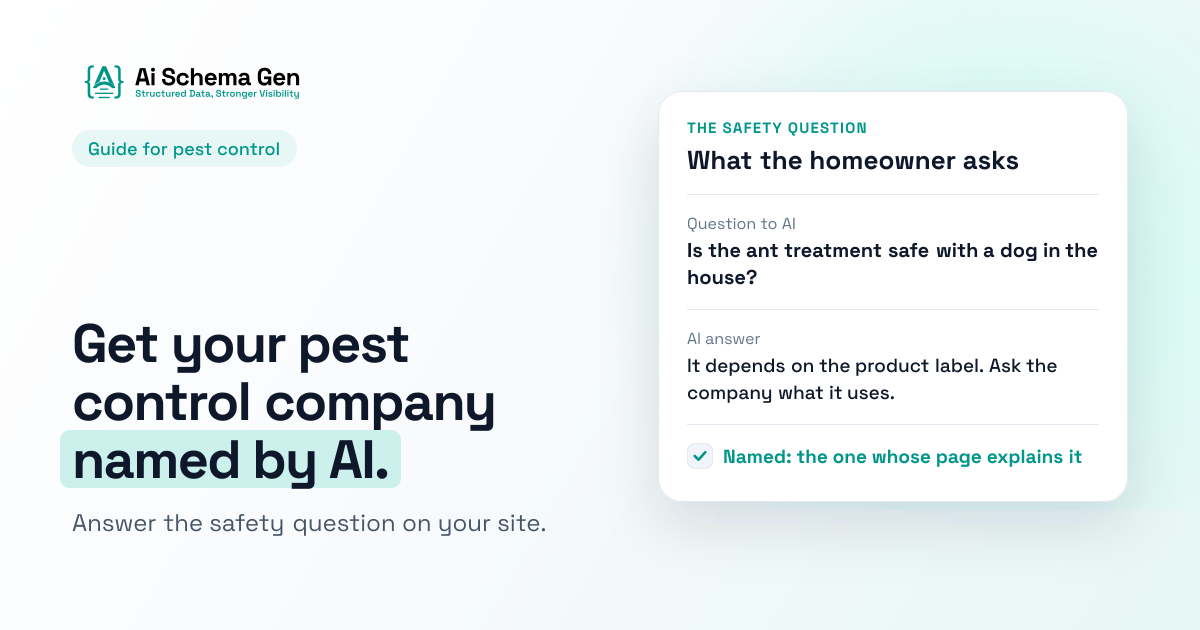
A homeowner finds small brown insects along the kitchen skirting board. They take a photo, show it to ChatGPT, and ask what it is and whether they need to call someone. The assistant makes its best guess, explains the usual signs, and then does what it nearly always does with pest problems: it says a licensed pest control company should confirm what it is and treat it. Then the homeowner asks the next questions. Is the treatment safe with a toddler and a dog in the house? Will they come back? Do I have to sign up for a year?
Those follow-up questions are where a pest control company gets named or passed over. They are not new questions. The US Environmental Protection Agency has told homeowners to ask them of any pest control company for years. What has changed is that people now ask an AI assistant first, and the assistant can only answer from what companies have actually written down. This guide is about writing those answers down, on your own website, in a way an assistant can find and repeat.
What AI SEO for Pest Control Means
AI SEO for pest control means making your company the one that ChatGPT, Google's AI answers, Perplexity and similar assistants mention when someone in your area asks about a pest problem, and making sure what they say about you is correct. People also call it AEO (answer engine optimization) or GEO (generative engine optimization). The names differ, the job is the same.
Ordinary search ranks pages and lets the person choose. An AI assistant reads a handful of sources, writes one answer, and usually names only a few businesses, sometimes none. Being in that answer depends on two things: whether the assistant can find a clear, checkable record of your business, and whether your site answers the specific question the person asked better than anyone else's does.
Most Pest Control Companies Aren't Named Yet
There is very little research on AI answers for this trade, and nearly all of what turns up is sales copy with no method behind it. One study does have a method. In September 2026, 8ight.AI asked ChatGPT who the best business was in each of 20-plus trades across dozens of US and Canadian places, then checked the answers against real businesses listed on Google Maps for those places.
For pest control, ChatGPT named 6.7% of businesses the researchers checked: 75 businesses across 17 places. In 29.4% of those places it named at least one local pest control company at all. That put pest control 17th of the 20 trades with enough places to compare. Read it with care: it is one study, it used ChatGPT's developer access with web search switched on rather than the app people use, the authors say an app user may see a different answer, and 8ight.AI sells AI visibility services. Seventeen places is a small sample. But the direction is clear enough. For most pest control companies, the honest starting point is that the assistant doesn't mention them.
The demand is not small. In a Harris Poll survey for the National Pest Management Association, carried out in early 2026 with 1,389 homeowners, 52% of homeowners in the US said they had used a licensed pest control professional in the past year. Plenty of those jobs will now start with a question to an assistant.
The Questions Homeowners Were Already Told to Ask
The EPA publishes a short fact sheet called Choosing a Pest Control Company. It gives homeowners six questions to put to any company before hiring it:
- Is the company licensed?
- Will it explain the treatment it plans to use?
- What is its track record?
- Is it insured?
- Does it guarantee its work?
- Does it belong to a professional association?
It then lists what a treatment plan should cover: which pests, how bad the problem is, the active ingredient in the pesticide, possible health effects, how it is applied, any non-chemical options, what the household should do to reduce exposure "(such as vacating the house, emptying the cupboards, and removing pets)", and how to keep the problem from coming back.
Read that list again as a set of prompts. "Is [company] licensed?" "What does [company] use for ants, and is it safe for cats?" "Does [company] guarantee termite treatment?" These are the exact questions people type into an assistant now, usually before they phone anyone. An assistant that can find your answers will repeat them. One that can't will either guess or answer with a competitor whose site was more open.
That is the organising idea of this guide. The rest of it works through the questions in the order homeowners tend to ask them: what is this pest, is the treatment safe, will it come back, what am I signing, and who are you. It ends with a route that skips the homeowner entirely: termite reports for home sales.
"What Is This Bug?" Comes First
Many pest jobs now start with a photo. The person asks an assistant to identify the insect or the droppings, and the assistant gives its best guess with a range of possibilities. It cannot see the wall cavity, the attic or how far the problem has spread, so for anything beyond a one-off insect it points to an inspection.
That hand-off is the opening for you, and it rewards pages written around the pest as the homeowner sees it, not around your service menu. A page called "General Pest Services" with a list of twelve pest names doesn't answer anything. A page about carpenter ants that covers the following does:
- What people usually notice first. Sawdust-like material near wood, large black ants indoors in spring, rustling in walls. In plain words, the way a homeowner would describe it.
- What it is often confused with. Carpenter ants and termites get mixed up all the time, and so do bed bugs and carpet beetles. Saying how you tell them apart shows the assistant, and the reader, that you know the difference.
- How you confirm it. What your inspection involves, how long it takes, and whether it costs anything.
- What treatment usually looks like for that pest in your area, and how many visits it normally takes.
- Where you do this work. The towns or counties you cover, written out in text.
You don't need a page for every insect in the region. Start with the pests that bring in most of your calls, and the ones where a wrong guess is expensive: termites, bed bugs, rodents, and anything that stings.
Is It Safe? Answer the Question People Actually Ask
Safety is the question homeowners ask most anxiously, and it's the one where vague answers hurt you most. Plenty of pest control sites say "safe for kids and pets" or "eco-friendly" in a banner and nothing else. An assistant asked "Is [company]'s treatment safe for my dog?" finds that banner, has nothing to back it up, and often falls back to general caution or to a company that explained itself properly.
The EPA's own position is that the product label decides how a pesticide may be used. Its label-reading guide puts it simply: "the label is the law." Every label carries precautions, including hazards to people and domestic animals, and how long people and pets should stay away depends on the product. The EPA fact sheet tells homeowners to ask to see the label or safety data sheet. A company that explains this, instead of promising blanket safety, gives the assistant something true and specific to pass on.
What a safety page should say:
- What you typically use for each common job. Name the kinds of product (baits, gels, dusts, sprays, traps, exclusion work) and where each goes. You don't need to list every brand, but saying "gel bait in cracks behind appliances, not sprayed on open surfaces" answers a real worry.
- What you'll ask the household to do. Leave for a set time, keep pets out of treated rooms until dry, cover fish tanks, empty cupboards. Say that the exact time comes from the product label and that the technician will tell them on the day.
- How you adapt for children, pregnancy, pets, allergies and older residents. The EPA says safety concerns like these "should be noted and reflected in the choice of pesticides." Say that you ask about them, and what you change when the answer is yes.
- Non-chemical options, and when they work on their own: sealing entry points, traps, heat for bed bugs, removing what attracts the pest.
- That customers can see the label. Offer it before the visit or leave a copy afterwards.
Some states also have notice rules a homeowner might ask about. Pennsylvania, for example, keeps a registry of people who are sensitive to pesticides, and pest control businesses must notify registered people before treating within 500 feet of their home, work or school. If your state has a rule like this, say on your site that you follow it. It's a small line, and a neighbour asking an assistant "do pest companies have to warn me before spraying next door?" may land on it.
Will It Come Back? Spell Out the Guarantee
The second worry is whether the money is wasted. The EPA fact sheet tells homeowners to be "skeptical about a company that does not guarantee its work," and also to find out what they must do to keep their part of the bargain. Its example is pointed: a termite guarantee can stop applying if the homeowner makes structural changes to the house without telling the company first.
Most pest control sites mention a guarantee in one line ("100% satisfaction guaranteed") and stop. When someone asks an assistant "what does [company]'s guarantee cover?", that line gives it nothing to work with. A guarantee page that answers the questions a careful buyer would ask is more useful to the buyer and gives the assistant something it can actually quote:
- Which pests and services it covers, and which it doesn't.
- What "come back" means. A free return visit between scheduled services? A re-treatment? A refund? For how long?
- What the customer has to do. Keep the plan active, allow access, fix a moisture problem you pointed out, tell you before building work or a new extension.
- For termites, whether the guarantee covers re-treatment only or repair of new damage as well, and whether it transfers when the house is sold. Buyers and their agents ask about this, and it comes up again in the home-sale section below.
The same applies to explaining why pests come back at all. The EPA describes integrated pest management (IPM) in four steps: set a level at which action is needed, watch for and correctly identify pests, prevent them, and then control them, starting with the least risky effective method. If that's how you work, a short page saying so in your own words explains why the first visit might be an inspection rather than a spray, why you'll talk about leaky pipes and gaps under doors, and why scheduled visits exist. An assistant asked "why does my pest guy keep coming back every three months?" has a plain answer to give.
What Am I Signing? Put the Contract Terms on the Page
Pest control is often sold as a plan: quarterly general pest visits, an annual termite plan, monthly mosquito treatments in season. Homeowners now ask assistants about the plan before they agree to it. "Does [company] lock you into a contract?" "Can I cancel [company] pest control anytime?" "What does a quarterly pest plan include?"
These are also the questions that turn into complaints and bad reviews when the answer was unclear at the start, and complaints and reviews are sources an assistant reads too. Writing the terms down clearly helps on both sides.
A plan page should cover:
- What each visit includes. Inside and outside, or outside only? Which pests are covered? Are call-backs between visits free?
- How often you come, and how the schedule shifts with the seasons in your area.
- How long the plan runs and whether it renews by itself. Say so plainly if it does.
- How to cancel, with the notice needed and any fee. If there is no fee, say that.
- What happens if the customer cancels mid-term, including what it means for any guarantee.
There is currently no federal rule forcing easy cancellation: the FTC's "click to cancel" rule was struck down by a federal appeals court in July 2025, before it took effect, and the FTC has not replaced it. Several states have their own automatic-renewal laws, though, and they generally require the renewal terms to be clear before the customer agrees. Check your own state's rules. Either way, a plan page that answers the cancellation question honestly is the one an assistant can use to tell a nervous buyer that you're straightforward to deal with.
Who Are You? Licences, Insurance and the Names Behind Them
The first question on the EPA's list is whether the company is licensed, and AI assistants check this more than most businesses realise. In the 8ight.AI study, licensing boards and government registries were among the sources ChatGPT read most often across trades. Our contractors guide covers how those registers are used. For pest control, the detail that matters is that most states license more than one thing.
Two examples show the pattern:
- California registers the company and licenses the people, and both are split by type of work. Branch 1 is fumigation, Branch 2 is general household pests, and Branch 3 is termites and other wood-destroying organisms. An individual can be an applicator, a field representative or an operator, and only an operator can own a company or act as its qualifying manager.
- Florida licenses each business location separately, and each location needs a certified operator in charge for each category of work done there, such as general household pest and rodent control, termites, lawn and ornamental, or fumigation.
So a single pest control business can have a company registration, location licences and several people's licences, each for particular kinds of work. A homeowner asking "is [company] licensed for termite work in [state]?" is asking about a specific category, not just whether a licence exists.
What to show on your site:
- Every licence the business holds, with the number written exactly as it appears on the state register, and what each one covers. If you operate from more than one location, list each one.
- The licensed people, at least the qualifying manager or certified operator, with their licence type. If technicians hold their own applicator licences, saying so is a strong trust signal.
- The name on the licence. Pest control firms often advertise under a brand while the state register lists the legal company name. Put that legal name in your footer or on your About page, so a homeowner or an assistant checking the register finds a match. Our fix guide on consistent business details shows how to check this across your listings.
- Insurance. The EPA notes that most states don't require pest control companies to carry insurance, and tells homeowners to think twice about a company that doesn't. If you're insured, say what kind of cover you carry.
- Association membership, if any, as plain text with a link to the association's member listing where it has one.
The Other Route: Termite Reports for Home Sales
Not every pest control customer is a homeowner with a problem. A steady part of the work, especially in termite-prone areas, comes from home sales: a buyer, a seller, a real estate agent or a lender needs a wood-destroying insect inspection report, and needs it quickly.
The standard form for this in most of the US is the NPMA-33. The National Pest Management Association's guidance says the form must be used for any HUD or VA guaranteed property transaction and is typically used for conventional sales as well. Some states have their own required form instead. The same guidance points out several things that buyers and agents ask about and often misunderstand:
- The report covers termites, carpenter ants, carpenter bees and wood-boring beetles. It is not a structural damage report.
- It reports what was visible on the day of the inspection only, and it is not a warranty.
- It asks for both the company's pest control business licence number and the inspector's own certification or licence number.
- If the house is already under a termite service agreement, the report should say so, with the expiry date.
Agents and buyers put these questions to assistants all the time: "who does termite inspections for home sales in [city]," "how fast can I get a WDI report," "does a termite bond transfer to the buyer." Very few pest control companies have a page aimed at them. A page for real estate inspections should cover:
- Which report you provide: the NPMA-33, or your state's own form, and that it's accepted for VA and FHA loans where those apply.
- How fast you turn it around, and whether you can schedule around a closing date.
- What the inspection covers and doesn't, in plain words, including the "date of inspection only" point. Agents will appreciate it, and so will a buyer asking an assistant what the report means.
- What happens if you find activity: whether you treat, how quickly, and whether the treatment comes with a service agreement the buyer can take over.
- Who to contact, if agents have a separate booking line or email.
This is one of the few corners of pest control where the person asking the assistant is often a professional with a deadline, and where very little competition has written a clear answer.
Structured Data for Pest Control Companies
Structured data (schema markup) is code on your pages that states facts about your business in a fixed format machines can read without guessing. It doesn't replace any of the writing above. It labels it.
There is no pest control type in schema.org's vocabulary. The closest fits are LocalBusiness, or HomeAndConstructionBusiness, the LocalBusiness subtype that covers trades like electricians and plumbers. Our guide on Organization vs LocalBusiness explains how to choose. On top of that type, a few properties carry the most weight for this trade:
additionalType, which schema.org describes as a way to add a more specific type from another vocabulary. Use it to say "pest control" more precisely than the generic type can.areaServed, listing the towns, counties or regions you cover.hasOfferCatalog, listing your services and plans: general pest plans, termite treatment, WDI inspections, rodent exclusion and so on, each as its own item.hasCredential, for licences. Put the company's licence on the business, and each licensed person's licence on that person, matching the split the state itself uses.
Get the markup right, but keep it in proportion. A clean record helps an assistant connect your site to the state register and your listings. It won't make up for a site that never answers the safety, guarantee or contract questions.
Common Mistakes
"Safe for kids and pets" with nothing behind it. A blanket safety claim is the one sentence an assistant can't check and a careful parent won't trust. Explain what you use, where, what the family needs to do and how you adjust for their situation.
A guarantee in one line. "100% guaranteed" answers nothing. Say what it covers, what the customer has to do, and how long it lasts.
Contract terms only in the paperwork. If the only place a homeowner can learn about auto-renewal is the agreement itself, the assistant can't tell them, and some of them will find out the hard way and write about it.
A licence number with no category. "Licensed and insured, #12345" doesn't tell anyone whether that number covers termites, fumigation or only general pests. In states that split licences by type of work, the category is the whole point of the question. Say which kinds of work each number covers, and whose number it is.
A services list instead of pest pages. Twelve pest names in a grid don't answer "what are these tiny ants in my bathroom and how do you treat them." Pages for the pests you deal with most do.
Nothing for real estate. Termite inspections for home sales are steady, time-sensitive work, and agents look for the company that makes them easy. A site that never mentions WDI reports is invisible to that whole route.
Seasonal pages that never change. A mosquito page that still talks about "this summer's" programme in February, or a termite swarm page with last year's dates, looks neglected to a reader and gives an assistant out-of-date facts. Put a "last updated" date on seasonal pages and update them each season.
How to Check and Fix It
- Ask the questions your customers ask. "Best pest control in [city]" is mostly decided by directories and reviews. Ask the follow-ups instead: "is [your company] licensed for termite work," "is [your company]'s treatment safe for cats," "can I cancel [your company] anytime," "who does termite inspections for home sales in [city]." Write down each answer and the pages it cites. Ask each one a few times on different days, because the same question rarely gets the same answer twice; our guide to checking ChatGPT's answers sets out a fair way to run the test.
- Go through the EPA's six questions and find where your site answers each one. Anything you can't point to is a gap.
- Write the safety page, the guarantee page and the plan terms first. They answer the questions homeowners worry about most and the ones competitors usually skip.
- Build pages for your top three or four pests, written around what the homeowner sees, how you confirm it and what treatment looks like.
- Add a real estate inspection page if you do WDI reports, aimed at agents and buyers.
- Match every licence on the site to the state register, letter for letter, for the business, each location and the licensed people.
- See what an assistant can read. Once the new pages are up, run your site through our free AI readiness checker. It reports whether AI crawlers can get to your safety, guarantee and pest pages at all, whether your business and its details come through clearly, and which gaps to close first.
Frequently Asked Questions
Is your website ready for AI?
Check now. Free readiness score in under a minute, no signup, no card.