
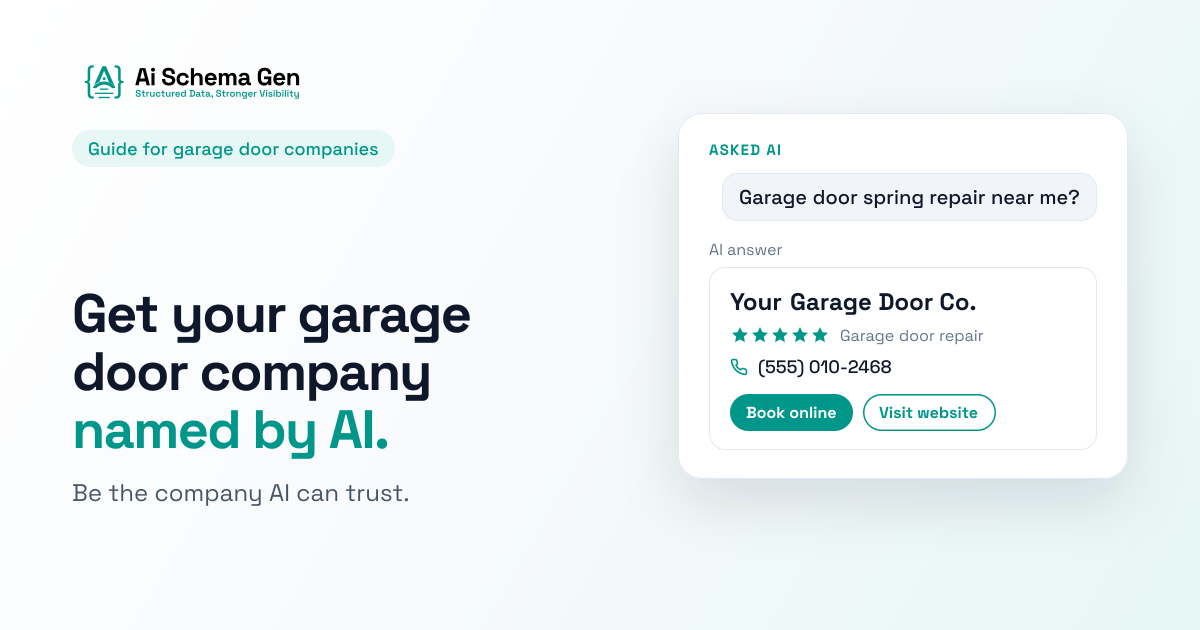
It's 7:40 on a Saturday morning in Columbus. A homeowner heard a bang from the garage last night, and now the opener hums but the door won't lift. The car is inside. They ask ChatGPT what happened, and the answer is probably a broken spring. They ask whether they can fix it themselves, and the answer is a firm no. Then they ask the question that decides who gets the job: "How much should a garage door spring replacement cost, and how do I avoid getting ripped off?"
That last half of the question is the one that matters for a garage door company. Garage door repair has a reputation problem, and homeowners know it. They are not only looking for someone who can come today. They are looking for someone they can trust not to turn a spring job into a new door. When they ask an AI assistant, the companies it can recommend with confidence are the ones whose own websites answer the trust question plainly.
This guide is about how to be one of those companies.
What AI SEO for Garage Door Companies Means
Garage door companies sell two things at once: a repair, and the confidence that the repair is fair. AI SEO for this trade means giving assistants like ChatGPT, Gemini and Perplexity enough evidence of both that they can name you when a nearby homeowner asks for help, and describe you as a company that can be trusted.
The evidence lives mostly on your own pages: how you price, how you decide between repair and replacement, what you tell people about safety, and who stands behind the business. The rest of this guide takes those in turn, then covers openers and new doors, which bring their own questions.
How Often Garage Door Companies Get Named
The clearest public data comes from 8ight.AI, which in September 2026 asked ChatGPT "Who is the best {trade} in {city}? Name specific businesses" for dozens of trades in US and Greater Toronto Area places, then checked the answers against real businesses listed on Google Maps.
For garage door repair, ChatGPT named 12.9% of businesses checked, 132 businesses across 19 places. In 57.9% of those places it named at least one local garage door company. So in a little over half of the places tested, a homeowner asking that question got at least one local company back; most individual companies were not on the list.
That's roughly seven businesses checked per place, one question, one month, from a company that sells AI visibility work, so it won't tell you what happens in your town. What it does show is a category where an assistant is willing to name someone more often than not, and usually picks from a very short list.
The Trade With a Trust Problem
Most trades have the occasional bad operator. Garage door repair has a well-known pattern, and the people who protect consumers have named it. The Better Business Bureau's scam alert on garage door repair warns that "Many scams advertise a low fee for the service call, only to demand more money for additional 'repairs.'" It also notes that scammers often "do not have a legitimate physical showroom or will use a fake address," and advises homeowners to get several estimates and a written quote before any work starts.
Google treats the trade with similar caution. For its Local Services ads, Google says "The garage door category is considered an urgent category" because homeowners have "time-sensitive, urgent needs," and garage door companies go through extra screening, including background checks and Google's Advanced Verification process. Locksmiths get the same treatment, for the same reason.
You can see the effect in what homeowners ask AI. Alongside "how much does a spring replacement cost?" come questions like "is $900 for garage door springs a scam?", "do I really need a new door?", and "how do I know a garage door company is legit?" A website that answers those questions directly gives an assistant something it can repeat. It also sets you apart from the operators the BBB is warning about, in the place homeowners now check first.
Explain Your Prices Like a Company With Nothing to Hide
You don't have to publish a price list. You do have to make your pricing understandable, because that is exactly what an anxious homeowner is asking an assistant to help with.
Start with the parts of a repair visit that cause the most confusion:
- The service call or trip fee. Do you charge one? How much, roughly? Does it count towards the repair if the homeowner goes ahead? Is there a different charge for evenings, weekends or holidays?
- What a spring replacement includes. Many doors have two torsion springs. Say whether you replace both when one breaks and why, whether the price includes new cables, rollers or a safety check, and what's optional.
- Spring quality. Springs come in different grades, often sold as standard or longer-life ("high-cycle"). Explain the choice in plain words and roughly how the price differs. Be honest that how long a spring lasts depends on the door and how it's used; the door makers' association DASMA notes in its spring guidance that "Spring cycle life may not necessarily coincide with door cycle life," and that fitting a spring that doesn't match the door's weight shortens its life and can make the door unsafe to open by hand.
- Parts you might recommend, and when. Rollers, cables, hinges, bearings. Say what you check, and that you'll show the homeowner the worn part before replacing it.
- Card fees and taxes. If the price changes at payment, say so on the page.
- The written quote. Say that you give a written price before starting work, and that the homeowner can say no and pay only the service call (or nothing, if that's your policy).
If you're comfortable with numbers, add ranges for the jobs you do most: one broken spring, both springs, a cable off its drum, an opener replacement. Say when you last updated them, and update them whenever your own prices change. A homeowner standing in a garage with a technician's quote in hand wants a figure to compare it with, and a local company's own published range is about the most credible figure there is.
There's a quieter benefit, too. Honest operators lose jobs to the "$29 service call" because their real price looks high next to a bait price. A page that explains what the full job costs, and why, lets the homeowner see that the bait price was never the real comparison.
Repair or Replace? Answer It Honestly
"The whole door needs replacing" is the line homeowners most fear hearing. It's the expensive version of the problem the BBB describes: more work than the door actually needs.
Garage doors make this easier to explain than most trades, because the moving parts are separate from the door itself. Springs, cables, rollers, hinges, sensors and the opener can almost always be replaced on their own. A door off its track can usually be put back. What tends to end a door's life is the door: panels too damaged to fix on a model whose panels are no longer made, rust or rot through the frame, or an old single-panel door that can't be made safe.
Write that down in your own words, with the jobs you actually see. Then add one sentence that does more for trust than anything else on the page: "If your door can be repaired, we'll tell you, even if you ask about a new one." An assistant asked "can my garage door be repaired?" can only pass on a company's stance if the company has stated it.
Safety Questions Homeowners Ask First
Garage doors are heavy, and the springs that balance them store a lot of force. That's why the first questions homeowners ask an assistant are often about safety: can I open it by hand with a broken spring? Can I replace the spring myself? Why does my door go down and then come back up?
Assistants usually give the cautious answer, and so should you, but your page can add what a homeowner really needs in the moment:
- What not to do with a broken spring or snapped cable (don't keep pressing the button; be careful pulling the emergency release while the door is open).
- How to get the car out safely, or why it may be better to wait for a technician.
- Why spring and cable work is for trained technicians, in plain words, without scare tactics.
- What the safety sensors do. Openers have had to protect against trapping people under federal law for decades: on June 19, 1991, the Consumer Product Safety Commission "issued a final rule codifying the provisions of the entrapment protection requirements of UL 325," according to the Federal Register. Explain how to check that the sensors and the auto-reverse work, and when an old opener is worth replacing for safety.
These pages often get read at the worst moment of the homeowner's week. A calm, specific, local page is more useful to them than an advert, and it's the kind of page an assistant can cite.
Openers, Smart Features and Brands
Opener questions are easier to plan for than repairs, and homeowners often arrive with a brand in mind. They ask things like "which garage door opener is quietest?", "does my opener work with my phone?" or "belt or chain drive for a garage under a bedroom?"
Write a page that names, in text:
- The openers you stock and recommend, by brand and model, and your view on fitting a unit the homeowner has already bought online.
- Drive types (belt, chain, wall-mounted) and when you recommend each.
- Smart features and apps the openers support, and what you set up on installation.
- Battery backup, for areas with power cuts.
- Which brands you repair, including older ones.
- Warranty: the maker's warranty on the opener, and your own on the installation.
Opener questions are often really compatibility questions ("will a new opener work with my old door?", "can I keep my keypad?"), so a short note on what you check before swapping an opener is as useful as the list itself.
New Doors: The Planned Purchase
New doors are a different conversation: weeks of looking, not an emergency call. Homeowners ask assistants about styles (carriage house, modern flush, full-view glass), materials (steel, wood, aluminium, composite), insulation for an attached or heated garage, and cost.
If you sell and install doors, give that work its own pages:
- The door lines you carry, by name, with what each is good for.
- Insulation, explained plainly, and when it's worth paying for.
- What a typical installation day looks like, including removing the old door and disposal.
- Rough price bands for common sizes and types, with a date.
- Local requirements, if your area has them, such as wind-rated doors in hurricane-prone areas or HOA approval.
A showroom page with photos and "call for a quote" won't match a question like "insulated steel garage door for a cold garage near [town]." A page that uses those words will.
Pass the Checks the BBB Gives Homeowners
The BBB's alert reads like a checklist of what a fake listing can't show: a real physical location, a name that matches across ads and records, proof of insurance and licensing, a written estimate. A genuine company can show all of them, and its website is the obvious place to do it.
Go through the alert's list and answer each point on your site, in the open: the address of your shop or showroom (or, if you run from home, the town and how to reach a real person), the company's registered name next to the name on your vans, your insurance, any licence your state or city requires for garage door work, and a line saying every job gets a written price first. Photos of your own trucks and technicians, with names, do more here than stock images ever will.
Then make the listings agree with it. The fake-listing problem means your company may already appear under someone else's number in a directory you've never heard of. Our fix guide on keeping business details consistent walks through finding and correcting them, and our contractors guide covers the wider set of checks homeowners make before hiring any trade.
Structured Data for Garage Door Companies
For a trade with a fake-listing problem, structured data (the business facts a site states in its code, in schema.org's vocabulary) is mainly an identity tool. There's no garage door type, so HomeAndConstructionBusiness with a clear description is the normal choice. What matters more is that the identity it states is the real one: the registered name, the actual address or base town, the phone number that reaches your office, and links to the BBB profile and Google listing that are genuinely yours. If a lead-generation listing uses your name with a different number, the links in your own code are one more signal of which record is the real one.
List the towns you cover in areaServed, and state hours you actually keep. A separate line for emergency availability is fine if you really offer it.
Our structured data guide explains how to choose between the main business types if you're unsure. Whatever you put in the code has to match what the page says.
Common Mistakes
"$29 service call" headlines. Even if it's genuine, a tiny headline price with nothing about what follows looks exactly like the pattern the BBB warns about. Say what the fee covers and what usually comes next.
No word on what a spring job includes. Homeowners compare quotes line by line. If yours doesn't explain both springs, cables or the safety check, a cheaper quote that leaves them out looks like the better deal.
A spring price with no spring details. "Springs from $X" without saying one spring or two, which grade, or whether the service call is extra, reads like the bait the BBB describes, even when it isn't.
Every page selling new doors. If your repair pages push replacement, they feed exactly the fear homeowners bring to the conversation.
Different names on different listings. Lead-generation directories sometimes list a company under a slightly different name or number. Find them and get them corrected or removed.
How to Check and Fix It
- Play the worried homeowner. Take a real quote you've given recently, then ask an assistant as a homeowner would: "I was quoted [your price] to replace both garage door springs in [town]. Is that fair?" Then "how do I know if a garage door company in [town] is legit?" See whose prices and advice the answers are built on, and whether your company appears as an example of a fair one. Our guide to checking ChatGPT's answers covers repeating it so one answer doesn't mislead you.
- Write your pricing page: service call fee, what a spring job includes, spring grades, parts you might recommend, written quotes, and dated typical prices if you're comfortable.
- Write your repair-or-replace page with the honest rules you already use.
- Write your safety page for broken springs and cables, and how to test the opener's safety features.
- Name your brands for openers and doors, in text.
- Check your listings for wrong names and numbers, especially lead-generation directories.
- Run the free AI readiness checker. For a garage door company the identity part of the report matters most: whether an AI reading your site can tell who runs the business, where it's based and how to reach it, the same things a homeowner checks against a fake listing.
Frequently Asked Questions
Is your website ready for AI?
Check now. Free readiness score in under a minute, no signup, no card.