
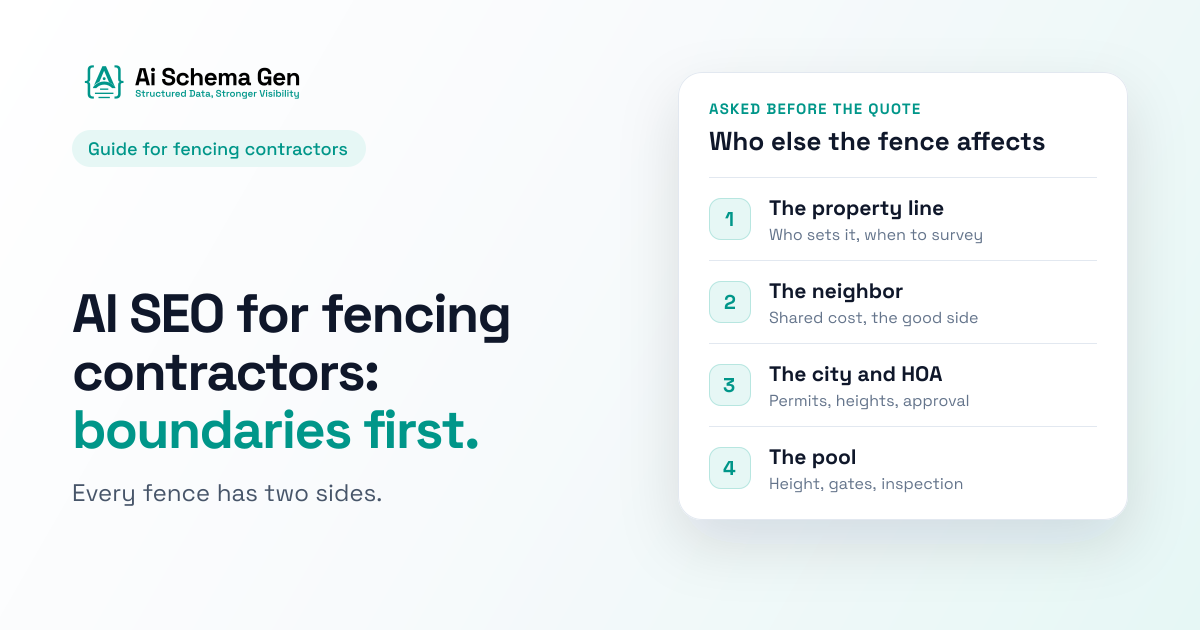
A family in Tampa has just had a pool put in, and the old wooden fence along the back of the yard is leaning toward the neighbor's lawn. Before calling anyone, one of them asks ChatGPT three questions in a row. "Does a pool fence have to be a certain height in Florida?" "The fence between us and our neighbor is falling down. Who has to pay for it?" "Do I need a survey before I replace a fence?"
Not one of those questions is really about fencing materials. They're about the neighbor, the city, the property line and the safety of small children. A fence is a building job, but it's also a boundary, and almost every question a homeowner asks first is about the boundary.
That's the gap a fencing company's website can fill, and the subject of this guide.
What AI SEO for Fencing Contractors Means
AI SEO for a fencing contractor is the work of making your company easy for assistants like ChatGPT, Gemini and Perplexity to understand and recommend, by publishing clear answers to the questions homeowners ask before they hire anyone.
For fencing, most of those questions involve people and rules beyond the customer: where the line is, what the city allows, what the homeowners' association (HOA) will approve, what a pool needs, and who pays when a fence is shared. A contractor who explains how they handle each of those, in their own area, gives an assistant a reason to send the homeowner their way.
How Often Fencing Companies Get Named
Fencing does better than most trades in the one public study that breaks results out by trade. In September 2026, 8ight.AI asked ChatGPT for the best businesses in dozens of trades and towns, and compared the answers with the companies listed on Google Maps in each place.
Fencing contractors were named more often than most. ChatGPT named 16.7% of fencing contractors checked (54 businesses in 12 places), and named at least one local fence company in 41.7% of places. Only painters and towing companies had a higher share of businesses named, and appliance repair matched it.
Treat it as a rough signal: 54 businesses is not many, each town got one question, and 8ight itself warns that differences between trades show "a direction, not a ranking." Still, it suggests something useful: assistants are fairly willing to name fence companies. The open question is which ones, and that depends on what each company has made easy to find.
A Fence Is a Boundary Before It's a Building Job
Most home projects only involve the person paying. A new kitchen affects the homeowner. A fence usually affects at least one neighbor, often the city, sometimes an HOA, and, around a pool, anyone with small children nearby.
So the questions homeowners ask are full of other people:
- "How close to the property line can I build a fence?"
- "Does my neighbor have to pay half?"
- "Which side of the fence faces the neighbor?"
- "Do I need a permit for a 6-foot fence?"
- "What fence will my HOA approve?"
- "Can I put a fence on a corner lot?"
- "What does a pool fence need to pass inspection?"
A fencing contractor answers these questions every week, on the phone and in driveways. Almost none of it is written down on fencing websites, which mostly show photos, list materials and ask for a quote request. The rest of this guide is about putting what you already know where an assistant can find it.
The Property Line Question
The most common fear in fencing is building on the wrong side of the line. Homeowners ask assistants whether they need a survey, how to find their property pins, and what happens if the fence ends up on the neighbor's land.
Your site should say plainly how you handle it:
- Who decides where the fence goes. Most fencing companies build where the homeowner shows them and ask the homeowner to confirm the line. Say that clearly, so nobody assumes you've checked the legal boundary when you haven't.
- When you recommend a survey. For example, when the line is disputed, when old fences don't agree with each other, when there are no visible markers, or when the fence runs along a shared driveway.
- What you do if you find a marker. Whether you'll locate pins the homeowner points out, and what happens if they're missing.
- How far inside the line you build, if that's your practice or your area's rule, and why some homeowners choose to set the fence back a little.
- Utility marking. Every post hole is a hole in the ground. Say that you arrange for underground lines to be marked through the free 811 service before you dig.
None of that is legal advice, and you can say so. It's simply a clear description of your process, which is what the homeowner needs before they can trust you with their boundary.
Neighbors and Shared Fences
"Who pays for the fence between us?" is one of the most common fencing questions people ask, and the answer depends on where they live. Some states have laws on it. California is a well-known example. Its Civil Code section 841 says adjoining landowners are "presumed to share an equal benefit from any fence dividing their properties" and, unless they've agreed otherwise in writing, are "presumed to be equally responsible for the reasonable costs of construction, maintenance, or necessary replacement of the fence."
The same California law also sets out a process. A landowner who plans to spend money on a shared fence must give "30 days' prior written notice to each affected adjoining landowner," and the notice has to describe the problem, the proposed solution, the estimated costs, the proposed cost sharing, and the timeline.
Other states handle this differently, and many leave it to neighbors to agree. You don't need to explain the law in every state. But you can help with the part homeowners struggle with, which is the conversation with the neighbor:
- State whether you'll quote for a shared fence, and whether you can split the invoice between two households.
- Offer a written quote that's easy to share, with a drawing, the materials, and the price, so one neighbor can show it to the other. If your state has a notice process like California's, a clear quote covers much of what the notice needs to say.
- Explain the "good side" question. Whether the finished side faces in or out, what your area's rules or HOAs typically require, and whether you offer styles that look the same from both sides.
- Say what happens on the day. Access to the neighbor's yard, removing the old fence, and what you need from both households.
If you work in a state with a law like California's, a short page explaining it in plain words (with a link to the law, and a note that you're not lawyers) will answer one of the most-asked questions in your trade better than most sites in your area.
City Rules and HOA Approval
Fences are one of the most regulated small projects a homeowner can take on. Cities set rules on height, on where fences can go, on corner lots where drivers need to see around them, and on materials. Many neighborhoods add HOA rules on top, covering style, color and height.
Homeowners ask assistants about these all the time, and assistants usually answer with "check with your local authority." A local fencing company can do much better, because you deal with the same few city and county offices every week. Write a page for each place you work most, or one page covering several, that answers:
- Do you need a permit, and for which kinds of fence? Who applies, you or the homeowner? How long does it usually take?
- What height limits apply, in front yards and back yards, as you understand them. Link to the city's own page so readers can check.
- Corner lots and driveways: what you've seen the city require, and how you design around it.
- HOA approval: whether you'll prepare the drawings, material samples and specifications an HOA asks for, and how long approval typically takes in neighborhoods you've worked in.
Keep these pages dated and check them yearly, since rules change. A page that says "updated March 2026" is far more useful to a homeowner, and to an assistant looking for a current local answer, than one that has quietly gone out of date.
Pool Fences Are a Safety Job
A pool fence isn't a decoration or a privacy screen. It's a safety barrier for small children, and homeowners know that's what they're asking about when they ask an assistant what a pool fence needs.
The US Consumer Product Safety Commission's Pool Safely campaign gives a short barrier checklist for families: "Install a 4-foot fence around the entire perimeter of the pool or spa," and "Use self-closing and self-latching gates that open out from the pool." It also advises owners to "ask your local authorities if there are additional requirements," because state and local codes are often stricter, and many places require an inspection before a pool can be used.
That makes pool fencing one of the clearest chances in the trade to be the local expert. A pool fence page could cover:
- The rules where you work, with the minimum height, gate requirements, and gaps under and between parts of the fence, as your local code states them.
- The hardware you fit: self-closing hinges, latches out of a child's reach, gates that swing away from the pool, and how you set and test them.
- Whether you coordinate with the pool builder and the inspector, and what happens if a fence fails inspection.
- Removable mesh pool fencing, if you offer it, and when it's allowed.
- Upkeep: checking that gates still close and latch on their own, and how often.
Write it carefully and plainly. A homeowner with a toddler and a new pool wants confidence that the company they hire understands what the fence is for.
Materials for Your Area, Not Every Area
Material questions are where most fencing websites put all their effort, with a page per material that could have been written for any town in the country. A more useful version says what you recommend for your area and why.
- Wood: which kinds you use, how long they last in your climate, and what upkeep they need.
- Vinyl: how it handles your summers and winters, and what colors you can supply.
- Aluminum and steel: for pools, front yards and slopes.
- Chain link: with or without privacy slats, and for which jobs.
- Composite and other options, if you install them.
Then answer the questions that come after the material choice: how you set posts and how deep, how you build gates so they don't sag, how you handle slopes (stepped or following the ground), what happens with tree roots, and how long a typical job takes from signing to finished fence. Homeowners often ask an assistant "why does my fence gate sag?" or "how long does it take to install a fence?", and a local contractor's own answer is exactly what an assistant can use.
Project Pages Built Around the Situation
Fence photos look alike, so describe each job by the situation it solved, not just the material. A homeowner's question usually starts with their situation, too.
"Six-foot cedar privacy fence on a sloped corner lot in Brandon, stepped to follow the grade, kept back from the sidewalk corner to meet the city's sight line rule, with a double drive gate for a boat trailer" is the kind of description that matches real questions. "Beautiful cedar fence!" doesn't match any.
That's an illustration of the style; write yours from your own jobs. Useful situations to describe include shared fences built for two households, pool barriers that passed inspection, HOA-approved designs, fences on slopes, fences for dogs that dig or jump, and replacements after storms.
Structured Data for Fencing Contractors
Search engines and AI tools also read a layer of labeled facts that sits in a page's code, called structured data, written in the schema.org vocabulary. Fence builders pick from the building-trades family there, most often HomeAndConstructionBusiness, and let the services list do the work of saying "fences."
What's worth getting right:
- Your real business identity: registered name, base location, phone, and links to the profiles that are genuinely yours.
areaServed: the cities and counties you work in, the same list as your permit and HOA pages.- Your services, by name: privacy fences, pool fences, gates, fence repair, commercial fencing.
Our post on Organization vs LocalBusiness covers how to choose the main type. If your state licenses fencing work, list the license on your site too; our fix guide on showing your legal business details explains why those facts matter to an AI.
Common Mistakes
A material catalog with no local facts. Pages about vinyl and wood that could be on any site in the country give an assistant nothing to connect you to your area.
Nothing about the property line. It's the first worry for many homeowners. Silence makes them wonder whether you've thought about it.
Permit and HOA questions answered only on the phone. If you already know your city's rules, writing them down is the easiest win in the trade.
A pool fence page that just says "pool fencing available." For a safety job, homeowners want to know that you understand the rules. Show them.
Ignoring the neighbor. Shared fences are a large part of the work. A sentence about split invoices and shareable quotes could win you jobs your competitors' sites never mention.
How to Check and Fix It
- Ask the boundary questions. Try "who pays for a shared fence in [state]?", "do I need a permit for a fence in [town]?" and "best pool fence company in [town]". Notice whether local fence companies appear in the answers at all, or only general advice. A few repeats of each question will show you whether the pattern holds.
- Write your property line page: who sets the location, when you recommend a survey, 811 marking.
- Write your neighbors page: shared fences, split invoices, shareable quotes, the good side, and your state's rules if it has them.
- Write a permits and HOA page for the places you work most, with dates.
- Write a pool fence page with your local rules and the hardware you use.
- Rewrite material pages for your climate, and add gates, posts and slopes.
- Describe projects by situation.
- See what's machine-readable. Fence sites often lean on galleries and quote widgets, and AI tools can miss what's inside them. Our AI readiness checker is free and shows whether your pages and business details are coming through.
If you also do outdoor projects like patios or landscape work, our guide for landscapers covers how to describe that kind of work, and our contractors guide covers the licensing and insurance checks homeowners make for any trade.
Frequently Asked Questions
Is your website ready for AI?
Check now. Free readiness score in under a minute, no signup, no card.