
A renter in Sacramento has a lease ending on the 30th. Movers are booked for the 28th, the landlord has already mentioned "professional cleaning," and the deposit is two months' rent. So they open ChatGPT and type: "Who does move-out cleaning in Sacramento that will actually get my deposit back? I have a cat and I won't be there to let them in."
Look at what that question contains. A type of clean (move-out), a goal (the deposit), a complication (pet hair), and a trust problem (someone working in an empty home with a key). The assistant can only name a local company if it can find one whose website speaks to those things. Most cleaning websites don't. They say "reliable, professional, affordable cleaning you can trust," and stop there.
That gap is the opportunity this guide is about.
What AI SEO for Cleaning Companies Means
AI SEO for a cleaning company means making your business easy for assistants like ChatGPT, Gemini and Perplexity to describe accurately, so that when someone nearby asks for a cleaner with specific needs, the assistant has enough detail to put your name forward.
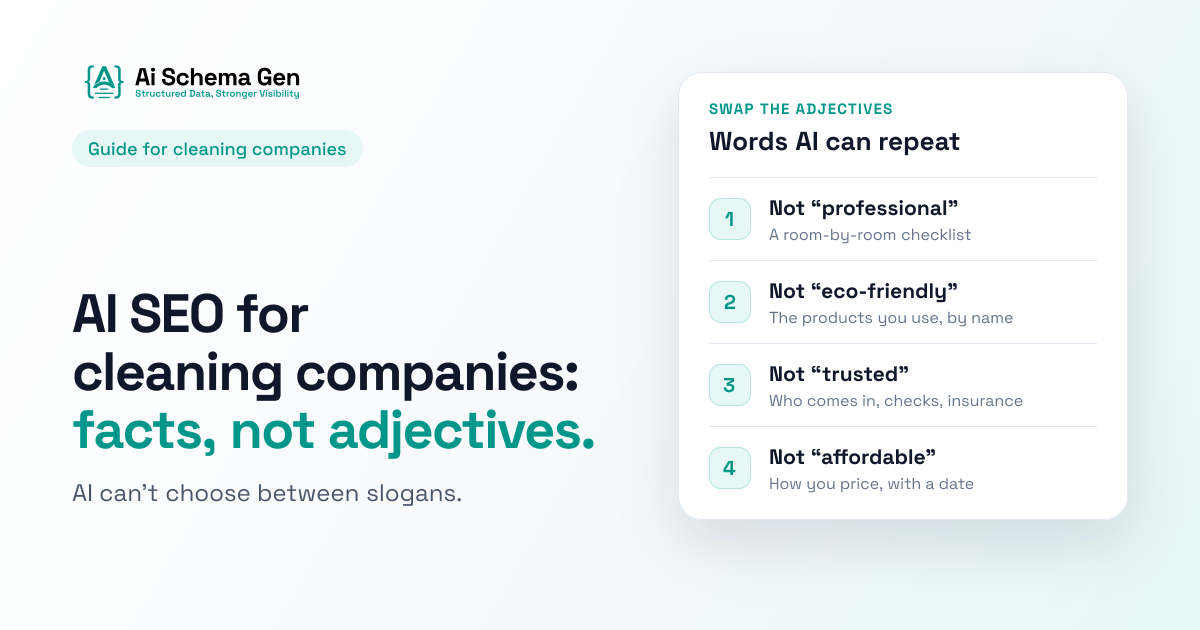
For most trades the hard part is proving you can do a difficult job. For cleaning, the hard part is different: almost every cleaning company describes itself in the same words, so an assistant has nothing to separate one from another. The work in this guide is about replacing adjectives with facts: what each clean includes, how you price, who comes into the home, what products you use, and which special jobs you take on.
Why House Cleaners Are So Rarely Named
8ight.AI published a study in October 2026 that puts a number on this. For each trade and town, it took the businesses Google Maps listed, asked ChatGPT to name the best ones, and counted how many of those businesses turned up in the answer.
House cleaning came out near the bottom. Out of 85 house cleaning businesses in 15 places, ChatGPT named just 4.7% of them. In nearly three places out of four (all but 26.7%), it didn't name a single local house cleaner. Window cleaning, in the same study, did much better: 12.5% of 56 businesses named, with at least one named in 38.5% of places. That puts house cleaning among the least-named trades in the whole study.
Read those numbers with care. Each place got a single question, the answers came from the developer version of ChatGPT rather than the app people use, and 8ight sells marketing services built around AI answers. 8ight itself says the gaps between trades should be read as "a direction, not a ranking," and it doesn't explain why one trade scores higher than another.
Our own reading, and it is only a reading, is that the two kinds of cleaning differ in how easy they are to describe. A window cleaner does one clear job: windows, inside and out, perhaps screens, gutters and pressure washing too. "House cleaning" can mean a weekly tidy, a top-to-bottom deep clean, a move-out clean, a turnover between vacation guests, or an office at night. When every site in town uses the same vague phrase for all of that, an assistant answering a specific question has very little to go on. Reviews and map listings matter too, and our guide to how near me searches work covers that side. This post is about the part you write yourself.
Every Cleaning Website Says the Same Five Words
Open the websites of ten cleaning companies in any city and count the words "reliable," "professional," "trusted," "affordable" and "eco-friendly." Then try to say what any one company actually does differently. Usually you can't.
A homeowner can't tell either, which is why they now ask an assistant to sort it out for them. And the questions they ask are full of the details that the websites leave out:
- "Which cleaning services near me bring their own vacuum and supplies?"
- "Is a deep clean worth it for a first visit?"
- "Do house cleaners clean inside the fridge?"
- "Cleaning company that uses fragrance-free products, my son has asthma."
- "Who can clean an Airbnb between guests on the same day?"
- "Are cleaners from an app insured, or should I use a local company?"
None of those can be answered by "professional and reliable." Each can be answered by a single plain sentence on a cleaning company's site. The rest of this guide is a list of those sentences, grouped by the questions they answer.
Write Down What Each Clean Includes
The single most useful page a cleaning company can publish is a checklist: room by room, what's included in each type of clean you offer. It's also the page most cleaning sites don't have, or hide inside a booking form.
Start with the cleans you actually sell, and give each one its own section or page:
- Standard or recurring clean. The visit a weekly or every-other-week customer gets. Kitchen surfaces and outside of appliances, bathrooms, dusting, floors, beds if you make them, trash out.
- Deep clean. What you add on top: baseboards, door frames, light switches, inside the microwave, behind furniture you can move, limescale, grout. Say whether you recommend it as a first visit and why.
- Move-out or move-in clean. Empty-home work: inside cabinets and drawers, inside the oven and fridge, walls spot-cleaned, windowsills and tracks. More on this below, because it's tied to money the customer cares about.
- Post-construction or renovation clean. Fine dust, paint flecks, stickers on new windows. Different tools and more time.
- Short-term rental turnover. Linen changes, restocking, photos for the host, damage reporting, same-day timing between guests.
Just as important, say what's not included, or what costs extra. Inside the oven, inside the fridge, inside windows, laundry, dishes, walls, balconies, garages and heavy furniture are the usual sources of disappointment. "We don't do dishes, but we'll load the dishwasher if it's empty" is a small sentence that saves an argument and gives an assistant a precise answer to "do house cleaners do dishes?"
If your checklist exists already as a PDF or an image, put the same words on the page as text. An assistant can read a heading and a list far more reliably than words inside a picture.
Explain How You Price
Cleaning prices confuse people because companies price in different ways, and customers comparing two quotes are often comparing two different things. Explaining your method is more useful than publishing a single number.
Answer these on a pricing page:
- What you price by. Bedrooms and bathrooms, floor area, an hourly rate per cleaner, or a flat price per job. If it's hourly, say how many cleaners usually come and how long a typical home takes.
- Why the first visit costs more. If you charge more for a first clean or require a deep clean before recurring service, say so and explain why.
- Recurring prices. Whether weekly, every-other-week and monthly customers pay different rates.
- What changes the price. Pets, the condition of the home, extra rooms, stairs, parking, and anything else that makes you adjust a quote.
- Cancellation and lockout fees. If you charge when a cleaner arrives and can't get in, say how much and how much notice you need. Customers ask assistants about this before booking, not after.
- Tips. Whether cleaners keep tips, and whether tipping is expected. People ask this constantly, and a company that answers it looks open.
If you're comfortable sharing numbers, add dated starting prices for common home sizes. A "from" price with the date beside it gives an assistant something concrete to pass on when someone asks what a cleaner costs in your town, and the date tells it the figure is current.
Say Who Comes Into the Home
A cleaner is one of very few trades that regularly works inside a customer's home while the customer is out. That makes the questions about people sharper than in most trades, and more personal.
Answer them directly:
- Employees or contractors. Are your cleaners on your payroll, or self-employed people you match with customers? Both models exist. Say which is yours.
- Background checks. If you check new hires, say what kind of check and who runs it. "Background checked" on its own tells nobody much.
- The same cleaner each time. Whether recurring customers get a regular cleaner or team, and what happens when that person is on vacation.
- Insurance and bonding. Say what insurance you carry, such as liability cover for damage in the home. If you're bonded, explain it in a sentence: a bond is a kind of protection that can pay a customer back for theft by one of your staff, within the limits of the bond. Many customers ask "are you bonded?" without knowing what it means, so explaining it is itself a service.
- Keys, codes and lockboxes. How you store keys, who has access, and what happens to them if a customer leaves.
- Breakages. What you do if something gets broken. Customers trust a company that has clearly thought about it.
There's a money side to the employee question that homeowners raise with assistants more and more: "do I have to pay taxes for my house cleaner?" The IRS's guide for household employers lists housecleaning workers among household workers, and says Social Security and Medicare taxes apply to household workers paid "$3,000 or more in cash wages in 2026." It also says: "If an agency provides the worker and controls what work is done and how it is done, the worker isn't your employee."
A cleaning company shouldn't give tax advice, and doesn't need to. But if your cleaners are your employees, a plain sentence saying so ("our cleaners are employed by us; we handle their pay and taxes") answers a question many customers have and can't easily get answered elsewhere.
Name Your Products, Don't Just Call Them Green
"Eco-friendly cleaning" is probably the most common phrase on cleaning websites, and one of the least useful to anyone deciding who to hire.
It's also a phrase US regulators warn against using on its own. The Federal Trade Commission's Green Guides say that "Unqualified general environmental benefit claims are difficult to interpret and likely convey a wide range of meanings," and its worked examples single out a product called simply "Eco-friendly" as likely to mislead. The fix the guides describe is to qualify the claim: say what, specifically, is better.
For a cleaning company, that means naming what you use and why:
- The products and brands you use as standard, by name, in text.
- Certifications those products carry, if any. The EPA's Safer Choice label, for example, marks products with safer chemical ingredients, and the EPA has a product search where a customer can check one.
- Options for sensitive homes: fragrance-free products, products customers can supply themselves, what you do in homes with babies, pets or people with asthma or allergies.
- Equipment: whether you bring vacuums, mops and cloths, and whether cloths are color-coded or washed between homes.
- What you don't use, if that matters to your customers, such as bleach in homes with certain surfaces.
A homeowner who asks for "a cleaning company that uses fragrance-free products" is asking a precise question. A site that says "we use fragrance-free products on request, at no extra charge" answers it. A site that says "eco-friendly" doesn't.
Move-Out Cleaning and the Deposit
Move-out cleaning is the clean customers ask about with the most at stake, because a security deposit often rides on it. That's also why renters ask assistants so many questions about it: what does a landlord expect, will a professional clean get my deposit back, do I need a receipt?
Some of those answers depend on local law, and it helps to know what yours says. In California, for example, Civil Code section 1950.5 lets a landlord keep part of the deposit for cleaning only to return the unit "to the same level of cleanliness it was in at the inception of the tenancy." Since April 1, 2025, the same section has also required California landlords to take photographs of the unit after the tenant hands it back, before any cleaning they plan to charge for. Other states have their own rules, so check yours before you write about them.
You don't need to be a tenant lawyer to use this. A strong move-out page:
- Lists exactly what a move-out clean covers, room by room, especially the parts landlords inspect: inside the oven, fridge, cabinets, bathroom grout, window tracks.
- Explains the difference between dirt you can remove and damage or wear you can't. Cleaners can't fix carpet wear or scuffed paint, and saying so plainly saves disputes.
- Offers before-and-after photos the customer can keep, with the date on them.
- States your re-clean promise, if you have one: how many days the customer has to report a missed spot, and what you'll do.
- Gives a receipt that lists what was cleaned, which some landlords ask to see.
Move-out cleaning also pairs naturally with moving companies, and people often ask an assistant about both in the same conversation. Our guide for moving companies covers that side of the move; if you work with local movers, mention it.
Give Specialty Work Its Own Page
Window cleaning got named nearly three times as often as house cleaning in the 8ight study. Whatever the full reason, specific services are easier for an assistant to match to specific questions, and many cleaning companies do far more than their homepage admits.
If you offer any of these, give each its own page with its own details:
- Windows: inside, outside, height limits, screens and tracks, how often you recommend it.
- Carpets and upholstery: method (hot water extraction or dry), drying time, stain and pet odour treatment.
- Short-term rentals: turnover times, linen service, restocking, what you report to the host, and whether you work with the property management apps hosts use.
- Offices and small commercial spaces: evening or weekend hours, keys and alarms, how you handle confidential paperwork, supplies.
- Post-construction: what you need from the builder, how long it takes, safety on a site still being finished.
- One-off jobs: after a party, before a sale, hoarding or clutter clear-outs if you do them, with care in how you describe them.
Each page should say where you offer that service (some services may cover a smaller area than your regular cleaning), roughly what it costs, and how to book it. "Carpet cleaning" mentioned once in a list on the homepage won't match a question about pet odour in carpets. A page about it will.
Structured Data for Cleaning Companies
Structured data is the set of business facts a website states in its code, using schema.org's shared vocabulary, so software can read them without guessing. Cleaning companies run into one awkward fact straight away: schema.org has no type for house cleaning, maid services or janitorial work. Its home services types cover electricians, general contractors, HVAC, painters, locksmiths, movers, plumbers and roofers, and stop there.
Most cleaning companies end up with HomeAndConstructionBusiness, the broader type those trades sit under, or the general LocalBusiness, and then rely on the description to say what kind of cleaning they do. One type to avoid: DryCleaningOrLaundry, which sounds close but is described on schema.org simply as "A dry-cleaning business." It's for the shop that cleans clothes, not the company that cleans houses.
Two details matter more than the type:
areaServed: the towns and neighborhoods you cover, matching your service area page. Most cleaning companies work in customers' homes and have no public address, which is normal and fine.- The services themselves: each clean you sell described as a service, with a name and description that match the checklist on its page.
If a service is in the code but not on the site, or the other way round, an assistant has two stories to choose between. Our post on Organization vs LocalBusiness covers the type choice in more depth.
Common Mistakes
A booking form instead of a checklist. Many cleaning sites send every visitor straight into a booking widget that asks for bedrooms and bathrooms and shows a price. It works for a ready buyer, but it hides everything an assistant needs to read: what's included, what isn't, what changes the price.
"Eco-friendly" with no product names. It tells the customer nothing they can check, and as the FTC's guides show, it's the kind of claim regulators want qualified.
"Insured and bonded" with no detail. Say what kind of insurance, and what the bond covers. A phrase with no facts behind it looks copied from every other site.
One page for every kind of clean. A move-out clean, a weekly clean and an office clean are different products bought by different people. One page describing all three answers none of their questions well.
Copying a franchise template. If your site uses the same words as a hundred others in your network or from the same web designer, there's nothing on it that's specifically yours. Add your own details: your team, your area, your checklist, your photos.
How to Check and Fix It
- Test with detailed requests, not "best cleaner." Type in what a picky customer would: "move-out cleaning in [town] with before-and-after photos," "house cleaner in [town] who uses fragrance-free products," "same-day Airbnb turnover cleaning in [town]." Write down who gets named and which details the answer repeats; those details tell you what the named companies wrote that you didn't. Answers change from one try to the next, so run each test several times before reading anything into it.
- Write a checklist page for each clean you sell, including what's not included.
- Write a pricing page that explains your method, first-visit pricing, recurring rates, and cancellation and lockout fees.
- Write a "who comes to your home" page: employees or contractors, checks, insurance, bonding, keys.
- Name your products and equipment, and your options for sensitive homes.
- Give each specialty service a page with its area, rough cost and how to book.
- Replace the five words. Go through your homepage and swap each "reliable," "professional" or "eco-friendly" for the fact it's standing in for. Our fix guide on how to describe the business covers what an AI needs to know about who you are.
- Find out what's readable. Many cleaning sites put their prices and checklists inside booking tools that AI systems can't open. Our free AI readiness checker shows what an AI can actually read on your pages, and whether your business details come through.
Frequently Asked Questions
Is your website ready for AI?
Check now. Free readiness score in under a minute, no signup, no card.