
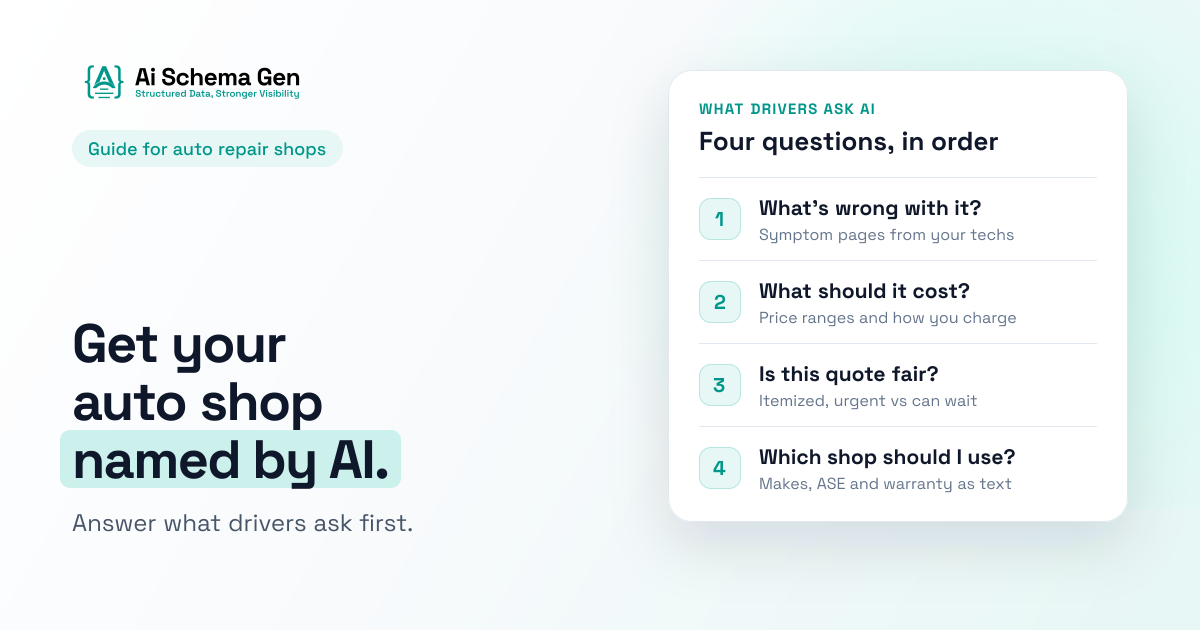
A driver hears a grinding noise every time they brake. Before calling anyone, they open ChatGPT on their phone. Over the next two days they send it four messages:
- "What does a grinding noise when braking mean?"
- "How much do front brake pads and rotors usually cost on a 2017 Subaru Outback?"
- "A shop quoted me $780 for front pads, rotors and a brake fluid flush. Is that fair?"
- "Find me an honest mechanic near me who knows Subarus."
Only the last message asks for a shop by name. But the first three decide what the driver believes before any shop gets a chance to speak: what the problem probably is, what it should cost, and whether the quote they already have looks like a rip-off. By the time an assistant names two or three shops, the driver has a picture in their head of what a fair, honest shop sounds like.
That is the real job of AI SEO for auto shops. It is not only about being named in answer four. It is about being the shop whose website helps answer questions one to three, so that when the assistant does name shops, yours is the one whose prices, explanations and policies match what the driver has just been told. This guide walks through each of the four questions, what an assistant needs to find to answer it, and what that means for your website.
What AI SEO for Auto Shops Means
For a repair shop, AI SEO (also called GEO or AEO) means two things. The visible part is being one of the shops an assistant names when a driver nearby asks for a mechanic. The less obvious part is what happens before that: making sure that when an assistant explains a symptom, gives a price range or judges a quote, the picture it paints matches the way your shop actually works, and that your website is one of the places it can check.
Listings still matter. Your Google Business Profile, Bing Places and Apple Business Connect entries feed straight into these answers, and the listing basics are in our local business guide. Car repair is a trade where trust records such as the Better Business Bureau, state complaint files and certification directories deserve more attention than usual, because the main fear is being cheated and those records are where outside proof lives. The rest of this post is about that part.
Car Repair Starts With Distrust
Most trades have a trust problem. Car repair has a famous one.
In a AAA survey of 1,001 US drivers, 63% said they generally do not trust auto repair shops. Asked why, 76% pointed to shops recommending services they didn't need, 73% to overcharging, 63% to bad past experiences, and 49% to worry that the work wouldn't be done right. The survey is from 2016, so treat the exact numbers with care, but the same fears come up in almost every conversation about choosing a mechanic. AAA also found that 64% of drivers had found one shop they did trust. People don't distrust their own mechanic; they distrust the ones they don't know yet.
That is exactly the gap an AI assistant now fills. A driver who doesn't have a shop, or who doesn't trust the quote in front of them, has a patient, free second opinion in their pocket. FixMyCar's 2026 Auto Repair Report, based on a survey of 2,000 UK drivers, found that 60% of drivers had used an AI tool such as ChatGPT for a car-related task in the past year. Breaking that down, 25% had used AI to work out what was wrong with their car and 20% to help understand a garage quote, according to Garage Talk's summary. Those are UK figures from a company that runs a garage-booking site, so they are a signal rather than a census, but they line up with what shops on both sides of the Atlantic report: customers arriving with an AI diagnosis already in hand.
The same report found that 46% of drivers wanted clear, open pricing when booking, while only 33% said the lowest price mattered most. Put that next to AAA's list of fears and a pattern appears. Drivers are not mainly hunting for the cheapest shop. They are hunting for a shop that won't take advantage of them. Every one of the four questions above is a way of checking that.
Question One: "What's Wrong With My Car?"
When a driver describes a symptom, the assistant answers from general knowledge and from pages it finds on the web. Grinding brakes, a flashing check engine light, a car that shakes at highway speed, a sweet smell from the vents: these questions get asked constantly, and the answers usually list three or four possible causes, explain which ones are urgent, and end with "have a mechanic inspect it."
Your shop is not likely to be named in that answer, and you won't out-write the big car-care sites on general explanations. That isn't the goal. The goal is service pages that carry your shop's own experience: what you find on the cars you see, what you check, and what it costs to find out. Those pages are useful to a driver who has just been told "have a mechanic inspect it", and they are what an assistant reads when it later looks at your shop. A long blog archive of generic car-care articles does far less.
Write about the symptoms you actually see. A short page for each common complaint, written by someone at the shop, beats a generic "brake services" page. Say what the noise or warning light usually means on the cars you work on, which causes are safe to drive on for a few days and which are not, and what you check first. If you see a lot of one make, say so. "On Subarus we often find..." is the kind of sentence an assistant can't get from a parts catalog.
Say how you diagnose, and what it costs. The step from "it might be one of four things" to "this is the one" is where drivers get nervous, because it is where a shop could start guessing at their expense. Explain your process in plain words: what a diagnostic inspection includes, how long it usually takes, what it costs, and whether that fee comes off the bill if they go ahead with the repair. The FTC's auto repair guide tells drivers to find out "if there will be a diagnostic charge" if they have the work done somewhere else, so answer that before they ask.
Respect the AI diagnosis, then explain the gap. Shops increasingly meet customers who have already "diagnosed" their car with ChatGPT and want a specific part replaced. A page that says, in a friendly way, why a scan code or a description of a noise points to possibilities rather than an answer, and what the inspection adds, does two jobs. It helps the customer, and it gives an assistant a clear, quotable explanation from a real shop. An FAQ section works well here; we explain why short question-and-answer blocks get picked up in our post on FAQs AI cites.
Question Two: "What Should This Cost?"
Price questions are where shops lose the most ground to other websites. When a driver asks what a repair costs, the assistant wants a range, and it will take that range from whoever publishes one: national price-guide sites, parts retailers, forums, or a shop that is willing to put numbers on its own website.
Most shops won't. "Call for a quote" is understandable, because the honest answer depends on the car, the parts and what the technician finds. But a page with no numbers gives an assistant nothing to repeat, and a driver nothing to compare. The aim is not to publish a fixed price list. It is to publish enough that both the driver and the assistant can see your prices are sane.
Publish ranges for your most common jobs. Brake pads and rotors, a timing belt on a common engine, a battery, an alignment, a state inspection. A range with a note on what moves the price ("higher for trucks and performance brakes, lower if the rotors can be reused") is more useful than a single number and more honest.
Say how you charge for labor. The FTC tells drivers to ask whether a shop charges a flat rate for labor or the actual time spent. Very few shop websites answer that. A sentence explaining which method you use, and your hourly rate if you're comfortable sharing it, answers a question drivers are told to ask.
Explain your parts choices. Drivers hear "OEM" and "aftermarket" and don't know what either means for their wallet. Say which you use by default, when you'd suggest the other, and whether the customer can choose. If you'll install parts the customer brings, say so and say what that does to your warranty. The FTC's guide notes that new parts vary in price and quality and that salvage parts' reliability "is seldom guaranteed", which is the kind of trade-off a short paragraph on your site can explain far better than a price-guide site can.
None of this needs to be long. A single "How we price" page, linked from every service page, does most of the work.
Question Three: "Is This Quote Fair?"
This is the question that has changed the most. The FTC has long told drivers to consider a second opinion when they have questions about recommended work. A driver who used to sit in the waiting room wondering whether $780 was reasonable can now photograph the estimate and ask an assistant. The assistant can't see the car, but it can compare the line items against typical prices, flag anything that looks unusual, and suggest questions to ask. In FixMyCar's survey, one in five drivers had already done this.
You can't control what an assistant says about a specific quote. You can make your quotes easy to check, and you can explain the parts of your process that most often look suspicious from the outside.
Make your estimates itemized and readable. The FTC tells drivers that a written estimate should name the problem to be fixed, the parts needed and the expected labor charge, and should say the shop will call for approval before going past a set amount. A quote that lumps everything into "brake service: $780" invites suspicion, from a person or a machine. A quote that lists pads, rotors, fluid flush and labor separately can be checked line by line, and a fair shop has nothing to lose from that.
Explain how you sort urgent from "can wait". The top fear in AAA's survey was being sold services the driver didn't need. Many shops already use a traffic-light system on their inspection reports: red for "fix now", yellow for "soon", green for "fine". If you do, show it on your website with an example and say plainly that customers can decline anything that isn't red. That one page answers the biggest fear in the trade, and it gives an assistant something specific to say about how you work.
Say when you'll call before doing more. In some states this is the law. California's rules for repair shops say an estimate "shall be provided to and authorized by the customer before any work commences" (16 CCR 3353), and many other states have their own written-estimate rules. Whatever your state requires, say on your website what you do: that you give a written estimate, that you call for approval before going over it, and how you handle something new found halfway through a job.
Offer the old parts back. The FTC suggests drivers ask for the parts that were replaced. Saying on your site that you return them, or keep them for the customer to see, costs nothing and tells a nervous reader you're not hiding anything.
Question Four: "Which Shop Should I Use?"
Now the assistant names businesses. When it does, it usually names only two or three, each with a one-line reason. Mentioned-on, a company that sells AI tracking for local businesses, says it parsed about 2,300 AI answers about auto repair across 40 US cities between June and October 2026 and found that the top shop in each city held about 22% of the mentions there. That is a vendor's own data with only a summary of its method, but the shape matches what anyone who asks these questions sees: a short list, with a reason attached to each name.
The reason is the part to work on. "Known for honest pricing", "specializes in European cars", "offers a 24-month warranty", "ASE-certified technicians": an assistant can only write a reason like that if it can find the fact somewhere. These are the facts drivers are told to check, and where they should live.
The makes and jobs you're good at
The FTC tells drivers to ask whether a shop has experience with "the same make or model vehicle as yours." A driver with a Subaru, a diesel truck or a hybrid wants a specialist, and assistants pick up on that: "find me a mechanic who knows Subarus" is a common question. If 40% of your work is on one or two makes, say so on your home page, not buried in a list of 30 brands. "All makes and models" tells an assistant nothing it can use as a reason.
The same goes for jobs. If you're a state inspection station, an emissions repair facility, or set up for hybrid and electric vehicles, put that in plain text on its own page. These are exactly the narrow questions ("emissions repair shop near me", "who can fix a Prius hybrid battery") where a small shop can be one of very few good answers.
Certifications, written as text
ASE certification is the credential drivers are told to look for. The FTC suggests looking for shops that display it, and to "make sure the certifications are current", while warning that certification alone is no guarantee of honest work. ASE also recognizes whole shops through its Blue Seal of Excellence program, which requires that at least 75% of technicians doing diagnosis and repairs are ASE certified, with every area of service covered by at least one certified technician. Recognized shops are listed in ASE's own shop locator.
Give the details, not just the seal: how many of your technicians are ASE certified, in which areas, whether you're a Blue Seal shop, and any manufacturer or equipment training you hold. If you belong to a network such as AAA Approved Auto Repair or NAPA AutoCare, say that in words too, and link to your listing on their site.
Your warranty, in writing
The FTC points out that there is no standard warranty on repairs and tells drivers to get theirs in writing. That makes the warranty one of the clearest ways to stand out in an assistant's answer, because it is a specific, comparable fact. Say how long it lasts in months and miles, what it covers (parts, labor or both), whether it's honored at other shops if the driver is out of town, and what it doesn't cover. A shop with a clear "24 months or 24,000 miles, parts and labor, honored nationwide through our network" line has handed an assistant a ready-made reason.
Your state registration, if your state requires one
Several states license or register repair shops, and some now say what your website must show. California is the clearest example. Since October 1, 2025, its Bureau of Automotive Repair has required online advertising, including a shop's own website, to show the business name exactly as registered, the automotive repair dealer registration number, and the phone number on file with the Bureau. The Bureau's guidance says you "must also display the required information on your website" in a place that is easy to find, with the details for each location if you have more than one.
That rule was written for consumer protection, not for AI. But it describes what helps an assistant too: a name that matches a public record, a number that can be looked up, and a phone number that is the same everywhere. If your state has a registration or licence number for repair shops, put it in your footer as text. If it doesn't, your years in business, your physical address and your owner's name do a similar job. AAA's advice to drivers includes finding out how long a shop has been in business and checking how it handles complaints with the Better Business Bureau or the state.
The facts in one place
| What drivers are told to check | Where it should be on your site | Who else shows it |
|---|---|---|
| Experience with their make | Home page and a specialties page, in words | Review text, directory categories |
| How you diagnose and what it costs | Each service page and your pricing page | Rarely anywhere else |
| How you charge for labor and parts | A "How we price" page | Price-guide sites, in general terms only |
| Written estimates and approval before extra work | Pricing page or FAQ | State consumer pages (the rule, not your shop) |
| Current certifications | About page, as text, with numbers and areas | ASE shop locator, network directories |
| Warranty terms | A warranty page, linked from every service page | Network directories, if you belong to one |
| State registration number, where required | Footer, as text, for each location | State lookup tools |
| Years in business and complaint record | About page | BBB, state consumer agencies |
Where Assistants Check Your Story
A shop describing itself as honest proves nothing. What carries weight is an outside record that says the same thing, ideally one the shop had to earn.
Directories with entry rules. Some directories only list shops that meet standards. ASE's Blue Seal locator is one. AAA said in its 2016 survey release that its Approved Auto Repair network had nearly 7,000 facilities, inspected quarterly and required to hold customer satisfaction ratings of at least 90%. Listings like these are worth having because they are an outside check, not a page you wrote about yourself. Make sure your name, address and phone number on each one match your website exactly, and link to those listings from your own site; our fix guide on linking your profiles shows how to do that through your business details.
Reviews that name the repair. A review saying "great service" gives an assistant nothing to repeat. One saying "told me the rotors could wait another 10,000 miles" or "found the misfire the dealer missed" is a reason, and it speaks directly to the fear of being sold work you don't need. When you ask a happy customer for a Google review, ask them to mention what you fixed and how you explained it.
Local roundups and forums. "Best mechanics in [city]" articles from local news sites and community threads on Reddit or make-specific forums are read by assistants that search the web as they answer. You can't buy your way into a good forum thread, but you can be the shop people mention because you explained things well. Keep an eye on where you are and aren't being mentioned; our post on how to track brand mentions explains a simple routine.
Chains, Franchises and Multi-Location Shops
If you run more than one location, or a franchise location under a national brand, an assistant has to work out which location to name. A single website page listing five addresses makes that hard.
Give each location its own page with its own address, phone number, hours, services, makes it specializes in and, where your state requires it, its own registration number. California's rule already asks for this: the required details for each registered location must be shown on the website. For a franchise location, say what is local (your technicians, your hours, your specialties) and what comes from the brand (the warranty, the booking system). The national brand page is what assistants find first; your location page is what lets them name you instead of the brand in general.
Structured Data for Auto Shops
Structured data is hidden code that tells software, without any guessing, that this shop opens at 7:30 on weekdays, sits at this address and fixes cars. schema.org's type for a repair shop is AutoRepair. It sits under AutomotiveBusiness, which sits under LocalBusiness, so everything a local business can say, an auto repair shop can say too. There are also sibling types such as AutoBodyShop for collision repair.
In AI Schema Gen, choosing "Auto Repair / Mechanic" as your business type in Business Identity sets the AutoRepair type for you, and the details you fill in (name, address, phone, hours, service area and your profiles on other sites) are written into the structured data on every page. If you have more than one location, each one should be described separately.
Your ASE details, warranty terms, pricing approach and any California registration number belong in the words on your pages, where drivers read them too. What matters most is that the details in your structured data match the details on the page and in your listings; our fix guide on keeping details consistent covers how.
Common Mistakes
A tracking phone number that doesn't match your listings. Many shops use a separate call-tracking number on their website or ads. To a person it makes no difference. To an assistant comparing your website with your Google profile and your directory listings, it can look like two different businesses. In California it can also conflict with the rule that ads show the phone number on file with the Bureau.
"Call for pricing" on every page. It hands the price conversation to price-guide sites and forums, and it reads as evasive to a driver who already distrusts shops.
"All makes and models" and nothing more. It gives an assistant no reason to name you over anyone else. Say what you see most and what you're best at.
Symptom pages that never mention your shop. A blog post about grinding brakes copied from a parts catalog helps nobody. Write what your technicians actually find and what you do about it.
A warranty that isn't written down. "We stand behind our work" is not a warranty an assistant can compare. Months, miles, parts, labor.
How to Check and Fix It
- Ask the four questions yourself. Use ChatGPT, Gemini and Perplexity. Describe a symptom you fix every week, ask what the repair costs in your city, paste in one of your own (anonymized) quotes and ask if it's fair, then ask for a shop like yours nearby. Note where your shop appears, what is said about it, and which other sites are quoted.
- Fix your details first. Make your business name, address, phone number and hours identical on your website, Google Business Profile, Bing Places, Apple Business Connect, Yelp and any directory that lists you. Retire the tracking number from your website or make sure it isn't the main number shown.
- Write the trust pages. A "How we price" page, a warranty page, a page on how you diagnose and sort urgent from "can wait", and an about page with your certifications, network memberships, years in business and any state registration number, all in plain text.
- Name your specialties. Put the makes and jobs you're best at on your home page and give each its own page.
- Add symptom pages for your most common complaints, written from what your technicians actually see, with an FAQ section on each.
- Run a free check. Our AI readiness checker shows whether assistants can reach your site, read your business details and match them to the rest of the web, and what to fix first.
Then ask the four questions again in a month and see what changed.
FAQ
Why would a driver ask AI about a repair before asking for a shop?
Because most drivers don't trust shops they don't know. In AAA's survey, the top reasons were being sold unneeded work and being overcharged, so a driver wants to understand the problem and the likely price before they talk to anyone who might take advantage. An assistant is free, patient and has no stake in the repair. A shop whose website helps answer those early questions is easier to trust when the assistant finally names a few businesses.
Should I put prices on my website if every car is different?
Yes, as ranges with an explanation of what moves the price. Without them, assistants take price ranges from other sites, and drivers compare your quote against numbers you had no say in. A range for your most common jobs, plus how you charge for labor and parts, is enough.
Does ASE certification help my shop get recommended by AI?
It's one of the facts drivers are told to check, so it's worth showing clearly. There's no public evidence of how much weight any assistant gives it. What helps is writing it as text (how many technicians, which areas, Blue Seal if you have it) and being listed in ASE's shop locator, so the claim can be matched to an outside record.
What should I do when a customer arrives with a ChatGPT diagnosis?
Treat it as a starting point. Explain what the inspection adds, show them what you found, and use the same explanation on your website so the next customer reads it before they arrive. A shop that explains clearly where the AI was right and where it couldn't know is easier to trust than one that dismisses it.
Does my state require my registration number on my website?
It depends on the state. California has required it for online advertising, including shop websites, since October 2025, along with the registered business name and phone number. Check with your state's repair-shop licensing agency or attorney general's office. Even where it isn't required, showing a registration or licence number in text helps people and software confirm you're the real business.
I added a warranty page and prices. Why doesn't ChatGPT mention them yet?
New pages have to be found and read first. An assistant that searches the web while it answers may pick up a new warranty or pricing page within a few weeks of it going live, especially if it's linked from your home page and service pages. An assistant answering from what it learned during training won't know until a later update. Fixing a mismatched phone number on your listings tends to show sooner than new content does. Give it several weeks, then ask the same questions again.
Is your website ready for AI?
Check now. Free readiness score in under a minute, no signup, no card.