
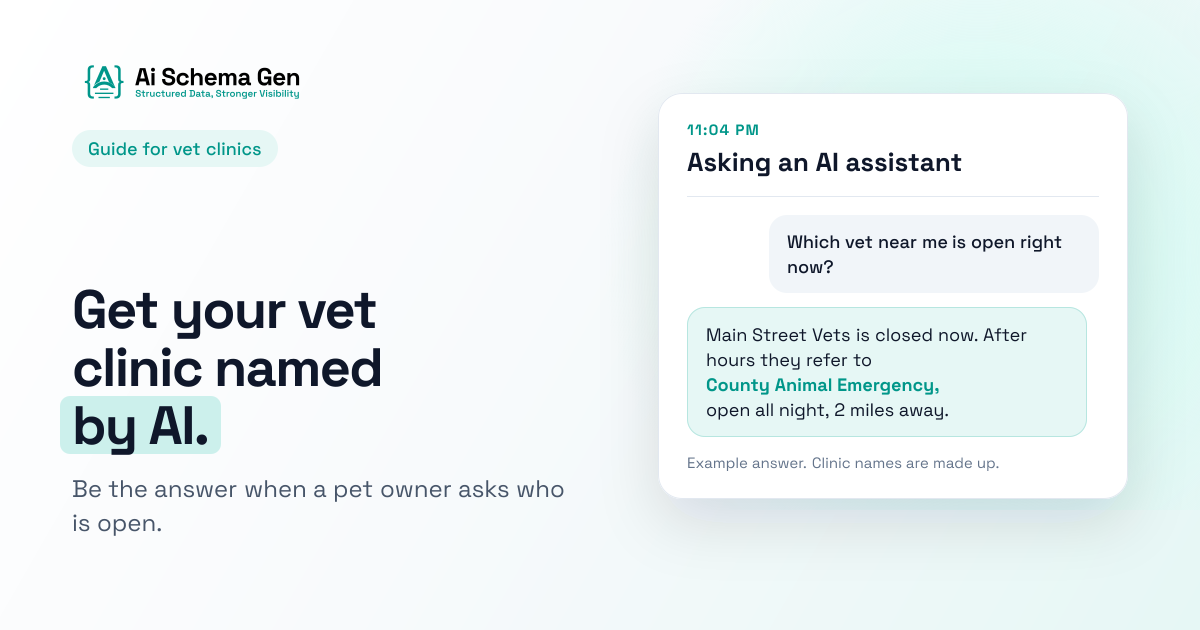
It is 11pm and the dog has just eaten something from the kitchen floor. The owner doesn't search for a vet first. They ask an AI assistant whether it is dangerous. The assistant explains what it can, and then says what assistants usually say about a sick animal: contact a veterinarian or an emergency clinic. The owner's next question is the one that matters to your practice: "Which emergency vet near me is open right now?"
That two-step pattern is how a lot of veterinary business now begins. The first question is about the animal. The second is about who can help, and the AI engine has to hand the owner on to a real clinic. Getting named at that hand-off is what GEO for veterinarians is about.
So the useful work for a clinic is not trying to out-explain an AI on pet health. It is making sure that when the AI passes a worried owner along, your practice is the obvious name to pass them to. The sections below start with the pet owner surveys, look at the one published study of vet clinics in AI answers, then go through the four questions that trigger a hand-off and the page each one needs.
What GEO for Veterinarians Means
Generative engine optimization, or GEO, is the work of getting AI assistants to describe your clinic correctly and name it when a pet owner asks for help. ChatGPT, Gemini, Perplexity and Google's AI answers all build their replies from what they can read and check about you. For a practice, the facts that count are unusually concrete: the animals you see, the hours you keep, where you send people at night, the vets on your team and the bodies that have accredited you.
Veterinary care sits close to human health care, and AI engines treat health questions with extra caution. Our guide to AI search for healthcare clinics explains why a clinic rarely wins general medical questions, and why the practical questions only the clinic can answer (new patients, booking, who you would see) are where it can win. Most of that applies to vets. This post covers what is different about animals.
Where Pet Owners Start: The Symptom Question
Pet owners are already asking AI about their animals, often. In an April 2026 survey of 2,000 US pet owners by Talker Research, commissioned by the pet food company Darwin's, 43% said they had used AI tools for information about their pet's health or nutrition, on average about seven times a week. The most common topics were nutrition (55%) and symptoms or illness (54%). Since a pet food company paid for it, treat the exact numbers with some care.
The same survey has the finding that matters most for vets: 71% of owners still called their veterinarian their most trusted source, against 14% who relied mainly on AI. When the advice conflicted, 64% said they would follow the vet and 12% the AI. Owners use AI to decide what to do next, then rely on a vet for the answer.
A February 2026 survey of 1,000 US cat and dog owners for MetLife Pet Insurance points the same way. It asked about pet mental health and behavior: 23% had used AI tools like ChatGPT to look into it, and among them, 17% used it to decide whether they should see a vet. That is the hand-off in a single figure.
One more study shows what clinic websites are up against. Researchers at the University of Edinburgh showed 201 people anonymous answers to two real pet owner questions, one written by an experienced vet and one by ChatGPT. 68.1% preferred the ChatGPT answer, and it scored much higher on perceived empathy (4.53 against 3.35 out of 5). The study did not check whether either answer was medically correct, and it was small, but the lesson for a clinic website is clear enough. Owners now compare your pages with a patient, well-organised, kind-sounding assistant. Short, cold, jargon-heavy pages lose that comparison.
The One Published Study of Vet Clinics in AI Answers
The only published study of veterinary recommendations in AI answers so far comes from 5W, a public relations firm that also sells AI visibility services, so read it with that in mind. In the first quarter of 2026, it ran more than 65 pet owner questions through ChatGPT, Claude, Perplexity and Google's AI Overviews, covering general vet care, emergencies, specialty care and recommendations in named US cities.
Three brands owned by Mars Petcare took the biggest shares of the veterinary brand mentions it counted: Banfield Pet Hospital 11.5% of citations, VCA Animal Hospitals 10% and BluePearl 6%. BluePearl, an emergency and specialty group, led on urgent and complex care questions. 5W also says roughly 80% of independent US practices had effectively no citation share in their own city and category. It doesn't publish the per-question data behind that figure, so treat it as a rough picture rather than a measurement.
Two things are worth taking from it. First, the large groups are well documented online: every location has a page with hours, services and vets, plus lots of reviews. Second, the study's one independent success story was a specialist, an oncology practice it describes as the most-cited source on pet cancer treatment. Being clearly the best answer to one specific question beats being a general answer to every question.
The Four Hand-Offs
When an AI assistant passes a pet owner on to a clinic, it is usually answering one of four questions. Each needs something different from your website.
| The owner's question | What the AI needs from you | Where it should live |
|---|---|---|
| "Is this an emergency?" | Plain guidance on when to call you now, when to go to an emergency hospital, and when it can wait | A "when to call us" page |
| "Who is open now?" | Your hours, your after-hours arrangement, and which emergency hospital you refer to | Homepage, contact page, every listing |
| "Who treats my kind of animal?" | A clear list of the species you see, and the ones you don't | A species or "who we treat" page |
| "Who is good at this?" | Services, your vets' training and interests, accreditation and certifications that outside bodies list | Service pages, team pages |
Hand-off 1: "Is this an emergency?"
The AI will answer the medical part of an owner's question itself, carefully and with a recommendation to see a vet. Your page doesn't need to compete with that. What it can do is give the next step in your own words: which situations mean "call us now," which mean "go straight to the emergency hospital," and which are fine to book for the next day.
There is a good reason to keep this as guidance rather than diagnosis. In the US, the American Veterinary Medical Association's model rules say a vet-client-patient relationship needs the vet to have examined the animal, and state rules on what can be done remotely vary. A "when to call us" page is not a diagnosis. It is the same triage advice your front desk gives on the phone every day, written down.
A useful version, written with your vets, covers:
- Call us straight away: the situations where you want the owner to phone during opening hours, and how fast you can see them.
- Go to the emergency hospital: the situations you would send to an emergency hospital even when you are open, and which hospital that is.
- Book the next available appointment: the common worries that are rarely urgent.
- Poisoning: what to have ready when calling (what was eaten, how much, when), and the number of a pet poison helpline your vets recommend.
Write it the way your best receptionist talks: calm, clear, specific. That is the tone owners rated highly in the Edinburgh study, and it is the kind of text an AI engine can hand on with confidence.
Hand-off 2: "Who is open now?"
Most general practices close at night, and that's fine. The problem is when the website never says what happens after closing. An AI engine asked "which vet is open now near me" at 11pm cannot recommend a clinic whose hours are missing or wrong, and it gains nothing from one that says "for emergencies, call your nearest emergency vet."
Three facts cover it:
- Your opening hours, including weekends and holidays, the same on your website, Google profile and every other listing.
- Your after-hours arrangement. Do you have a vet on call for existing clients? Does the phone line send callers to a partner emergency hospital? Say so.
- The emergency hospital you refer to, by name, with its address. Naming it helps the owner at the worst possible moment. It also gives an AI engine a complete answer that includes your clinic: "Main Street Vets is open until 7pm; after hours, they refer to County Animal Emergency Hospital."
If you are an emergency or 24-hour hospital, the details owners care about are different: whether a vet is on site overnight or only technicians with a vet on call, whether you take walk-ins, and whether there is an exam fee before treatment. Spell them out. An owner deciding between two emergency hospitals at midnight will often pick the one whose page answers those questions before they get in the car.
Hand-off 3: "Who treats my kind of animal?"
This is where independent clinics have the clearest opening, and it is the question chain clinic pages often answer least specifically. An owner with a rabbit, a bearded dragon, a parrot or a horse can't take it to just any vet, and they know it. Their question to the AI says so: "vet for rabbits near me," "who sees reptiles in Portland."
Write a page that lists the animals you see, in plain words, and the ones you don't:
- Species you treat: dogs and cats, plus any of small mammals (rabbits, guinea pigs, ferrets), birds, reptiles, horses, farm animals.
- What you do for each: routine care only, or surgery and dentistry too. "We see rabbits for vaccinations, dental care and neutering" is far more useful than a rabbit photo on the homepage.
- Who sees them: the vet with the interest or training in that species, by name.
- The ones you don't treat, and where you send them if you know a good clinic. It sounds like turning people away. In practice it makes the rest of your list believable.
If you are one of the few clinics in your area that sees a given species, this page may matter more than your homepage. An AI engine looking for an exotic-animal vet in your town has very few pages to choose from.
Hand-off 4: "Who is good at this?"
For a planned procedure (a dental, an orthopedic surgery, a cancer consultation) the owner has time to compare, and so does the AI engine. It looks for evidence that a clinic does this well, and some of the best evidence sits on websites you don't control.
Accreditation. The American Animal Hospital Association accredits hospitals against its standards, and AAHA says only about 15% of US practices hold it. If you are accredited, say so in words on your site, and make sure your listing in AAHA's hospital locator matches your name, address and website. Owners can check it, and so can an AI engine.
Certifications. Fear Free certification for handling, the Cat Friendly Practice program, or veterinary emergency and critical care facility certification are all checkable on outside websites. List the ones you actually hold, at the level you hold them.
Board-certified specialists. The AVMA recognizes 22 veterinary specialty organizations covering 48 specialties. A vet certified by one of them is a board-certified specialist. A general practitioner with a strong interest in dentistry is not, and calling them a specialist is the kind of claim that can be checked and found false. Describe interests and extra training honestly: "Dr. Patel has completed advanced training in feline dentistry" is accurate and still useful.
Licensed vets with real names. Every vet on your team page should have a full name, degree, the year they qualified, their interests and the species they see. State veterinary boards run public license look-ups, so a named vet is a checkable vet. "Dr. Sam, loves dogs" under a photo is friendly, but there is no record anywhere to match it to.
Tell Owners Who Owns the Clinic
Some corporate-owned clinics keep their original local names, so owners (and AI engines) don't always know which clinics belong to a group. If you are independently owned, say so plainly: "Independently owned by Dr. Maria Lopez since 2004." It is a fact some owners specifically look for, and an AI engine can only repeat it if your website states it.
Beyond ownership, the advantages an independent practice can show are concrete: vets who have treated the same families' animals for years, a species or service the big clinics nearby don't offer, a small-town location the chains don't serve, a direct line to the vet. Each one is only an advantage if it is written on your site in words an AI can read.
5W's oncology example points the same way. A specific, well-documented specialty gave one independent practice a place in AI answers that a general clinic page would not. Pick the one or two things you genuinely do best, and give each its own detailed page.
Reviews, New Clients and Booking
Two practical facts decide whether an owner can actually use a recommendation: are you taking new clients, and how do they book? Put both on your homepage and contact page in plain words, and update them when they change. Some clinics run waiting lists for new clients in busy periods; if you do, say so, with a realistic estimate.
Reviews matter as they do for any local business: steady, recent and replied to. Pet owners often write about the vet by name and about how the animal was handled, which is useful detail for an AI engine. Our guide to local business AI search covers which review site each assistant tends to read.
Structured Data for Vet Clinics
Schema.org, the shared vocabulary search engines and AI systems use for this kind of code, files vet clinics under VeterinaryCare. Unlike a plumber or a dentist, that type is a kind of MedicalOrganization, not a kind of LocalBusiness. In practice it means the everyday local business details, opening hours above all, belong to the LocalBusiness type, and a clinic's page can carry both types at once: a medical organization for what it is, a local business for when and where to find it.
From the medical side, VeterinaryCare gets isAcceptingNewPatients, a plain yes or no that matches the new-client question above. Only use it if someone will change it when your list closes.
None of this replaces the pages. The species list, the after-hours facts and the named vets are what the code describes, so they come first.
Common Mistakes
"For emergencies, call your nearest emergency vet." It sends owners, and AI engines, away with nothing. Name the hospital you refer to.
A species list that is really a photo. A rabbit on the homepage is not a statement that you treat rabbits. Write the list.
Calling interests "specialties." Only board-certified vets are specialists. Describe training and interests accurately.
First-name-only team pages. "Dr. Sam" can't be matched to a license. Use full names and qualifications.
Accreditation as a logo only. Write it in words, and check your entry in the accrediting body's directory matches your site.
Holiday hours left out. The nights and holidays when you are closed are exactly when owners ask an AI who is open.
Cold, clipped advice pages. Owners compare your pages with an AI assistant that sounds patient and kind. Write care guidance the way your best staff speak to worried owners.
Hiding that you are independent. If ownership matters to your clients, say it. AI engines can't guess it.
How to Check and Fix It
Step 1: Play the worried owner. Take each hand-off question in the table, put yourself in the owner's place at 11pm, and try to answer it from your own website in under a minute. Wherever you can't, note the missing page.
Step 2: Test your site the way an AI reads it. Run it through our free AI readiness checker. One part of the report shows what an AI could tell about the practice from your own words alone, such as its location and the area it covers. Gaps there are gaps at the hand-off.
Step 3: Write the after-hours section and the species page. These answer the most urgent owner questions and take an afternoon, not a redesign.
Step 4: Fill in the clinic's Business Identity. In the AI Schema Gen dashboard, the veterinary business type, your service area and your founders sit in one form, alongside links to your listings on Google, Yelp, the AAHA locator and any certification directories. The fix guide on how to link your profiles elsewhere covers that last part. Your pages' structured data is generated from this form.
Step 5: Make the outside records agree. Name, address, phone, hours and website should be identical on Google, Yelp, Apple Maps, Bing, the AAHA locator and every certification directory you appear in.
Step 6: Keep a short question log. Pick three or four owner questions that matter to you ("emergency vet open now in [town]," "vet for rabbits in [town]," "cat-friendly vet near [neighbourhood]"), ask them on a fixed day each month, and keep the answers. Our guide on how to track brand mentions in ChatGPT explains how to tell a real change from normal variation.
Frequently Asked Questions
Is your website ready for AI?
Check now. Free readiness score in under a minute, no signup, no card.