
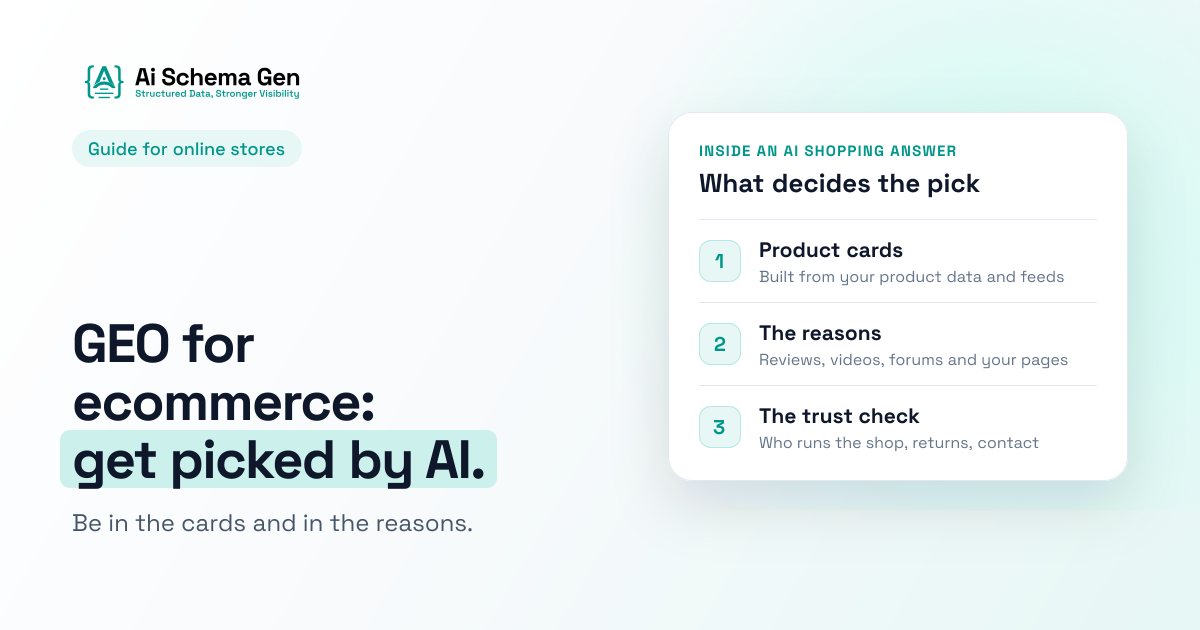
Ask ChatGPT or Google's AI Mode for "the best waterproof hiking boots under $150 for wide feet" and look closely at what comes back. There are really two answers on the screen. One is a row of product cards: pictures, prices, star ratings and the names of shops selling each pair. The other is a few sentences of reasoning: this boot runs wide, that one leaks after a season, this one is the best value, often with small links to a review site, a YouTube video or a Reddit thread.
Those two halves are built from different evidence. The cards come from product data that stores and platforms send in. The reasoning comes from pages the assistant reads and cites, and for most products, very few of those pages belong to the store selling them.
That split is the most useful thing to understand about GEO for ecommerce. A store can have perfect product data and still never be mentioned in the reasoning, so it shows up as one card among many with no reason given to pick it. Or it can be praised in a review the assistant quotes, while its product data is missing, so the shopper is sent to a competitor to buy. This guide covers what the research says about each half, what changed in 2026, and what a store can actually do to be in both.
What GEO for Ecommerce Means
For an online store, GEO (generative engine optimization) is about one moment: a shopper asks an AI assistant to help them choose, and your product is one of the options it shows and explains. Everything else in this guide serves that moment.
Classic search for shops was mostly about ranking a product or category page for a phrase. AI shopping is different in two ways. The shopper describes a situation ("for wide feet", "under $150", "for a toddler who chews everything") rather than typing a product name, so the assistant has to match products to needs. And the assistant answers directly, showing products and explaining its choice before the shopper clicks anything. Your page might never be visited unless it was chosen first.
Our guide to whether your online store is ready for AI shopping covers the groundwork: what Shopify now sets up automatically, which product facts only you can supply, and the company details shoppers and assistants check. This post goes a step further, into where the answers come from and how a store gets into them.
The Two Halves of an AI Shopping Answer
Half one: the product cards
Product cards are now a normal part of shopping answers on some assistants and missing entirely on others. Cloro, a company that monitors AI answers, ran 552 product-research questions on each of six assistants (electronics, wearables, home, kitchen, audio and outdoor gear) and counted how often each answer showed at least one product card:
| Assistant | Answers with product cards | Products shown per answer (average) |
|---|---|---|
| Google AI Mode | 91% | 4.7 |
| ChatGPT | 87% | 4.0 |
| Microsoft Copilot | 33% | 1.8 |
| Perplexity | 1% | 0.0 |
| Gemini | 0% | 0.0 |
| Google AI Overviews | 0% | 0.0 |
Cloro notes its questions lean towards US, English-language buying research, so the rates may run high. Even so, the pattern is clear: ChatGPT and AI Mode act like shops, while the others mostly talk about products without showing them.
The cards don't come from reading your web pages in the moment. They come from product databases. Google's AI Mode is powered by its Shopping Graph, which Google describes as holding "more than 50 billion product listings, 2 billion of which are updated every hour." Merchants feed that database through Google Merchant Center. ChatGPT takes product data through OpenAI's product feed program, which is open to approved partners, while Shopify stores are connected through Shopify's own integration. Our guide to ChatGPT shopping explains that feed and how it differs from the structured data on your pages.
Half two: the reasons and the sources behind them
The sentences around the cards are where an assistant says why. Those come from pages it read and, often, cited. In the same cloro study, the most-cited sites alongside product answers were YouTube and Reddit (each in 19% of answers), then RTINGS, a product-testing site (16%), google.com (12%), and editorial sites such as Forbes, PCMag and CNET. Brand-owned websites were, in cloro's words, "conspicuously absent from the top of this list."
A second, larger study tells a more mixed story. LLM Pulse, an AI tracking company, collected 391,073 citations from answers to about 1,468 general US shopping questions ("best X", "where to buy Y", "top X for Z") across five assistants between April and July 2026. Brand, manufacturer and smaller specialist sites made up 64.7% of citations. Google's own properties were 11.3%, Reddit and YouTube together 10.4%, review and editorial sites 7.4%, and big retailers and marketplaces just 2.9%.
The two studies are not as contradictory as they look. Cloro's questions were heavy on electronics and gadgets, a category with a strong culture of lab testing and video reviews. LLM Pulse's covered a wider spread of shopping categories, and its own write-up warns that it is "not a census." The fair reading is that where assistants look depends on what you sell. In gadget-heavy categories, review labs, YouTube and Reddit dominate the reasoning. In many others, brand sites and smaller specialist sites carry much more of it.
One more caution about all of these numbers: they come from sampling many answers across many questions. They describe patterns across the whole market, not how often any particular store is shown, which no outside study can measure. The most useful research for your store is a small version you run yourself, in your own category, which the checklist at the end of this post covers.
Marketplaces Matter Less Than Most Sellers Assume
Many independent sellers assume AI shopping will simply send everyone to Amazon. The studies so far don't support that.
In LLM Pulse's data, big retailers and marketplaces together drew 2.9% of citations. Amazon.com appeared across more shopping topics than any other site, but almost entirely through Google: 1,107 of its 1,114 counted citations came from Google AI Mode and AI Overviews. ChatGPT cited amazon.com 6 times and Perplexity not at all. The report's summary is blunt: "Amazon's AI visibility is almost entirely a Google story."
Cloro counted which shops were named in product cards and found Best Buy in 12% of answers, Walmart in 11%, Target in 5% and Amazon in 4%, across 606 different shops in total. Its products were just as spread out: 3,481 different products, with the most common one appearing in only about 2% of answers. As cloro puts it, "There is no 'rank #1 in ChatGPT' for a product the way there is for a keyword."
Two practical points follow. First, a strong Amazon listing doesn't carry you into ChatGPT or Perplexity. If you sell on your own site, your own product data and pages are the route in. Second, the field is wide open. With hundreds of shops and thousands of products sharing the answers, a small store with the right product for a specific need has a real chance of being shown.
What Changed in 2026: Discovery, Not Checkout
For a while in 2025, it looked as if AI assistants would become the place where people bought things, not just chose them. That has shifted.
In March 2026, OpenAI dropped Instant Checkout as a separate feature in ChatGPT. It had launched the previous September, letting shoppers buy from Etsy, Walmart and Shopify stores inside the chat. OpenAI said the first version "did not offer the level of flexibility" it wanted, and moved its effort into discovery: side-by-side product comparisons, searching by image for similar items, and narrowing results by conversation. Retailers such as Target, Sephora, Nordstrom, Best Buy and The Home Depot feed their catalogues and promotions into it, and Walmart launched its own app inside ChatGPT.
Google has gone a different way. Since November 2025, AI Mode can watch a price for a shopper and, with their permission, buy from eligible merchants "on the merchant's site using Google Pay." Google named Wayfair, Chewy, Quince and some Shopify merchants among the first.
For most stores, the takeaway is reassuring. The assistant's job today is mostly to help shoppers choose. The sale still happens on your site or your platform's checkout. That means your product page still has to finish the job: confirm the details the assistant promised, answer the last question and make buying easy. A shopper who arrives from an AI answer has usually already decided what they want. Don't make them hunt for it.
Getting Into the Cards
The product card half is the more mechanical of the two, and most of it is about keeping your product data complete, correct and current everywhere it is sent.
Send your catalogue to the places that build cards. For Google, that is Merchant Center. Free listings feed Google's shopping surfaces without paid ads. For ChatGPT, it is OpenAI's feed program (by application) or your platform's own connection if you're on Shopify. If you're on another platform, check whether it offers a ChatGPT or Merchant Center connection before building anything yourself.
Make product titles and attributes describe the product, not just name it. A card is chosen to fit what the shopper asked. "Trailmark Boot" tells an assistant nothing. "Trailmark Waterproof Hiking Boot, Wide Fit, Men's" matches the question. The same goes for attributes such as size, colour, material, age range and compatibility: fill them in, because a shopper's "for wide feet" can only be matched to a product whose data says "wide."
Keep price and stock in sync. An assistant that shows your boot at $129 when it's now $149, or in stock when it sold out last week, sends you a disappointed shopper. Daily or more frequent updates, generated from the same system that runs your shop, avoid most of this.
Treat your product page as the proof for your feed. Product structured data is code on your page that labels the name, price, availability and reviews. Google reads it alongside your Merchant Center feed, and its documentation says having both helps it "correctly understand and verify your data." Verification is the key word: the feed makes a claim, the page backs it up. A boot listed at $129 in the feed and $149 on the page fails that check.
Getting Into the Reasons
The reasoning half is harder, because most of the sources an assistant cites aren't yours. But it isn't out of your hands. Each of the main source types can be worked on honestly.
Write pages that match situations, not just products
Shoppers ask about situations, and assistants look for pages that answer them. A product page that says only what the product is gives an assistant little to work with when the question is "best boots for wide feet that don't need breaking in."
For each of your main products, write down the five or six situations people buy it for, and the ones it's wrong for. Then make sure the product page, or a short buying guide that links to it, says plainly:
- Who it's for and who it isn't for. "Built for wide feet; if you have narrow heels, try our Ridge model instead."
- The numbers people compare. Measurements, weight, capacity, battery life, materials, care instructions.
- Compatibility. What it fits, works with or replaces, using the names shoppers actually use.
- What owners say after real use. Specific review quotes about the situation, not just a star average.
An honest "not for you if" line is unusually valuable. Assistants are trying to match products to needs, and a page that rules some people out is easier to trust than one that claims to suit everyone.
Get your products in front of reviewers
In categories where review labs and editorial roundups dominate, being included in those reviews is the most direct way into the reasoning. That means doing the unglamorous work of public relations: finding the writers and testing sites that cover your category, offering review samples, and making facts and photos easy to get. It also means accepting that reviewers will write what they find. A fair review that names a weakness still puts your product into the answers.
Show the product on YouTube
YouTube appeared in nearly one in five product answers in cloro's study. Assistants cite videos that show a product in use, compare it with alternatives or answer a specific question about it. A short, plainly titled video ("Trailmark wide-fit boot: 6 months of daily walking") on your own channel is a start. Videos from independent creators, which you can support with samples, carry more weight with shoppers and are more likely to be the ones cited.
Take part in community discussions as yourself
Reddit and similar forums feed many answers, especially the ones about whether a product is worth it. Don't post fake recommendations: forums remove them, members spot them, and they can damage your name for years. What works is answering questions in your area of expertise openly as the brand or the founder, saying clearly who you are, and being useful whether or not your product is the answer. Our guide to improving brand visibility covers how to find which communities and sites matter in your category.
Collect detailed reviews
Reviews do double work. They feed the star ratings shown in cards and the reasons in the text. Short reviews ("great!") help the rating but say nothing an assistant can repeat. Prompt customers with a question that draws out detail ("What did you use it for, and how has it held up?"), and show reviews on the product page as text that can be read without clicking through tabs or loading a widget.
The Trust Check
Before buying from a shop they've never heard of, many shoppers ask an assistant whether it's legitimate. "Is [store] legit?" and "[store] reviews" are among the questions every new store eventually gets.
This is the one question where your own site is almost the whole answer. If the assistant can't find plain facts about the business behind the shop, it has to say it can't tell, and "I couldn't verify this store" ends most purchases. The store readiness guide linked near the top of this post covers exactly which company details to write down, so they aren't repeated here.
Common Mistakes
Treating the feed as the whole job. Complete product data gets you into the cards, but without reasons, you're one picture among many. Shoppers pick the product the assistant explains.
Writing product pages for search phrases, not situations. Pages stuffed with "best hiking boots 2026" don't help an assistant match a product to "wide feet, no break-in."
Assuming Amazon covers you. Amazon's AI visibility in the studies so far is mostly in Google's AI features. It barely appears in ChatGPT or Perplexity.
Faking community buzz. Fake reviews and planted forum posts get removed and can damage a brand for years. Honest participation is slower and lasts.
Hiding reviews behind a widget. Reviews loaded by a script after the page opens may not be seen by every crawler. Show the review text on the page itself.
Ignoring the trust check. A missing returns policy or contact address can lose a shopper at the last step, even after the assistant recommended your product.
How to Check and Fix It
- Split a few real answers into their two halves. Ask ChatGPT and Google AI Mode the kind of question your customers ask, with a situation and a budget. For each answer, note the shops in the cards on one side and the sites cited in the reasoning on the other. Are you missing from the cards, the reasons, or both? That tells you which half of this guide to start with.
- Check your product data. Confirm your catalogue reaches Merchant Center and, if available to you, ChatGPT. Spot-check ten products for complete titles, attributes, prices and stock.
- Compare a product page with its feed entry. Same name, same price, same availability.
- Rewrite your top five product pages around situations. Add who it's for, who it isn't for, the comparison numbers and specific review quotes.
- Pick one source type to work on this quarter. Reviewers, YouTube or communities, whichever showed up most in the reasons in step 1.
- Check the trust basics. About page, contact page, shipping and returns, all easy to find.
- Run a technical check. Our free AI readiness checker shows whether assistants can reach your product pages, whether your structured data describes the right things, and what to fix first.
Shopping answers shift a lot from one asking to the next, as cloro's spread of 3,481 products suggests, so a single check proves little. Keep the same set of questions, rerun them monthly, and judge by how often you appear across rounds. Our guide to tracking brand mentions explains how to tell a real change from noise.
FAQ
Is GEO for ecommerce different from SEO for ecommerce?
They overlap: fast, crawlable product pages, accurate structured data and good reviews help both. The difference is that AI assistants match products to a shopper's situation and explain their choice, so pages that state who a product is for, and mentions on the sites assistants cite, matter more than they did when the goal was ranking one page for one phrase.
Can my products be recommended without appearing as a card?
Yes. The reasoning half is built from pages the assistant reads, so a product praised in a review, a video or on your own well-written page can be named in the text even if it has no card. Cards make buying easier, though, so it's worth being in both.
Can a small store compete with big retailers in AI shopping answers?
Yes, more than in classic search. Both studies found answers spread across hundreds of shops and thousands of products, with no single product dominating. A small store with a product that clearly fits a specific need, and pages that say so, has a real chance of being shown.
Can I buy my way into AI shopping answers?
Not the reasoning. The assistant decides which pages to read and cite, and none of the studies here found a way to pay for that. What you control is your product data, your own pages and how easy it is for reviewers, creators and customers to write about your products.
Does selling on Amazon help my AI visibility?
Mainly in Google's AI features. In LLM Pulse's study, almost all of Amazon's citations came from Google AI Mode and AI Overviews, with ChatGPT citing it six times and Perplexity not at all. If you sell on your own site too, your own product data and pages matter for the other assistants.
How long does it take to show up in AI shopping answers?
No platform publishes a timeline. Fixes to your product data reach the cards as soon as the platform next reads your feed, which is why regular updates matter. The reasoning half is slower, because it depends on reviews, videos and discussions building up over time. Track your ten questions monthly and expect gradual change rather than a sudden jump.
Is your website ready for AI?
Check now. Free readiness score in under a minute, no signup, no card.