
When a patient asks ChatGPT to find a cardiologist, the answer is built mostly from pages the cardiologist doesn't own: the hospital's "find a doctor" list and the member lists of medical societies. When the same patient asks for a periodontist, an orthodontist or someone to fit an implant, something different happens. The answer is built mostly from dental practices' own websites.
That difference comes from a study of 1,405 patient questions published by Dental Economics in October 2026, and it is the most useful fact a dentist can know about AI search right now. It means the page ChatGPT leans on hardest when it recommends a dentist is the one you already control. It also means that on most practice websites, that page has very little on it for an AI to use.
This guide covers what the research found, why naming the treatment matters so much, how to build a treatment page that an AI can actually quote, the rules about calling yourself a specialist, and where your Google listing and reviews fit in.
What AI SEO for Dentists Means
AI SEO, GEO (generative engine optimization) and AEO (answer engine optimization) are three names for the same job. When someone asks ChatGPT, Gemini, Perplexity or Google's AI Mode for a dentist, the answer should be able to include your practice, describe it correctly, and match it to the right question: a child's first visit, a cracked tooth on a Saturday, Invisalign for an adult, or gum disease that needs a specialist.
No dentist, agency or tool decides which practices an assistant names, and the same question can get a different answer tomorrow. Every answer, though, is assembled from things you can see and change: your website, your listings and what patients write about you. For dentistry, the research below says one of those matters far more than the others.
In Dentistry, Your Own Website Is the Main Source
Nathan Woo's study for Dental Economics ran 1,405 patient-style questions through GPT-5.5, using OpenAI's API, in June and July 2026. The questions covered 20 US cities and seven areas of dentistry: general, cosmetic, orthodontics, oral surgery and implants, periodontics, pediatric and endodontics. Each question was asked several times to smooth out the way answers vary, and every source the answers cited was sorted into a category, 13,152 citations in all.
Practice-owned websites made up 53.8% of citations, more than three times the next-largest source. In 87.2% of the questions, at least one practice website was cited.
The comparison with doctors is what makes this stand out. The same team ran the same kind of study for physicians, and there practice websites drew only 23.1% of citations. The biggest source was the hospital-system roster, at 27.1%. Doctors are mostly described online by institutions they don't run. Dentists mostly aren't, because there is no big employer publishing a page for every dentist. So when ChatGPT needs a source about a dental practice, it usually lands on the practice's own site.
The study has limits, and the author states them. It covers ChatGPT only, in the US only, at one point in time. It shows which sources were cited, not why, and it starts from pages the model already cites. Other assistants may lean on different sources (more on Google's below). But for the assistant most patients mean when they say "I asked AI," the message is clear: your website matters more in dentistry than in almost any other part of healthcare.
If you also run a medical practice, or share a building with one, our guide to AI search for healthcare covers the questions patients ask about doctors and clinics, where the picture is different.
Name the Treatment and the Specialty
The study's second finding is the one to build your website around. The share of citations going to practice websites changed a lot depending on the question, and what moved it was whether the question named a specific kind of dental care.
| Type of question | Share of citations going to practice websites |
|---|---|
| Orthodontics | 75.8% |
| Periodontics (gum treatment) | 72.5% |
| Endodontics (root canals) | 60.2% |
| "Best dentist" and cosmetic veneers | about 46% |
When a question named a specialty, ChatGPT went to practice pages about that specialty. When a question was vague, like "best dentist in Phoenix," it went looking for a list, and dental directories supplied 15% of the sources. Even then, practice websites never dropped below 45% in any area tested.
The author expected the opposite. Cosmetic work and orthodontics are what patients shop for themselves, so you might expect them to lean hardest on practice sites. Instead, cosmetic questions sat near the bottom, because "cosmetic dentist" is vague and invites a list, while "I need a periodontist for gum disease" points straight at a specific kind of practice.
For your website, this means two things:
- Every treatment you want to be found for needs its own page. A single "Services" page that lists implants, veneers, Invisalign, root canals and whitening in one line each gives an AI nothing to match against a specific question.
- The page needs to use the words patients use. Patients ask about "gum disease," "a tooth that hurts when I bite," "straightening my teeth without metal braces" and "replacing a missing tooth." Use those words alongside the clinical terms.
What a Treatment Page Needs
The study's author used implants as an example. A page that says "We offer dental implants. Call today to schedule a consultation" gives an AI almost nothing to quote. A page that explains when an implant is the right choice, who is a good candidate, what affects the cost, how long it takes and how it compares with a bridge or a denture gives it real material. The study's summary of most practice websites was blunt: on most sites, this page "is close to blank."
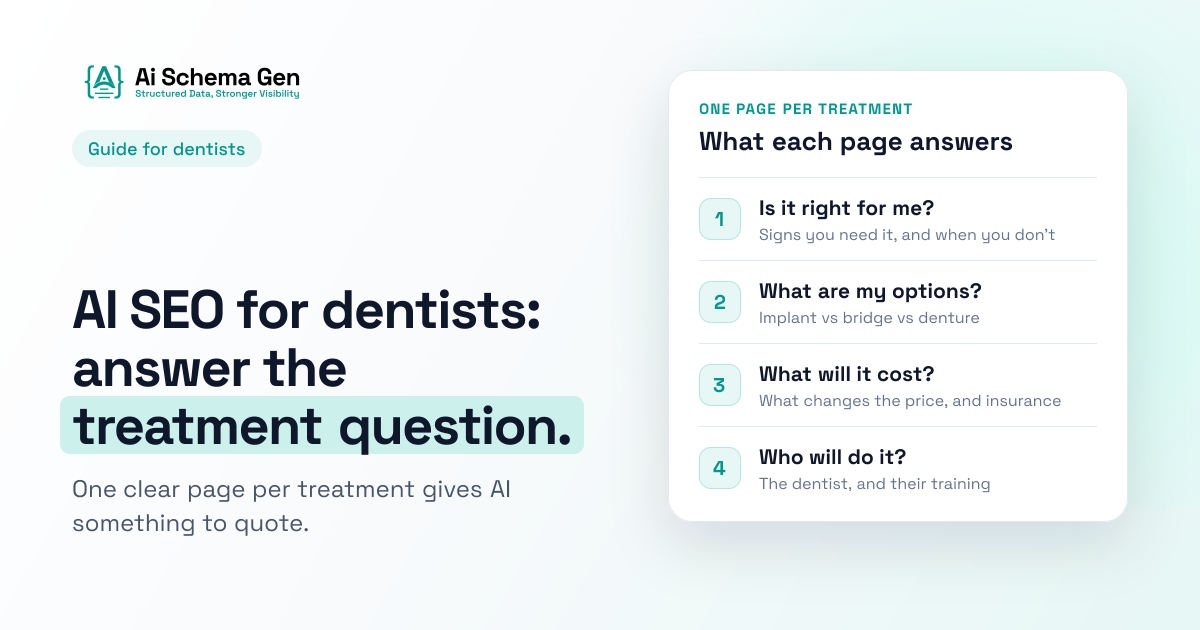
Here is what each treatment page should answer, written as the patient would ask it.
"Is this the right treatment for me?" Describe the problem the treatment solves and the signs that someone needs it. For a root canal, that is pain when biting, lasting sensitivity to hot or cold, or a swollen gum near one tooth. Say when it's the wrong choice, too, and what you'd suggest instead.
"What are my other options?" Patients compare. A page on implants should say how an implant differs from a bridge and a denture, and roughly when each makes sense. This is one of the most common things patients ask, and very few practice sites answer it.
"What happens, step by step?" Explain the visits, what happens at each one, and how long the whole process takes. For aligners, say how often the patient comes in and how many hours a day the aligners are worn. For implants, say how long healing usually takes before the crown goes on.
"Will it hurt, and what are my numbing or sedation options?" Fear stops many people from booking. Say plainly what numbing you use and whether you offer sedation. If you offer sedation, say which kinds, who on your team provides it and that they hold the permit your state requires. Many states, including Alaska, Florida and Maine, require a separate permit for moderate sedation, so naming the permit turns "we offer sedation" into a fact a patient can check with the board.
"How much will it cost?" This is the question practices most often avoid, and the study's own sample of questions included "how much do veneers cost." You don't have to publish a fixed price. You can explain what changes the cost (how many teeth, whether bone grafting is needed, which material), give a typical range or a starting price if you're comfortable, say how insurance usually treats it (covered, partly covered or rarely covered), and say whether you offer payment plans or an in-house membership plan for patients without insurance. A page that says "costs vary, call us" gives the AI nothing to say, so it uses another practice's page or a general article instead.
"Who will do it?" Name the dentist who does this treatment at your practice, with their degree (DDS or DMD) and any specialty training. If a visiting oral surgeon or periodontist handles it on certain days, say that too.
"How do I get started?" Say whether patients need a referral, what the first appointment involves, and how to book.
Write these as headings on the page, with a short direct answer under each. That shape is easy for an AI to quote, and it is exactly what a nervous patient reading on a phone wants. Our guide to FAQs that AI quotes goes into how to word those answers so they stand on their own.
Which pages to write first
Start with the treatments that bring in most of your new patients and most of your revenue. For most general practices, that means some mix of these:
- New patient exam and cleaning, with what happens at the first visit
- Emergency or same-day care, with your real hours and what counts as an emergency
- Implants, with options compared
- Clear aligners or braces
- Root canals
- Crowns and bridges
- Children's dentistry, including the age of a first visit and what it involves
- Gum treatment
- Veneers, bonding and whitening
One full page is worth more than five thin ones. Write the three that matter most to you this month, then add the rest.
Specialist or General Dentist: Say Which
The way a question routes in the study, from "periodontist" straight to periodontics practices, is a reason to be very clear about what kind of dentist you are. It is also something the American Dental Association has firm rules about.
Section 5.H of the ADA's Code of Professional Conduct (2025 edition) says a dentist may announce as a specialist only in a recognized specialty and only if they meet the education requirements, usually a two-year accredited advanced program or certification by a recognized board. The National Commission on Recognition of Dental Specialties and Certifying Boards currently recognizes 12 specialties: dental anesthesiology, dental public health, endodontics, oral and maxillofacial pathology, oral and maxillofacial radiology, oral and maxillofacial surgery, oral medicine, orofacial pain, orthodontics and dentofacial orthopedics, pediatric dentistry, periodontics, and prosthodontics. Your state may recognize others.
"Cosmetic dentistry" and "implant dentistry" are not on that list. Neither is "sedation dentistry."
Section 5.I covers general dentists, and it is just as clear. A general dentist can announce any service they provide, but must avoid wording that suggests they are a specialist, and the code says general dentists "shall also state that the services are being provided by general dentists." The ADA's code also sets conditions for announcing a credential in an area that isn't a recognized specialty, including a statement that the area is not a recognized specialty.
These rules bind ADA members, and state boards have their own advertising rules, so check both. Put them next to the routing finding from the study and the practical result is a clear label on every treatment page:
- A general practice that places implants should say so on its implant page, name the general dentist who does the work, and describe their training in plain terms (for example, the number of years they have been placing implants and the courses they completed). That matches it to "who does implants near me" without claiming a specialty it can't back up.
- A specialist practice should name the specialty in its page titles and headings, in the words the patient uses: "periodontist (gum specialist)," "orthodontist," "endodontist (root canal specialist)." It should also say whether patients need a referral.
- A multi-specialty group should say which specialist does which treatment, so that "I need an oral surgeon for wisdom teeth" can be matched to the right person, not just to the practice.
The label matters most for the questions where the study found practice pages dominate. A patient who asks for a periodontist is matched against pages that say "periodontist." A general practice that treats gum disease can still be a good answer to "gum disease treatment near me," but only if its page describes the treatment and who provides it, rather than borrowing the specialist's title.
Fellowships, Health Claims and Old Names
Beyond the usual warnings about "best" claims and guaranteed results, the ADA's code has three rules that are specific to dentistry and worth checking your site against.
- Fellowships that mean membership, not training. The code notes that some organizations grant fellowships as a sign of membership, and advertising them may suggest training the dentist didn't get. If a credential required an exam and a course of study, say what it involved.
- Health claims without evidence. Section 5.F.7 calls out social media claims about removing "toxic substances" from the body and claims about fluoride's safety that aren't backed by research. If you practice "holistic" or "biological" dentistry, describe the services, not health effects you can't support.
- Names of dentists who have left. Section 5.G says the name of a dentist who is no longer with the practice may be used for up to one year (longer only with the departing dentist's permission and clear public notice). AI assistants are slow to forget old names. If a retired founder's name is still on your homepage title, your Google profile and your "Meet the team" page, assistants may keep describing the practice by it long after they've left.
Your Google Profile, Yelp and Insurance Directories
The Dental Economics study covers ChatGPT. Google's own AI answers draw on a different mix, and BrightLocal's August 2026 study of local AI answers shows it.
BrightLocal looked at answers from Google AI Overviews, Google AI Mode and ChatGPT for local searches across 1,355 locations, and published a table of sources for each industry. For dentists, Google's own listings made up 57% of citations, Yelp 15.4% and Facebook 1.9%. Dental and health directories barely appeared: Zocdoc at 1%, Healthgrades at 0.5% and Delta Dental's dentist directory at 0.4%. The table mixes all three assistants together, and Google's own assistants lean heavily on Google's own listings, so it isn't directly comparable with the ChatGPT-only study. Read together, the two studies say your website and your Google Business Profile are the two sources that matter most for a dental practice. That's a narrower picture than healthcare as a whole, where other research has found AI tools leaning more on medical directories, and it fits the Dental Economics point that no big outside site publishes a page for every dentist.
For a dental practice, that means:
- Make your Google Business Profile match your website exactly. Same practice name, address, phone and hours. Pick the primary category that describes what you actually are (a general dentist and an orthodontist are different categories), and list your treatments as services.
- Keep your hours honest, especially for emergencies. "Emergency dentist open Saturday" is a common question. If you take emergencies on Saturday mornings, say so on both your profile and your emergency page. If you don't, don't let an old listing say you do.
- Check your insurance networks' directories. Delta Dental's directory turned up as a source in BrightLocal's data, and patients use these directories to check whether a dentist is in network. An old address or a "not accepting new patients" flag there is one more source telling a different story from your website.
- Claim your Yelp page. Yelp was the second-largest source in BrightLocal's dentist table. Make sure the basics there are right, even if you never use Yelp for anything else.
Our local business guide explains which assistant reads which listing, including Apple Maps for Siri and Bing Places for Copilot.
Reviews: Volume Helps, and Replies Have Rules
In August 2026, the UK agency Whito asked ChatGPT, Gemini and Google AI Mode the same question, "Who is the best private dentist in [city]?", in six UK cities. The three assistants named 59 practices between them. Two-thirds were named by only one assistant, and just five were named by all three.
Those five had something in common: very large numbers of reviews, repeated awards, or both. One was quoted at about 4,000 reviews. Where the assistants quoted a review count, the middle value was 368 for dentists, against 113 for solicitors and 37 for accountants in the same agency's earlier tests. Whito's own reading is that when there's no single trusted directory for a profession, assistants lean on whatever public signal is biggest, and for dentists that is reviews. It's one question, asked once per assistant per city, in the UK, so treat it as a hint rather than proof. It also fits with how the assistants explained their picks: in 54 of the 84 recommendations, the assistant quoted a review count.
The practical steps are simple:
- Ask every patient. A short text or email after the visit, with a direct link to your Google review page, does most of the work. Don't buy reviews, don't offer discounts in exchange for them, and don't write them yourself.
- Ask patients to mention the treatment. A review that says "Dr. Patel did my implant and explained every step" helps match your practice to implant questions. You can't script reviews, but you can say "it helps other patients if you mention what you came in for."
- Reply, but never with patient details. This is where dentists have been fined. The US Department of Health and Human Services settled with a California practice, New Vision Dental, after it disclosed patient information while replying to online reviews. The practice paid $23,000 and agreed to a corrective action plan, and HHS said the practice "is illegal under HIPAA." Thank people, invite them to call the office, and keep the reply general.
Where Structured Data Fits
Behind your visible pages, structured data (schema markup) gives AI systems and search engines a tidy summary of the practice: its name, address, phone, hours, the dentists who work there and links to your profiles elsewhere. Schema.org has a type made for this, Dentist, which counts as a LocalBusiness, a MedicalBusiness and a MedicalOrganization at the same time.
It's worth having, and our dental schema guide covers the details. But be realistic about what it can say. Schema.org's list of medical specialties has exactly one value for dental care, Dentistry. There is no value for orthodontics, periodontics or endodontics. So there's no simple way for structured data to say "periodontist" or "orthodontist." Markup can describe individual treatments and each dentist's areas of work, as the schema guide shows, but the clearest statement of what kind of dentist you are is still the page text, which is one more reason the treatment pages above matter most.
Common Mistakes
One "Services" page for everything. A list of 15 treatments with a sentence each matches nothing well. The study found the strongest results for questions that named a specific kind of care, and only a page about that care can match them.
Hiding the cost question. "Costs vary, please call" leaves the AI with nothing to say about your practice on one of the most common questions patients ask. Explain what changes the cost and how insurance usually treats it, even if you don't publish a price.
Implying a specialty you don't have. "Implant specialist" or "cosmetic specialist" on a general dentist's site goes against the ADA's code and gives an AI a claim it can't confirm. Say what you do, who does it and what training they have.
Not saying whether you take new patients. A practice that's full for six months and a practice with openings next week look identical on most websites. Say which you are on the homepage and the new patient page.
An emergency page with no hours. "We handle dental emergencies" without saying when is the most common gap on emergency pages. Say what hours you take emergency calls and how quickly you can usually see someone.
Old names and old dentists. A dentist who left two years ago is still on the team page. A former practice name is still in the homepage title. Assistants pick these up and repeat them.
Replying to reviews with treatment details. It feels like setting the record straight. It can also be a HIPAA violation, and it has cost practices real money.
How to Check and Fix It
Step 1: Ask the questions patients ask. Open ChatGPT and ask the same kinds of questions as the study: "best dentist in [your city]," "who does Invisalign in [your city]," "I need a root canal in [your town], who should I see," and "how much do implants cost in [your city]." Write down who gets named and which pages are cited. Ask each one more than once, on different days, because answers vary. Our guide on how to check what ChatGPT says about your business walks through doing this properly.
Step 2: Run a free check on your site. Our free AI readiness checker first confirms that AI crawlers can reach your pages. Then it gives an AI nothing but your own content and asks it basic questions about the practice. Watch the answer about what services you offer. If it comes back vague, an assistant reading your site has very little to match against a treatment question.
Step 3: Write your three most important treatment pages. Use the list of patient questions above: is it right for me, what are my options, what happens, will it hurt, what does it cost, who does it, how do I start.
Step 4: Fix the wording about who you are. Make it clear on every page whether the work is done by a general dentist or a specialist, name the dentist, and remove any claims you can't back up.
Step 5: Line up your listings. Google Business Profile, Yelp and every insurance network directory you're in should carry the same name, address, phone, hours and new patient status as your website.
Step 6: Fill in your Business Identity. In the AI Schema Gen dashboard, choose Dentist as the business type, then enter your legal name, address, the practice owner or founding dentists, and links to your Google, Yelp and other profiles. Your pages' structured data is generated from that one record, so updating it once updates every page. The rest of your team belongs on their own pages on your site, with their degree and the treatments they provide.
Step 7: Repeat step 1 after about six weeks. Use the same questions and note whether your practice, and your new treatment pages, start appearing among the cited sources. Expect gradual movement over several rounds rather than a sudden change.
Frequently Asked Questions
Is your website ready for AI?
Check now. Free readiness score in under a minute, no signup, no card.